
One reason it's been so hard to directly detect the dark matter is that we're not sure what it is. But for a long time, a leading candidate has been "Weakly Interacting Massive Particles" (WIMPs), so an impressive amount of experimental effort has been put into trying to detect them. Recently, a single provocative event appeared in the LUX-ZEPLIN (LZ) dark matter experiment. Daniel Akerib, a physicist at LZ, joins us to talk about dark matter and the recent data, which has low statistical significance but is intriguing nevertheless.
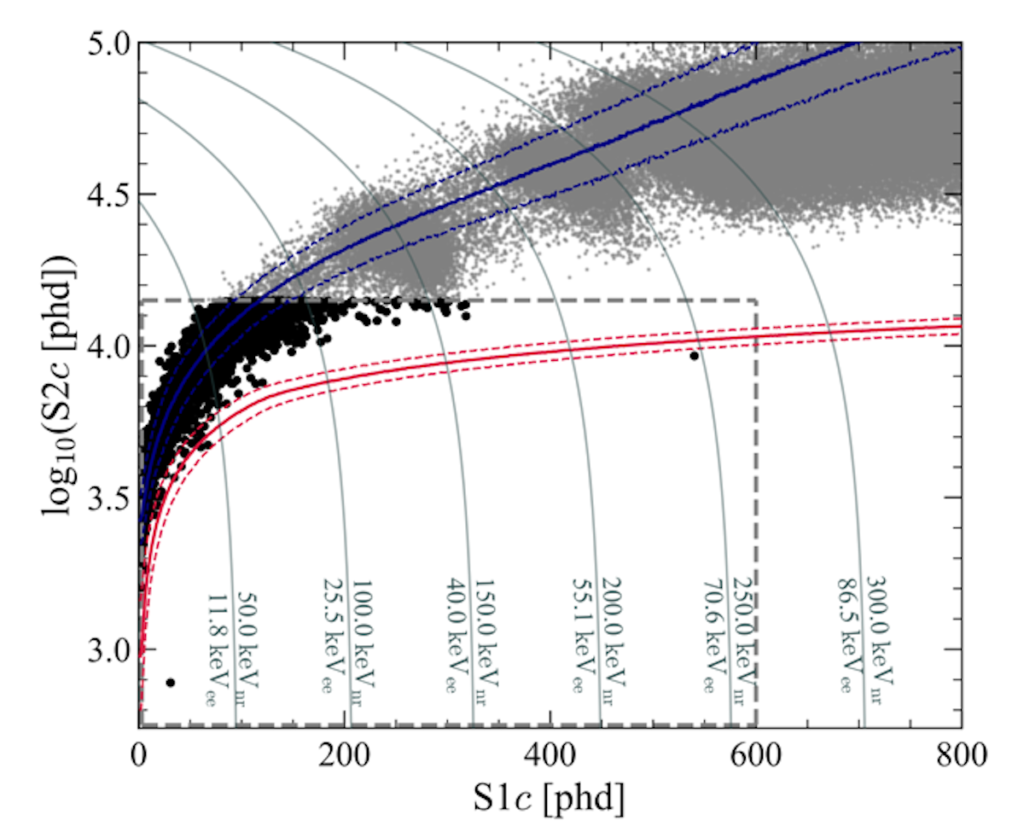
Data from the recent LZ run. Most of the points are background noise; the anomalous signal is the single point center-right, just below the red line.
Support Mindscape on Patreon.
Daniel Akerib received a Ph.D. in physics from Princeton University. He is currently Professor of Particle Physics and Astrophysics at the SLAC National Accelerator Laboratory and Professor of Physics, by courtesy, in the physics department at Stanford University. He has been searching for dark matter since the early 1990s, first with the Cryogenic Dark Matter Search and more recently with the LUX and LUX-ZEPLIN projects.
Click to Show Episode Transcript
0:00:00.4 Sean Carroll: Hello, everyone. Welcome to the Mindscape Podcast. I'm your host, Sean Carroll. You might have heard in the news, we're not up on the news here at Mindscape. We don't actually chase after every ambulance and try to fill you in on the latest wrinkle in scientific or other intellectual discovery. But occasionally it's worth changing the rules a little bit, doing something a little bit different. So you may have heard that there was a press release out from the LUX-ZEPLIN experiment, or just the LZ experiment. This is an experiment deep underground looking for dark matter, looking for the occasional dark matter particle that will come into their detector, bump into a nucleus, and leave a signal. And the new result is, there's many experiments that have been doing this for quite a while, now they've seen an event that they can't explain. And we're going to dig into this for two reasons. One is, it might be the dark matter, and that would be very exciting. It's not at all super statistically significant right now. It's a little hint of a clue. It's absolutely not something you should get overly excited about. But it's also respectable, right? I mean, these are people who know what they're doing. They tried very hard to kill it. This is what good experimenters do when they get a weird signal, something they didn't anticipate or something that would be very exciting.
0:01:23.6 SC: They really put a lot of effort into figuring out could it have been something else. And they can't figure out that it could have been anything else. Even though it's only one event, it still kind of sticks out like a sore thumb. So I think it's worth getting on top of that, figuring out what might it be, why are we interested in this, that kind of thing. But the other reason is it is a good lesson in how science works. It's how things actually get done, to find something and not know whether or not it's the final answer or not. We get a lot of, in the modern age, nonsense out there about how science works, and it's good to really hear from a true expert the process by which we gather data and then interpret the data and try very hard to understand what it could be, and all the different people working on this. And whether or not it turns out to actually be the dark matter, this is top-notch science in action as it's supposed to be done. So today's guest is Daniel Akerib, who is a physicist at SLAC. I think SLAC keeps changing its acronym, but it's the Stanford Linear Accelerator is what it used to be. Anyway, it's the particle physics laboratory associated with Stanford. And Dan is someone I've known for a long time. He's been working on dark matter searches for a long time.
0:02:48.7 SC: There's different kinds of dark matter, as we'll talk about, different kinds of searches. He and his teams have been looking for WIMPs, Weakly Interacting Massive Particles. For a long time, WIMPs were the leaders as the theoretical candidates for dark matter. They're not the only ones out there, but we've been looking for a long time and we haven't seen them yet. That doesn't mean they're not there. Maybe they're just out of reach. Maybe this is the first hint that we are seeing them. So I love it as an example of real science, of the care, the level-headedness, the tentativeness that real scientists have to go through every day. There's no answers in the back of the book. You can't hurry the process. You have to sit through it and be careful. So whether they get more data points, whether there are more events and we figure out this is the dark matter, or whether it someday goes away, or whether it's just a mistake of some sort, all these are possible. We'll know it's good science, in the meantime, we'll learn a lot. You folks who are listening here will be on top of what needs to be understood when more information comes in, both from this experiment and from other experiments doing similar things. So let's go.
[music]
0:04:16.7 SC: Dan Akerib, welcome to the Mindscape Podcast.
0:04:19.6 Daniel Akerib: Sean, it's great to be here. It's good to see you.
0:04:20.6 SC: It's been a long time. Dan and I have known each other for a long time, both when we were at different Midwest institutions, but now scattered to different coasts. But it's good to catch up again. Now you have devoted your life to looking for something that nobody has ever seen. So [laughter] tell us a little bit about dark matter. What is it? Let's go very general here. Why do we think it's there?
0:04:43.2 DA: Yeah. Okay, right. So very, very generally, either we don't understand the laws of gravity, or there's stuff that's missing. And a simple example that I like to use is the solar system. We understand since Kepler and Isaac Newton how it fits together. The sun's gravity keeps the planets moving in their circular orbits. The outer planets take a lot longer to orbit because gravity... The strength of gravity falls off. It's much weaker out there, and so things move more slowly. Just like a ball on a string, you can twirl it hard and fast, tension in the string, or a weaker, more gentle force, things will move more slowly. Apply that same physics to the galaxy as a whole, the Milky Way, and things seem to be moving much too fast given the amount of stuff that is present in stars. So for about 100 years now, there's been this mystery of we see gravitational forces that we can't account for with the mass that should be giving rise to it. And I'm a particle physicist by training, and it was understood at some point, let's say roughly sometime in the '80s or '90s, that ordinary stuff couldn't make up the difference, that ordinary matter, protons, neutrons, the periodic table, anything that's been made in an accelerator, can't account for this missing stuff. And so that's kind of cool because as a particle physicist, I latched on to this hypothesis, which is there must be a new form of matter to explain the dark matter. And so let's go hunt for new particles. And that sounds out there, but oftentimes over the course of nuclear and particle physics, going back to the '20s and '30s, a favorite conservation law seemed to be violated. Well, we can't give up on this law. Let's invent a new particle. And over the fullness of time, often those particles were discovered. And so we're working kind of in that tradition. Let's not be so cavalier to throw away the laws of gravity. Let's see if we can find the missing stuff.
0:07:02.9 SC: Well, you mentioned this possibility that gravity is to blame. Let's sort of get that out of the way. I mean, maybe it's true, like you said, but how seriously do you take that possibility?
0:07:16.0 DA: That one could modify the laws of gravity?
0:07:18.1 SC: Yeah.
0:07:19.1 DA: For me, I have the option of just sidestepping that [laughter] because that's not my area.
0:07:26.6 SC: Right.
0:07:27.0 DA: I don't come up with new theories of gravity. People have been working on new theories of gravity for 30 years. I would... You know much more about this than I do, so I'm not sure I'm really gonna answer your question there.
0:07:41.8 SC: No, I mean, it's perfectly okay. I guess I'm just asking you personally, do you go to sleep at night thinking, like, what if the dark matter just isn't there?
0:07:50.4 DA: Well, I do that anyway [laughter] because we've been hunting for 30 years or more. When I worry about it not being there, I don't worry about it not being there because I worry that the laws of gravity are different. But that's... Part of that is just, you... As a scientist, you place your bets based on the coins you have in your pocket, what problems can you approach. Right? And I think the nature of research, if we could go a little bit meta, is it's easy to sit back and say, "I wonder what everything's made of." Right? That's not very helpful unless you can ask that question in a way that might be answerable with a new theory or with a measurement that you can go make in the laboratory or an observation that you can make. And so I think the choices we make as scientists are what question looks cool and interesting, and am I a person who, with the tools I have and the collaborations I'm part of, that I can approach that question in a useful way.
0:08:55.0 SC: By the way, if at any point you're tempted to go meta on science or the scientific process, you have come to the right place. This is where you're allowed to do that. Don't feel guilty about that. But this leads exactly into the next question because you say, "Okay, there's new particle. Let's put aside the gravity thing. Let's imagine dark matter is the simplest explanation." I mean, plenty of particles are hard to see, so one more isn't that much of an ask. How much can we sort of infer about this? Is it more or less if there's dark matter of the form we suspect, then we more or less know what it has to be like? Or are there many, many, many different possibilities?
0:09:31.8 DA: So we kind of turn to unanswered questions in particle physics, which in many ways arose independently. So there, we have the standard model of particle physics. And the experts, of which I am not, I'm a practitioner, will tell you that, well, this spectrum of particles that we have and the fundamental forces, six quarks and leptons, da, da, da, da, seems very arbitrary. There's mass scales involved and grand unified theories, and it looks in many ways unnatural. So people have come up with theories like supersymmetry and others that maybe have now gone out of fashion where let's fix... Let's get a more fundamental theory that seems more natural. And the kind of stupid analogy I like to make is that imagine we had the periodic tables of the elements with all these patterns and ionization potentials and valences and all of that, but we didn't know about quantum mechanics. Then it would say, "Oh, we have this interesting structure of periodic table, but there must be more to it. There must be a more fundamental theory." And quantum mechanics discovered, explained all of this, right? Chemistry is in a sense understood through the laws of quantum mechanics. Right? And so I know this analogy doesn't really hold to strict scrutiny, but the standard model of particle physics seems arbitrary in many ways. And so is there a deeper underlying theory that will shed light on the structure of the thing that we see? And when theorists have come up with different new theories like supersymmetry or technicolor or whatever, they invariably predict new particles. And the connection that was made, I don't know, 30-plus years ago was that, "Oh, astrophysicists and cosmologists are looking for this missing mass, and particle physicists are looking for these underlying explanations to the standard model, and they seem to be pointing in the same direction. We should go look."
0:11:35.3 DA: And that's not the only one. There's, in the theory of strong interactions, this is the strong force that holds the nucleus together, there were fundamental symmetries that seemed not to be violated, and they seemed like they should have been violated. And so the theory was come up with to solve the strong CP problem. And this was Helen Quinn and Roberto Peccei, and they proposed a new symmetry, and that new symmetry led to the prediction of another particle called the axion, which behaves quite differently from the one that we're looking for, which is the WIMP, a Weakly Interacting Massive Particle. It might be a supersymmetric extension to the standard model. Others are looking for axions, which would appear in detectors in a quite different way. They would be wave-like. I'm sure we'll go into this more. We're looking for billiard ball scatters. They're looking to tune in the axion radio station. So there's different clues from particle physics that we've been looking at. About, I don't know, 10 or 15 years or so ago, as we'd been carrying out these searches and nature wasn't yet yielding to our experiments, new ideas came up, which was rather than just be guided by missing open questions in particle physics that could predict particles that could be the dark matter, this problem is so fundamental, our axion searchers and our WIMP searchers, they're doing a wonderful job, but nature hasn't yielded yet. And so let's expand the portfolio and let's change the question a little bit and say, is there anything that isn't disallowed, did I get my double negatives right? Isn't disallowed by particle physics that could also produce dark matter?
0:13:20.3 SC: Yeah.
0:13:21.0 DA: Right. And so let's expand the portfolio in that direction, too. And that gave rise to this whole thing called dark sector, and there might be dark photons, et cetera, et cetera. And so it's a wide open field. There are, I don't know, 30 decades of mass of different particles that physicists can envision that might be detectable or could be produced in accelerators, et cetera, to try to get at this really fundamental problem.
0:13:49.4 SC: And for better or for worse, different kinds of particles, it sounds like, require different experimental strategies.
0:13:55.2 DA: Absolutely. [laughter] Right. And so as these theoretical ideas were proposed, of course they weren't done in a vacuum. It was like, "Oh, this could be searched for in a Beam Dump. This could be looked at at CERN in high-energy collisions." et cetera, et cetera, right, so.
0:14:10.7 SC: And again, for the audience that's out there and may have heard a little bit about some of these buzzwords, there are WIMPs, like you mentioned, Weakly Interacting Massive Particles. And you also briefly mentioned supersymmetry is an idea that may have something to do with that. So are WIMPs part of supersymmetry or are they related somehow?
0:14:31.5 DA: So as a WIMP hunter, we get to be a little bit theory-agnostic, right? And we would be sensitive to any particle that could have been produced in the Big Bang that interacts with ordinary matter. It's useful to have specific targets. And so we... When we run an experiment and we exclude some parameter space, we can say, some particular parameter space of supersymmetric models appears not to explain the dark matter. And there are many orders of magnitude that we haven't searched. So there are models to hunt. It's a way of connecting with other techniques. So there are what we do, we call direct detection. This is a WIMP directly scattering from a nucleus in our detector and registering a signature. WIMPs could also collect in large gravitational bodies at the center of stars, at the center of the galaxy, and WIMPs and anti-WIMPs could annihilate and produce a gamma-ray signature or some other signature. And so by couching it in terms of some specific models, it allows us to compare and contrast with other types of techniques of looking for dark matter, supersymmetric searches at colliders like at Fermilab and now at the LHC. And so they're like, "We do or don't see this model. Might you be seeing something that is connected with this?"
0:16:06.2 SC: And I think you mentioned something like 30 years. I mean, you, the community, have been looking for this for a very long time. Was there some feeling that we should have seen it by now? Are we a little bit surprised it's not there yet?
0:16:18.5 DA: So yeah. So if we go back to the '90s, I guess, when supersymmetry was... It was right around the corner. It was felt that this is a very natural explanation for these questions in particle physics. It's such a golden opportunity for nature to have picked supersymmetry in the early universe and produced dark matter that we could now detect. And it was thought to be a very natural scale at which to produce dark matter. And we've looked through, I don't know, seven or eight orders of magnitude on the WIMP search side. We are probably now pushed to regimes where the cognoscenti would say, "Well, if it was natural, it would have kind of showed up by now." right? And I think this is part of what led people to invest real time 10, 15 years ago to say, let's... "It might still be there and we're making progress, but maybe that isn't what nature chose. And so let's expand the portfolio." So I think that's a very just natural reaction of the scientific community, right, to say, "Let's grow the portfolio. Let's keep looking, but let's grow the portfolio."
0:17:29.3 SC: So the WIMP idea as a candidate for dark matter is something that is still alive and kicking, but the fact that we haven't found it yet hasn't led to despair. It's led to, let's think of what else it could be, because there's plenty of theoretical possibilities.
0:17:43.6 DA: That's absolutely right. Yeah. Yeah.
0:17:45.1 SC: But you're in WIMP land. That's what you're looking for.
0:17:47.6 DA: I am in WIMP land. Right. Right.
0:17:49.7 SC: And how are you doing that?
[laughter]
0:17:52.0 DA: How are we searching or why do I...
[overlapping conversation]
0:17:55.0 SC: How are you searching? What does the experiment look like?
0:17:56.4 DA: Perfect. Right. So I am a simple-minded guy, Sean. [laughter] Billiard ball scattering is such a simple concept. So our detector is made of many, many, many 10 tons, if you will, of Xenon billiard balls, condensed into a liquid. So...
[overlapping conversation]
0:18:17.4 SC: Sorry. When you say Xenon billiard balls, you mean the actual atoms, individual atoms?
[overlapping conversation]
0:18:19.5 DA: I mean Xenon... Actual atoms of Xenon, and we're gonna think of them as microscopic billiard balls in the context of the experiment. Dark matter being... Having very rare interactions, you wanna stick as much instrumented target material in its way in the hopes that dark matter is going through your detector. By having more detector mass, you'll improve the chances that a dark matter particle will hit a Xenon nucleus. That Xenon nucleus will recoil and register a signature. So the current experiment that we're running, the LUX-ZEPLIN or LZ experiment in South Dakota, which has been taking data for... I don't know, when did we start taking data? 2023, is comprised of the inner chamber, seven tons of liquid Xenon. So picture a titanium vessel about a meter and a half in diameter, about a meter and a half tall, of this liquefied Xenon. So it's about minus 100 Celsius in temperature.
0:19:22.1 SC: Okay.
0:19:22.7 DA: Easily cooled with liquid nitrogen as a cooling thing that you can just buy industrially. And this Xenon is about three times the density of water. And when particles interact with it, it produces small flashes of light, and some of the Xenon gets ionized. So electrons are freed up. And with a special system of electrodes, we can drift those electrons and pull them into the gas phase at the top of the liquid surface. We get scintillation light from the event where, that first interaction, so light and charge. The charge turns into a second light signal. By recording these light signatures with arrays of photomultiplier tubes, we can record event by event what happened in the detector and where. And by measuring these two signals separately, we can learn things about what sort of particle may have interacted. Many of the interactions are mundane. Residual radioactivity in the environment of the experiment, background neutrons from radioactivity that might scatter multiple times or leave signatures in other parts of our detector system.
0:20:41.6 DA: So all of this is about trying to find a needle in a haystack, a very weak signal of unknown strength in the face of enormous backgrounds. We put the experiment a mile underground in a former gold mine in South Dakota. We surround it with 8 meters of purified water. When we have additional detectors outside this titanium tank to look for residual backgrounds, gamma rays from radioactivity, neutrons, et cetera. Then we, even within the Xenon tank, we can locate exactly where the event took place. Meter and a half in diameter, we can locate the event down to a few millimeters. If it occurred near the edges of this tank, let's say the outer 10 centimeters of the Xenon, then we can say, ah, too high a chance it's due to radioactivity. So let's only focus our dark matter search on the inner four or five tons, and we'll use that outer ton or two as a shield, as an active shield. So now we're trying to create this inner sanctum that is very quiet in terms of radioactivity, radiation being able to penetrate, et cetera. And then we wait and we look for a special signature.
0:21:59.3 SC: One thing I just got to remark on is you say something like seven tons of Xenon, and my imagination thinks that's the size of a house, but it's like a meter across. It's not that big. [laughter]
0:22:10.8 DA: Yeah. Right. You can sort of outstretch your arms and touch the edges of the detector.
0:22:15.1 SC: What fraction of the world's Xenon population are you using?
[laughter]
0:22:18.6 DA: Yeah. So the annual production of Xenon worldwide is somewhere between 60 and 100 tons. So we're using a tenth of world production. We bought it over a few years. You want to buy it without spiking the price, it can get pricey depending on industrial uses. It's about one in 10 million atoms in the atmosphere is a Xenon atom. And so you liquefy massive amounts of air for industrial uses and you distill out the rare gases, Xenon, krypton, and I think neon also is from distillation.
0:23:04.9 SC: I know there are supply chain issues in the world today. Do you need to worry about your Xenon supplier?
0:23:10.9 DA: Right now it's okay. I mean, you buy the Xenon once and you safeguard it. You have all these redundant systems, so if you lose your cooling power and the Xenon starts to boil, you turn on your backup generators. You do everything you can to never return it to the atmosphere. And...
[overlapping conversation]
0:23:34.4 SC: But it doesn't go bad.
0:23:36.4 DA: It doesn't go bad. No, no, no. It's not consumed. Yeah.
0:23:40.9 SC: And so you have this meter and a half or whatever sized tub of Xenon. You've protected it from, say, layers of shielding. You put it a mile underground, which is amazing, but also there's a history of that. Talk about this idea of putting physics labs underground.
0:24:00.8 DA: Right, right. So I guess one of the early ones was done by a guy named Ray Davis, who was interested in detecting neutrinos from the sun. And I think, I don't know what the original motivation was. Maybe it was just test the standard solar model. So nuclear interactions in the sun produce heavier elements, protons fuse to make heavy isotopes of hydrogen and helium. And these interactions produce neutrinos, so very weakly interacting particles. In a sense, you could think of them as quite similar to WIMPs, except they're very light. And so Ray set out to build a big experiment, figured out how much target mass he would need. And this was... I don't know, was this... I don't remember the numbers, but many tons of chlorine in some liquid form. I think it was like dry cleaning fluid. I think it was a cheap industrial way to buy chlorine. [laughter] And he staged it in, actually in the same cavern that we're working in today. It's now called the Davis Cavern.
0:25:16.1 SC: Oh, nice.
0:25:17.0 DA: Fast forward, Ray was quite successful in detecting neutrinos from the sun, but he uncovered a big mystery. He only detected one-third the amount that was predicted from the standard solar model. And the way that he collect... He measured the rate was that on Earth, in radioactive... If you have a piece of material that's radioactive, it can undergo beta decay. A neutron in a nucleus will turn into a proton, emit an electron and a neutrino. Ray used the reverse process. He had chlorine atoms in his detector. They would absorb a neutrino from the sun. A neutron would turn into a proton. And that meant that that chlorine atom, happily in some molecule in the cleaning fluid, would turn into an argon atom, a noble gas that would suddenly, in a sense, be freed up from that molecule that it was part of. And Ray could drift a dozen or so argon atoms from this enormous tank of cleaning fluid every month. But he only uncovered about a third the number that was predicted from the solar model. So this became a big mystery in its own, right. Everyone was like, "Ray, maybe you don't understand your detector. Maybe you lost some of your 10 argon atoms a month." or whatever it was. Ray stuck to his guns. He persevered.
0:26:44.7 DA: In the end, the SNO experiment in Sudbury used a different technique to measure neutrinos from the sun, and they uncovered the neutrinos that were missing from Ray's experiment that the sun was producing, but along the way they changed flavor, so Ray's detector wasn't sensitive to them. And the experiments combined explained that neutrinos have flavor and they change flavor on their journey from the sun. And this is a whole field in its own right. We do now mount large experiments to study how neutrinos change flavor. So this was arguably the first big, successful, groundbreaking underground experiment. And the reason Ray did his experiment underground was that cosmic rays are high-energy particles that are from space. Maybe they're from supernova remnants, whatnot. They create an enormous amount of high-energy radiation at the surface. If you wanna conduct a very sensitive experiment to look for very rare processes, you don't wanna do it at the surface. It would be like trying to do astronomy during the day. Yes, the stars are on during the day, but there's an enormous amount of scattered sunlight. So let's do astronomy at night. So for us, the equivalent is, let's do... Let's make our measurements deep underground where we're shielded, or at least some of our backgrounds, cosmic rays, are shielded by this mile of Earth or whatever you have.
0:28:15.6 SC: And I love the fact that it's in a mine because physics is not cheap. It costs a lot of money and we spend a lot of money on it, but I think people don't understand the extent to which physicists try their best to do things on the cheap whenever they can. Like, you could have built an underground, you could have dug underground, but you're like, "No, that costs money." [laughter]
0:28:33.7 DA: That's right. That's right. We are frugal. And there's never... There's just more good ideas to pursue in science than there is money to pursue them. And so there's this just natural competition of ideas and getting funding and all. That's a whole different subject. But yeah, this was found space, right?
0:28:57.9 SC: Yeah. Talk a little bit about then the history of looking for dark matter. I mean, you mentioned 30 years, but your experiment's not been running for that long. So were there previous experiments you're building on? Are they the same thing but smaller, or do technologies change?
0:29:12.7 DA: So technologies certainly changed over time. And in fact, prior to physicists searching for the rare process of dark matter interactions, physicists had been searching for another rare process called neutrinoless double beta decay. So we talked a little bit about a neutron decays into a proton, produces neutrinos and electrons. There is a process that hasn't been discovered yet called neutrinoless double beta decay. Let me back up a second, that... So there are certain isotopes in nature which are forbidden from undergoing a single beta decay because that would require them to decay into a nucleus that is heavier. And that's not allowed by energy conservation. Energy and mass are equivalent, E equals MC squared. So an object of a given mass can't decay into something heavier because that would violate energy conservation. So there are certain nuclei, germanium is one, germanium-76, which can't undergo single beta decay. But if it makes a double hop, it can do two-neutrino beta decay and end up at a lighter nucleus.
0:30:32.9 DA: So that is allowed by energy conservation and the Standard Model, et cetera. Xenon, interestingly, also has a double beta decay nucleus. And both germanium and Xenon happen to be also good materials from which to make very sensitive detectors. So around the time that searching for dark matter in the form of WIMPs was starting to become a thing, physicists were already operating germanium detectors to look for this double beta decay process. And so the first dark matter experiments were co-opted germanium double beta decay experiments. And so instead of trying to look for this signature at the beta decay endpoint, it was like, "Well, let's reconfigure this. We expect WIMP interactions to be rare, like double beta decay. So wow, it's great. You guys have already built experiments that are deep underground, that are shielded, that have very sensitive detectors with low radioactivity. This is kind of just what we need, except you're looking out at, in our energy units, two MeV of energy, and we wanna look at something that is about, I don't know, 100 times lower energy signals. We wanna look at 10 keV scale." And so the electronics, the readout was reconfigured to now look for ultra-low threshold. And so a handful of double beta decay experiments became the first dark matter experiments. And so that was...
[overlapping conversation]
0:32:10.7 SC: Okay. That makes perfect sense. I didn't actually know that. That's very useful. [laughter] And okay, you're on this thing called LUX-ZEPLIN. Tell us a little bit about that, 'cause we know that... We've all heard stories that at the Large Hadron Collider there's 5,000 people on an experiment. I've never been on collaborations that big. What about you guys?
0:32:30.3 DA: So when I started searching for dark matter, I had joined an experiment called CLEO. This was electron-positron collisions at an accelerator at Cornell. And when I joined, it was about 100 people working on it. And two years later, it had grown to about 200 people. And I don't know if anyone has studied this, but the number of meetings seems to be scale with, [laughter] I don't know if it's the log or the square root or whatever, the number of collaborators.
0:33:01.0 SC: Maybe linearly.
0:33:02.5 DA: And it just felt... Yeah. And it just felt like, wow, I seem to be spending less and less time in the lab and more and more time in meetings. And so just the way that I was working felt less satisfying. And I, for personal reasons, I had... Was motivated to move to the West Coast. And I looked around to see what was going on that was interesting. And I hit on a group that was searching for dark matter. And wow, it was only three institutions and it was about 30 people. And they were still looking for something that could lead to a fundamental discovery in particle physics. So that sociologically became very appealing. And so I jumped into this group that had just been part of these germanium converted from beta decay into dark matter experiments. And then they were launching a new type of detector, which is still operating today in a collaboration now called SuperCDMS. Back then it was CDMS I, Cryogenic Dark Matter Search. And it was using germanium hockey pucks cooled to ultra-low temperatures to look for, in a macroscopic chunk of material, a temp...
0:34:18.3 DA: A rise in the temperature of the device due to a single particle interaction. Right. So I worked a part of that program for about 15 years, and we made a lot of progress. We were, at many times over the course of that period, world-leading in the search for WIMPs. We had done more sensitive, longer time exposures than any other team. But then a new technology was coming online in about 2007, teams that had been developing liquid Xenon detectors for gamma-ray astrophysics and also for dark matter were starting to see, oh, possibility of using this type of detector to search for dark matter. And the first couple of detectors that ran were, I think, on the order of 10 kilograms. And we were approaching that mass with our germanium MilliKelvin devices. But when the XENON10 and the... I think it was... Was it ZEPLIN-II or ZEPLIN-III detector, these things started coming online and basically blew us out of the water because they could also make these detectors to have very low natural radioactivity. And they seemed to perform remarkably well at being able to detect signals at very low energy. And basically in 2007, XENON10 had a better... More sensitive search for dark matter than these germanium experiments. And so me, not being an inventor of technology but an end user, thought, it's time to change technology.
0:36:04.4 SC: Uh-huh. There you go.
0:36:05.3 DA: Right. And for the last 15 years, it's been the liquid Xenon detectors that have been in the lead. And there were three main collaborations. LUX and ZEPLIN merged to form LZ. The Xenon program, which has been operating detectors at the Gran Sasso laboratory about an hour from Rome, and the PandaX collaboration, a Chinese collaboration that has been operating detectors in China. And those three collaborations have sort of been, over time, been leapfrogging each other. I think each collaboration has at one point in time laid claim to the world's most sensitive time exposure for dark matter. And so that's kind of cool because it's not so much that you wanted to do the longest time exposure that didn't see something, but rather since you're now, oh, the next six months of our data will be more sensitive than anything that's come before it. Which means, funding agency, we have discovery potential. Right? It means if dark matter in the form of WIMPs was just around the corner, then we could be the ones to get that first glimmer of it.
0:37:23.0 SC: And now you found it, right?
0:37:24.6 DA: Oh my God. [laughter] We had our first glimmer of a hint of a maybe of something, and we don't know what that something is yet. It's...
0:37:32.9 SC: Tell us about the new event that's causing all this...
[overlapping conversation]
0:37:34.9 DA: Yes. Oh my gosh. Right, right. So let me take a breath there. [laughter]
0:37:41.3 SC: Please.
0:37:43.7 DA: So there had been a theoretical bias that WIMPs would produce these events at very low energy. About 10 years or so ago, the theorists were like, well, let's see if we can construct a more general set of models that might also cause us to look in the experiments that we're building in other places, in other ways. And so for me, these are just buzzwords. I know they mean more to you than they do to me. [laughter] And so effective field theories and non-relativistic effective field theories were basically saying, what is the most general set of ways that WIMPs could interact with Xenon nuclei or germanium nuclei or what have you? And what that led to were different types of recoil spectra. So we have this idea that a WIMP scatters from a nucleus. The WIMPs have their own distribution of velocities in the halo of the Milky Way. They're in some gravitational potential. So just like the sun, the solar system orbiting the center of the galaxy, each individual WIMP particle is on its own circular orbit around the center of the galaxy. So there's a velocity distribution. But then the question is, well, how do WIMPs interact with nuclei? If they're the most simple-minded thing, billiard ball scattering, then even simple calculations that I can follow, [laughter] show you that the energy spectrum of WIMPs would look like a falling exponential.
0:39:21.5 SC: Okay, hold on. I don't know what an energy spectrum is.
0:39:24.3 DA: Okay. So if you...
0:39:27.1 SC: I mean, I do, but let's assume that I don't.
0:39:28.9 DA: Yeah, right. If you were to measure 100 WIMP recoils in your detector, and you were to measure the energy of each of those recoils, you would make a graph of number of events versus energy. And if you took the logarithm of the number of events in each energy bin, it would look like a falling... A straight line that's falling. If you didn't take the logarithm, it would look like an exponential decay.
0:39:56.8 SC: Right.
0:39:57.6 DA: Okay. And so...
0:39:58.5 SC: So it's... But my point was, the spectrum is not like of an event. Like, one event doesn't have a spectrum. The spectrum is...
0:40:05.1 DA: That's absolutely right. Yes.
0:40:07.8 SC: The histogram of all the events...
[overlapping conversation]
0:40:08.0 DA: Of all the events...
0:40:08.7 SC: Because you're getting so many of them. Yeah.
0:40:09.8 DA: Right. So one hopes. Right. So what the theorists said was that, look more generally. Don't just look at this low-energy regime. Our more general ways that WIMPs can couple to the Xenon detector... The Xenon nuclei in your detector show that there are other models, other types of coupling, if we can include velocity dependence and spin and what have you, that you might get events that go out to significantly larger energies. So in our natural units, we use keV, kiloelectron volts. We'd been looking down at sort of the 10 keV scale, and so now we've been for some time motivated to look out to a few hundred keV. So in our experiment, we form these analysis teams. We have the low-energy nuclear recoil group, we have the high-energy nuclear recoil group, the low-energy electron recoil group, et cetera, et cetera. [laughter] Because with each of these groups, you're saying, "Well, this is the model... Signal model that we wanna study. These are the peculiar backgrounds that we'll have to worry about if we're to see a signal. These are the specific calibrations we'll have to do to calibrate our detector out in that regime." et cetera. So it's almost like there are four experiments built into this one single experiment.
0:41:37.6 SC: Okay.
0:41:38.4 DA: So we'd set limits previously on these searches out to a few hundred keV, which is kind of the limits of our calibration. It's hard to calibrate for practical reasons beyond that regime. There are probably people thinking about how to do better there as we speak. So in the data set that we'd accumulated in 2023 and 2024, the team that was searching for these high-energy nuclear recoils found an event. And it lied exactly on this nuclear recoil band that we'd calibrated by bringing up neutron sources to the detector. And it was sufficiently far away from residual backgrounds from radioactivity that produce so-called electron recoils. And we also had to study, when you're looking for a rare process, you have to think not just single events that could mimic the thing you're looking for, but are there conspiracies where [laughter] two events could arrive in the detector overlapping, and maybe one of them was on the edge of the detector and lost some charge or lost some light or whatever, and these events unwittingly conspired to populate your nuclear recoil band just by chance. Right? And so we have to be open to all those possibilities, and so all of these backgrounds were pored over. And in the end...
[overlapping conversation]
0:43:13.9 SC: I also wanna... Let me just...
0:43:16.8 DA: Sure.
0:43:16.9 SC: Highlight this thing that you mentioned very quickly, that you carry a neutron source over to the experiment and then pull it away. And so basically you're testing, "Are we detecting it when we know events really happen?"
0:43:29.5 DA: That's right. That's right. So we can't bring up a test beam of WIMPs, because that doesn't exist. But we can bring... Because our theoretical bias is that WIMPs would scatter from a nucleus in the detector. It's a big, heavy target. There's underlying quantum mechanics that says, "This is the signal to look for. This is embedded in our signal model." The way that a nucleus recoils in the detector leaves a very characteristic signature. And to demonstrate our understanding of that signature, we bring up a source of neutrons. So this could be a beam of neutrons created with an instrument called a DD generator, or it could be a fission source, a radioactive isotope that produces neutrons, or it could be a so-called alpha-n source where alphas get captured from one radiator... Anyway, so we have all these things in our toolkit. So we take our neutron source out of the vault and we bring it near the experiment. And since neutrons are neutral particles, they won't create these electron recoils, which are a background, but they will scatter, billiard-ball scatter, from Xenon nuclei. And so that gives us a way of calibrating the response of the detector. And it basically maps out this region in the measured quantities that we have that says this is where you should look for a nuclear recoil.
0:44:59.0 SC: Right. And so just so people know, it's not that you almost never see events, you see all sorts of events all the time.
0:45:06.2 DA: Right.
0:45:06.5 SC: And you're trying to pick out the weird-looking ones.
0:45:09.3 DA: We're trying to pick out things that are away from the edges. We're trying to pick out things that are consistent with a nuclear recoil, things that have just the right ratio of the primary scintillation and the secondary scintillation signal because those... The ratio of those two signals is a characteristic signature for us. Electron recoils, gamma ray comes in and scatters, it produces a certain ratio of charge to light. Nuclear recoils produce a lower ratio of charge to light. And so that's our signature. And we can map out that response using neutron calibration sources.
0:45:49.6 SC: Good, great. Sorry for interrupting. I think you were mentioning that you were inspired by theorists to look for different kinds of things and this is what maybe led you to the recent excitement.
0:46:00.3 DA: Yes. Yeah. So we found an event out at this sort of higher energy regime and we couldn't explain it with any of the backgrounds that we'd considered. And that represents a lot of head-scratching and a lot of experience that said, "This is all the different ways that we can think of for a conspiracy to happen, an accidental coincidence of two events overlapping that migrate out of the background region into the signal region."
0:46:32.3 SC: And the event itself is like two or three years old.
0:46:35.2 DA: It happened in 2023. In fact, we even joked about we need to look up who was on shift [laughter] and get them T-shirts to say, "I was on shift." And have, like that's the whole T-shirt: "I was on shift."
[laughter]
0:46:52.4 SC: And so what is so special about this event? Bottom line it for us.
0:46:58.0 DA: It's consistent with dark matter.
0:47:00.1 SC: Okay.
0:47:00.7 DA: And it's not consistent with any known background. But one event is not really enough to hang your hat on, right? So you do the statistical analysis and you ask rigorous statistical treatment of the backgrounds and the signal and what you expect and what you modeled, et cetera, et cetera, et cetera. And the... I'll just give you the expression in the paper, the global significance of this detection was 2.8 sigma, which is below the threshold for hint, evidence, discovery, et cetera... Three sigma, four sigma, five sigma. How much should we pay attention to this? And the reason is that one in 100 experiments will have a three sigma fluctuation. And particle physicists do hundreds of experiments per year. Right? I mean, when you go across the whole community. So when the community says, "I have a three sigma result." you go, "Well, that's nice."
0:48:01.9 SC: Yeah. [laughter]
0:48:03.4 DA: Take more data. [laughter] Because maybe we each have to assume...
[overlapping conversation]
0:48:05.2 SC: In psychology, this would be huge.
0:48:07.3 DA: Right. No, we each have to assume that our three sigma or our sub three sigma result might just be a fluctuation. And many things have fluctuated away when you subject them to more scrutiny. And there may be backgrounds that we haven't thought of and modeled yet. And so not only will taking more data give us more stats, more statistics, but the backgrounds that we can think of that may have conspired if we got the level wrong or whatever, or there's a different way that those backgrounds could come together that maybe we "got unlucky" that they landed right on the nuclear recoil band and we've made all this fuss for nothing. More events of this class don't know about this very thin special nuclear recoil band.
0:49:01.4 SC: Sure.
0:49:01.8 DA: So they might pepper other parts of this distribution.
0:49:04.6 SC: Good.
0:49:05.4 DA: Right? And that would teach us, "Okay, guys, we were excited, but it does look like it's something mundane. Didn't know about the nuclear recoil band. Now let's try to understand what that background was that we missed." Because then we wanna get rid of that background upfront in any future analyses, right? So that's one possibility is that we see more events, but they're not in the right place. Stand down, chill out, right. Okay. On the other hand, we could see more events that lie right on that band and then that would be, holy crap squared. Right? Or we might see nothing. There might be nothing more. This might just remain a mystery, full stop. Right? This has happened before.
0:49:56.2 SC: Just to give the folks a visual picture here, I'll try to include it in the show notes if I remember, but the plot is pretty suggestive, right? I mean, even though it's only one event, you have a plot and you see all the background events. They're very clear what the background is. And then you've got this one little bugger far away from anything else.
0:50:12.9 DA: Yeah, there's this big smear and then there's white space and then there's this event. You go, that gets your attention. Yeah.
0:50:20.9 SC: Do you have a favorite idea? If it is a background, like it's not neutrinos, we know about those, we would have figured those out. Do you have a hunch as to maybe what it could be?
0:50:34.0 DA: I don't.
0:50:35.0 SC: No. That's what makes it interesting. Yeah.
0:50:36.5 DA: That's what makes it... Because we threw a lot of brain power at this, right? A lot of studies. Part of... So if, by the way, if we hadn't seen anything, we also would have published that. We may not have made a press release, but every new null result we publish. So certainly, like, while we'd identified this as a data set of interest, we saw something, we're certainly gonna publish that. It gets it out there. There are other experiments. There's the XENONnT experiment. There's the PandaX experiment. This will certainly motivate them to go and look in their data if they haven't already, or maybe they're partway through their own analysis. And yeah, so we'll see if they see anything.
0:51:30.7 SC: I know that one of the hilarious things that I learned by hanging out with the LIGO folks when they discovered their signal was that they tried their best to fool themselves. They would inject fake data into the pipeline and look at it. Is that something that you do?
0:51:47.7 DA: So we do a process called salting. There's... So you can blind or you can salt. [laughter] So I think something that your listeners may be familiar with is the idea of a drug study. You do a double-blind study. There's the active drug, there's the placebo. Neither the patients nor the doctors know who in the study is getting the active drug versus the placebo so that you can approach the results in an unbiased way as possible.
0:52:18.0 SC: Yeah.
0:52:18.3 DA: Right. So we like to do our version of that. So we can blind ourselves to the signal region, make all of the decisions that we're gonna do to determine whether the big reveal doesn't suffer from bias. So you can blind yourself while you make all these decisions and you have calibration and you have sidebands and you have all these studies that you can do and all these... You make all these final decisions. "This is what a signal looks like and if it shows up, it shows up. If it doesn't, it doesn't." The other thing that you can do is called salting. So we can have a small working group within our collaboration, salt the data by manufacturing events that will show up to everyone else as if they were signal. And then only after the analyzers have done everything they're gonna do to look for signal in the data, do you then give them the magic recipe to check, is this... Are these salt events or are these real? And so we had a physics analysis meeting when the core analysis team had subjected themselves to 100 questions from the rest of the collaboration. "Did you check this? Did you look at that? What about that distribution?" Blah, blah, blah, blah, blah. Okay, we're done. Everyone is satisfied that we've done all we can do. Now it's time to unsalt. And so drum roll, unsalting. [laughter] It was not a salt event. The dot in the plot was not a salt event. Now, we're not super happy with the way that the salting was done for this result, so we weren't putting a lot of emphasis on it for this analysis.
0:54:03.6 SC: Okay.
0:54:04.1 DA: And part of that was just the happenstance of when the salting was done, and then we did more refined nuclear recoil calibrations, and it was like, hmm, that event looks like it was maybe from the old calibration. Right? It isn't where you would... Maybe it was sea salt and we should have used rock salt or, yeah, I'm just [laughter] kind of poking fun at it. But still, it's so far away from the backgrounds that we can explain. So I think some of our new data, some of it is salted post-improved calibration. So we'll see.
0:54:46.1 SC: And so let's let ourselves imagine that it's actually dark matter. We're allowed, like I'm allowed, certainly.
0:54:54.1 DA: You give me permission...
[overlapping conversation]
0:54:55.7 SC: Yeah, I give you permission. When would you expect to get some confirmation?
0:55:00.6 DA: So we have the data that we analyzed was 2023, 2024. We have three times as much data recorded that we haven't looked at yet because we wanted...
0:55:14.0 SC: Look at it. What are you doing on podcasts?
[overlapping conversation]
0:55:15.9 DA: Yeah. We will, we will.
0:55:16.7 SC: There you go.
[laughter]
0:55:17.3 DA: We chunked out this one chunk, and we're like, "Let's go to town on that while we continue to take data."
0:55:22.4 SC: It does take time.
0:55:23.6 DA: It takes time. So now we have our lessons learned. We have our algorithm. So there are active discussions within the collaboration now to say, "Okay, guys, do we go slow and super deliberate? Do we go in a mad rush? Something in between? Do we want..." We... I don't know. I don't wanna... I can't even say tip our hand because I don't think we've decided yet. I mean...
0:55:51.4 SC: Mad rush. Do the mad rush. I'm gonna vote for the mad rush.
0:55:54.9 DA: This result was reported a week ago yesterday. Right. So the team that led the analysis, frankly, is exhausted. [laughter] I mean, these guys were putting in some serious long days. The team that was writing the paper, the team that was reviewing the paper, the rest of us trying to kibitz and, I mean, the first paper draft had 300 comments. So this is a very deliberate process. And so we don't wanna blow it. There's this Far Side cartoon, symphony orchestra, and there's this guy in the back with two big cymbals, and his thought bubble says, "Don't screw up. Don't screw up. Don't screw up." And the caption is, "Roger screws up." [laughter] So we got to get it right. It's science. We have to get it right, so...
0:56:52.7 SC: Okay, one, here is a...
0:56:55.8 DA: Let's say we get it right.
0:56:56.8 SC: Yeah. Get it right.
0:56:57.3 DA: And let's say there's three more events and let's say they lie right on the nuclear recoil band. We're super excited. This is a game changer. This is beginning to maybe, just maybe start to answer this question that's been on the table for 100 years.
0:57:15.5 SC: And it sounds like it will be confirmable by other experiments before too long, if it's real.
0:57:22.0 DA: Yeah. Don't trust a single experiment. Right. Right. And...
0:57:24.8 SC: Don't trust a single event. Don't trust a single experiment.
0:57:26.3 DA: Don't trust a single event. Yeah. And everything in science is provisional. Right? This can be falsified. This could not show up again. This could go in the dustbin. We just don't know. We have to just keep at it.
0:57:41.3 SC: An important question is, if it is dark matter, is this... Does it fit nicely into our theoretical expectations for what dark matter would look like?
0:57:51.9 DA: Absolutely, yes. Yeah.
0:57:54.5 SC: It's just what you would have expected?
0:57:56.8 DA: Well, again, it's out at these higher energies. So we were taught think more broadly. But yes, this can easily be a dark matter particle that has... That... Well, we have to study to death, frankly. Right? So for us that means keep taking data and one event turns into three, turns into 20, then we get to start populating that energy spectrum, which contains information. You'd like to do an even bigger experiment that could detect hundreds of events if this is... If one event per 200, whatever, four ton-years of exposure is the rate. And of course the statistics on one event are all over the place fluctuation-wise. You'd like to study it in great detail. You'd also like to see that event show up in a collider experiment because if the mass is a TeV, which is our best fit with huge error bars, if it's even something, that should be accessible in colliders, right? And so you wanna study it in detail in the lab, you wanna study it in detail its astrophysical signature, then you wanna start interacting with your observer friends again. Hey, Risa, these simulations that you make of how galaxies form, [laughter] if the dark matter happens to be a one TeV particle with these couplings to ordinary matter, blah, blah, blah, does that help you understand your models? Does that help you tune your models, et cetera? You don't see dark matter in some galaxies, there's dwarfs or whatever. I mean, can we start to knit that whole story together? I mean, if what we see is real, it's just, it's defined the work we need to do over the next 30 years. Right.
0:59:55.1 SC: Yeah. Is it something that... I know it's only one event, does it tell us anything about the kind of dark matter it might be? Do we know what particle it is?
1:00:05.5 DA: We don't know what particle it is. There's so much we don't know about it. But... And now I'm gonna poke a little fun at my theory friends.
1:00:15.5 SC: It's a safe space.
1:00:15.6 DA: If you would like to read about a couple of 100 of the possibilities, [laughter] you could go online and look at some of the recent papers. I think it's fair to say it could still be just about anything.
1:00:30.9 SC: I've heard the word Higgsino. [laughter]
1:00:35.6 DA: Yep. Right.
1:00:37.8 SC: I mean, there are... I guess I wanna get across the impression that even though it doesn't tell us what particle it is, it implies something about the kind of particle. Some kinds of particles would be more like this.
[overlapping conversation]
1:00:49.4 DA: It's heavy but we know that it's... This... If this were real, this is a heavy particle with weak interactions, right? Weak interactions because it's taken four ton-years of exposure to finally show up. Right. Right. So we know it's weak interaction, we know it's massive. That's about all we could say based on one event. And there's still huge error bars on its coupling strength, on its mass, et cetera. But give us 10 more events, and...
1:01:19.8 SC: Yeah. Then it's a different story.
1:01:21.5 DA: It's a different story, right...
[overlapping conversation]
1:01:22.9 SC: But basically what you're saying that 100 different theorists saw this one event and said, they wrote a paper saying, "Well, it could be this."? [laughter] I love theorists.
1:01:31.0 DA: I mean, theorists... Theorists are great. They're very creative. [laughter] They help us figure out what to look for and they help us figure out what it might mean. Right? It's very much that partnership. And rightfully so, each theorist is excited about their own ideas.
1:01:47.9 SC: Yeah.
1:01:48.9 DA: And so cool. They're like, "I've been thinking about this for 30 years and if this particle is consistent with the theory that I've been thinking about, you're darn tootin' I'm gonna write a paper about it."
1:02:00.1 SC: You're gonna write a paper, of course.
1:02:01.7 DA: In fact, I'd already written the paper. Now I just... [laughter]
1:02:04.6 SC: Plug in the numbers.
[laughter]
1:02:04.9 DA: You put in the parameters, I plug in the numbers.
1:02:08.3 SC: I mean, talk about maybe the way that this is happening. And again, we're still in the mode like we're pretending it's real, right? We don't know, We don't know.
1:02:17.7 DA: That's right. That's right.
1:02:18.6 SC: Do you expect something like this to sneak up on you? Like you see one event and then you wait and maybe you see another event, or would you have expected to turn on the detector and there they are?
1:02:29.5 DA: So think about this as being a super fancy Geiger counter. So turn on a Geiger counter and it goes tick, tick-tick, tick, [laughter] tick-tick-tick, tick. Right? I mean, this is just a random...
1:02:47.8 SC: It's random, yeah.
1:02:48.3 DA: It's a random process, right? And this fools most people. If you're gonna flip a coin 50 times, right, you're very likely gonna get a stretch where you got like six heads in a row or something like that. When you ask people to make up a random distribution of coin flips, they invariably don't make enough in a row of heads or of tails, right? So we're not very good at this, right, thinking about statistics. I mean, everyone's had this experience with a Geiger counter trying to measure a low rate. Is it on? [laughter] Oh, yeah... Right? You know, so it's again coming back to one event, right? So anyone with basic stats can do this. One event in 220 days of exposure. If I now say, okay, I've got... I don't know what the number is, let's say 600 days in the can, you could make a 10% to 90% confidence envelope to say this is how many events you should see as you increase your exposure. And it gets very wide very fast. [laughter] Because...
[overlapping conversation]
1:04:06.3 SC: Have you done that?
1:04:09.0 DA: Yeah, of course we've done that.
[laughter]
1:04:09.8 SC: But I mean, so what do we expect? What's the range?
1:04:13.2 DA: I forget. I don't know.
[overlapping conversation]
1:04:15.4 SC: It's wide. It's wide.
1:04:16.9 DA: It's wide, right? I mean, if we... There's a reasonable chance that we see nothing in three times the stats. There's a reasonable chance that we see something in three times the stats. And that prediction is only worth the paper it's printed on. It's probably not even printed because we're gonna look. That's the answer. The answer is...
[overlapping conversation]
1:04:45.2 SC: And the important thing to keep in mind is even if you see nothing, it might still be real, right? You might have gotten lucky very early, right?
[overlapping conversation]
1:04:52.1 DA: It might be real. That's right. It might have been that tick and then nothing else for eight seconds.
1:04:55.9 SC: So you got to keep going after that.
1:04:57.9 DA: Right. And so we have to keep going, right.
1:04:59.9 SC: And you mentioned we're gonna try to connect it to particle accelerators. What about, you mentioned indirect detection, looking in the sky? Does this have implications for what to look for in the sky?
1:05:11.3 DA: So I'm not so expert on this. What is cutting-edge indirect detection now? That would... I feel like that would have to be modeled. In fact, maybe there's already a paper out there that says, okay, let's say... No, because people have been thinking about this. And so it is now an exercise of let's plug in the numbers and ask, what would a signal from the center of the galaxy look like? If this is a one TeV particle or a 10 TeV particle, et cetera, then we can say something about its abundance and therefore, how many might have collected in the center of the galaxy and what different signatures should we look for? I mean, people may go back to the data in the Fermi Gamma-ray Telescope and say, did we look... If this is the dark matter, did we look... Is there a more pinpoint search to make... To look for this thing rather than a broad search? Maybe that's happening. I don't know. Yeah.
1:06:19.3 SC: And you mentioned the LHC as some place we will look, but this is presumably, if it is a one TeV particle, so the Higgs boson, for comparison, is 0.125 TeV, it's [1:06:34.7] ____, presumably this is a lot of motivation for building even bigger particle accelerators.
1:06:40.7 DA: Absolutely. And certainly, we're in this shutdown now. The LHC, the machine is being upgraded, the detectors are being upgraded. But this thing that... Because are we still pretending that it's real?
1:06:57.6 SC: Yeah, let's pretend.
1:06:58.6 DA: Yeah. Okay. So [laughter] that this may be a clue as to the sector where dark matter is. And this one particle wouldn't be the whole story of the particle physics. If this is supersymmetry, it has a lot of cousins. And so people will be looking in their current data, making a more targeted search. If I inform my search based on this, let's also jump into the Dan-Sean room and pretend it's real, then how should I refine my search to see if any cousins of this dark matter particle are in my data? Right? And that's something that you can do now.
1:07:42.6 SC: I'm presuming that essentially no data that your experiment could get would tell us, "Oh, it's supersymmetry." Like, that requires much more detailed data from...
[overlapping conversation]
1:07:51.9 DA: Absolutely correct. That is not... Right. And we have both the benefit and the deficit of being a quite generic search. We're looking for billiard ball scattering. If we get a spectrum of events, we could say a little bit more about it, but that isn't... Supersymmetry is something that will be discovered in an accelerator. Right? And they will work out the couplings and they will say, "Oh, this seems to be... We're finding the cousins of your dark matter particle that scattered from your Xenon nucleus in June of 2023." And wow, that's so cool because now we know how the WIMP would have interacted, or the supersymmetric particle would have interacted, with other supersymmetric partners and ordinary matter in the early universe when the universe was 10 to the whatever, minus 37 seconds old. And this is how dark matter would have been produced. Right? That, the journalist asks me, "Did you guys solve the dark matter?" I'm like, "Not even close." [laughter] Right? I mean, to really wrap it up and put a bow on it. I mean, some of your listeners may be familiar with the Steven Weinberg book of a previous generation called 'The First Three Minutes'.
1:09:09.2 DA: We now understand, based on laboratory measurements and observations and theoretical modeling and the Big Bang expansion, we have a concordant picture of the ratio of the light elements as produced in the first three minutes of the Big Bang, the ratio of hydrogen to helium and deuterium, et cetera, et cetera. Right? We know the laboratory physics. We have, by winding the Hubble expansion backwards, we knew the temperature of the universe at a certain time, and there was... This was the ratio of protons to neutrons, and this was the nuclear binding energy, and this is how many would have fused to make helium, et cetera. Maybe this is the work of the next 30 years to do the detailed laboratory studies and the observations and the model building to be able to know that what went bump in the night in June of 2023 actually is a dark matter particle because we have all of the... We can tie that whole story together and literally calculate the relic density based on the physics of this species. That would be amazing.
1:10:21.2 SC: Okay, we can drop the reality distortion field and stop pretending. That's okay.
1:10:26.1 DA: Ah, back to work.
1:10:27.9 SC: As a final... No. Not quite back to work yet. I wanna ask you a final question to sort of, you've done the hard work here. If it does turn out to be real...
1:10:36.6 DA: Yeah.
1:10:37.4 SC: How will you feel? And also if it doesn't turn out to be real, if you never see another one again, how would you feel?
1:10:44.0 DA: So, okay, so if it turns out to be real, I will feel elation. It will be amazing. Just to be part of a discovery team. The thing that, 100-year-old mystery, it's just mind-boggling. I don't... Actually, I don't know how I'll feel.
1:11:03.4 SC: A little bit of relief?
1:11:05.9 DA: A validation, [laughter] relief. "Hey, family members, we're not crazy, it turns out." right? I don't know, it'd just be amazing to be part of that enterprise, right? I've been hunting for weird, rare things since my PhD experiment, and it would be amazing to be part of a discovery. That would just be the coolest thing. If it goes away, if it's, we see four more events and none of them are on the nuclear recoil band, then the pitch that we'd been making is still there, right? Looking for dark matter in the ways that we've been doing with the tools that we've been using, none of that motivation is changed. It's all still there, and we will still do our damnedest to make the case for not just continuing the experiment we're doing, but building the next one. And we've put some pretty concrete ideas out there as to what we think we need to build and why, and it's gone through the peer review process that our field engages in, which is, what are the most interesting ideas that we could pursue over the next decade, and let's prioritize them based on cost and breadth of program, et cetera, et cetera, et cetera. And this one survived that process and was recommended to go forward, but it did so in budget scenarios that have not yet been realized.
[laughter]
1:12:40.8 SC: And it's not just a matter of getting 100 tons of Xenon and doing the same thing again.
1:12:46.7 DA: In a way it is. It's building a bigger instrument with more Xenon, but also beating down the backgrounds. We talked a little bit about the backgrounds. So if you're gonna build a 10 times bigger thing and you're gonna run it for five times as long, you have to push your backgrounds down by a factor of 150. Otherwise, you're gonna make a really good measure of Krypton-85 decays or whatever, choose your background. And the fun thing sociologically is that, so our new proposed experiment is called XLZD. I'm gonna shamelessly use some time here for PR.
1:13:24.3 SC: Please.
1:13:24.9 DA: We have merged with our current competitors. So we're currently competing with the XENONnT collaboration, which is a partnership between some US groups, European groups, Japan, and they've been running a quite similar experiment to what we're operating and with similar technique, similar exposure, similar timelines. And a few years ago we joined forces with them to form XLZD: Xenon, LUX-ZEPLIN, DARWIN. Crappy name. Sorry, apologies. Think XKCD, XLZD. [laughter] Helps you pronounce it. So we've merged our teams to pitch and build this new experiment and draw from the broader pool of expertise. Some things that XENONnT did worked better than what choices we made in LZ and vice versa. And so that's just kind of cool to have sort of greatest hits from both teams to pool together. And of course, funding agencies like when you do this, because then you're sharing around the cost. And we've kind of come full circle now. Xenon is a double beta decay nucleus, as I mentioned early on, and we think that this instrument that was originally pitched for dark matter is now basically, it's being pitched for both types of science. We think we basically build the same instrument and you can use it to both do dark matter and double beta decay in Xenon-136.
1:15:07.4 SC: You know, I think that we all owe you some thanks for devoting your career to this. I mean, it'd be great if it happens. I'm rooting for you. I hope you found it. It does take a lot of time and a little bit of... More than a little bit of perseverance.
1:15:22.4 DA: I enjoy the hunt. Yeah.
1:15:25.3 SC: And maybe you found it. So we'll see. We'll check back. If you actually found dark matter and we're sure of it, I never, ever have the same person on Mindscape twice, but we'll have you back to tell us if you really did find the dark matter. [laughter] Special episode.
[overlapping conversation]
1:15:39.2 DA: To share the wealth, I have 200 collaborators, so.
1:15:43.0 SC: That's true. But okay, I guess we give them... Throw them some flowers as well. But this was great. Dan Akerib, thanks very much for being on the Mindscape Podcast.
1:15:50.3 DA: That was a lot of fun, Sean. Thank you so much.
[music]
The possibility of a faint hint of dark matter is fascinating because scientists are still working to understand what dark matter actually is. I enjoyed this discussion because it shows how even an uncertain or low-significance result can lead to interesting questions and encourage researchers to keep looking for better evidence. https://www.wyalusing-wes.com/
Relativity explains galaxy rotation curves. Mass that exists at relativistic velocities is irrelevant from our perspective. Relativistic velocities are occurring in the overwhelming majority of galaxy centers. This means that they exist in a “non local” state relative to their outer regions. The mass in our galactic center is not just there, it’s everywhere.
Einstein repeatedly said that Relativistic dilation (gamma) prevents astronomical concentrations of mass/singularities. He put this in writing in 1939. The phrase “mass becomes infinite at the speed of light” refers to it. Even mass that exists at 75% light speed is partially dilated. Nobody believed in singularities until television and movies popularized them. Schwarzchild was publicly corrected many times.
A common misconception is that mass increases as an object approaches the speed of light. It doesn’t, that’s why it’s called “invariant”. Mass becomes spread throughout spacetime relative to an outside observer.
A relativistic dilation graph illustrates the phenomenon. The best way to understand it is to imagine a spaceship traveling at a constant acceleration rate. When the ship reaches 50% light speed, as viewed from an Earthbound observer with a magically powerful telescope, it would appear normal because as the graph shows nothing has changed at that point.
When the ship reaches 75% light speed it would appear fuzzy because as the graph shows relativistic effects would be noticeable at that point. It would be partially irrelevant from an outside observer’s perspective.
When the ship reaches 99% light speed it would not be visible because every aspect of it’s existence would be spread throughout spacetime relative to an Earthbound observer. The ship would exist at the same potential in all directions from the observer’s perspective, just like the mass energy from our galactic center. The mass explains galaxy rotation curves, the energy explains the background radiation.
The Fermilab video “Is relativistic mass real?” shows the graph and explains why mass does not increase.
Relativistic dilation doesn’t occur in galaxies with low mass centers. They don’t have enough mass to achieve relativistic velocities. Therefore, all their mass is relevant from our perspective. It has been confirmed in 25 dwarf and ultra diffuse galaxies including NGC 1052-DF2 and DF4 to have normal rotation rates. All such galaxies have near Newtonian rotation rates (the effects of dilation will always be present to some degree).
Relativistically dilated mass is only dilated from the vantage point of an outside observer. Velocity is relative. Nothing has it’s own intrinsic velocity. We are all traveling at 67,000 mph around the sun, 483,000 mph around the galactic center, 1,300,000 mph with the galaxy and over 95% light speed relative to the farthest galaxies in the visible universe. We are all traveling at the speed of light relative to some potential vantage point. Our mass is dilated relative to these regions.
When we observe other galaxies, we can only observe the portion of the mass that exists in our relativistic momentum range. Galaxy rotation curves show the gravitational effects of the total mass. Relativistically dilated mass cannot be observed as a particle, it’s simply regular mass that is irrelevant from our perspective.
Shawn, interesting thoughts there. The thing I remain wondering about on how to apply your thoughts is that the 483,000 mph of me relative to galactic center is still only like 0.001*c, so I’m basically standing still as is most matter in the galaxy (compared to the speed of light). So, why should I expect to see extra mass between me and the center of the galaxy?