
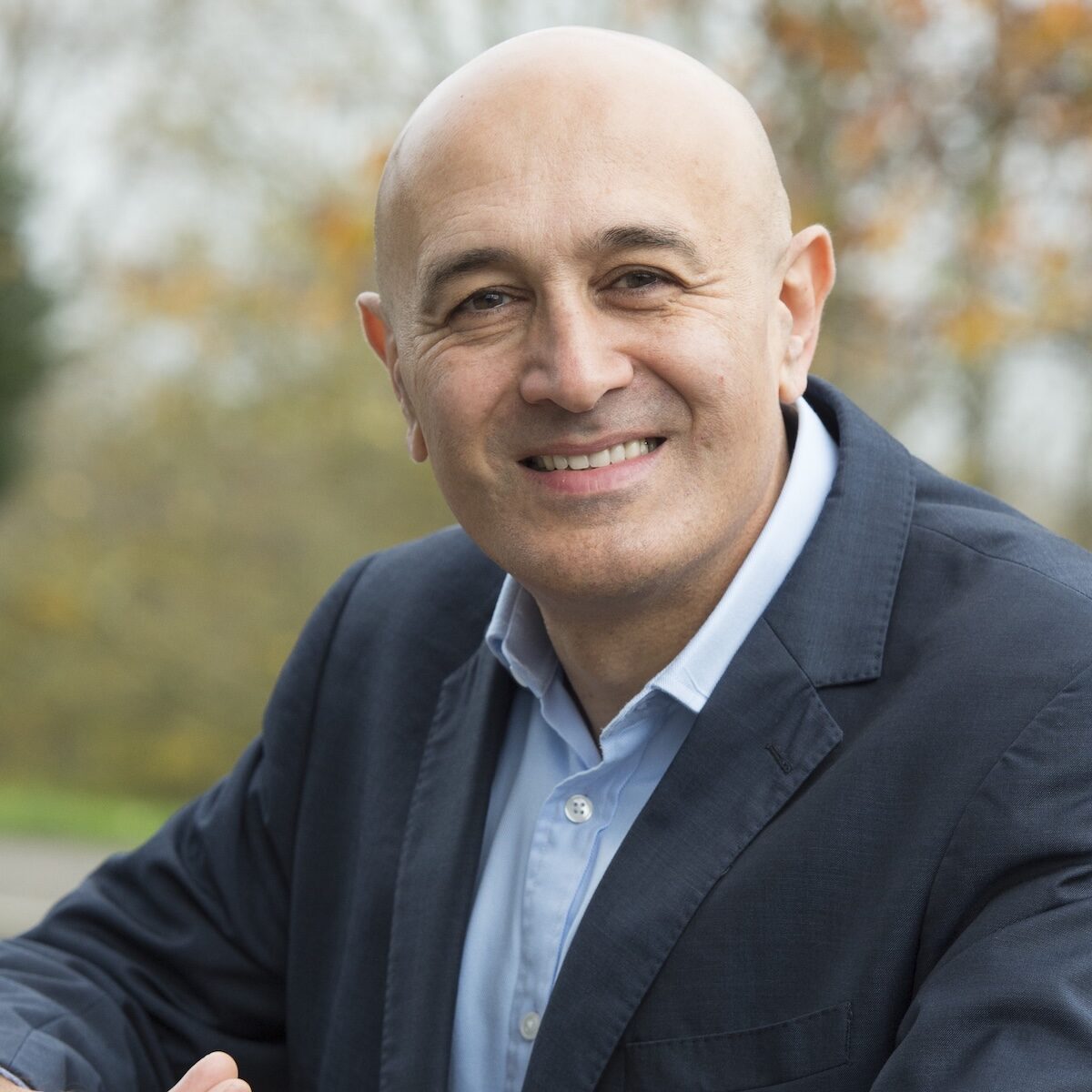
Everyone lives through time, but we continue to struggle to fully understand it. We remain unsure whether time is fundamental or emergent, why it has an arrow pointing from past to future, and how that arrow connects to our experience of time's passage. Jim Al-Khalili's new book is On Time: The Physics that Makes the Universe Tick. We discuss what time is at the most basic level, and how it connects to open questions in biology, cosmology, and quantum mechanics.
Mindscape listeners can try StatsKey Pro free for one month with code MINDSCAPE. After that, it’s $4.99 per month unless canceled. #ad
Support Mindscape on Patreon.
Jim Al-Khalili received his Ph.D. in physics from the University of Surrey. He is currently Distinguished Emeritus Professor of Physics at Surrey. He is a Fellow of the Royal Society, and has served as past president of the British Science Association. He has been awarded the Michael Faraday Prize by the Royal Society, and has been appointed an appointed Officer of the Order of the British Empire.
Click to Show Episode Transcript
0:00:00.4 Sean Carroll: Hello, everyone, and welcome to the Mindscape Podcast. I'm your host, Sean Carroll. A long time ago, 15 or more years ago now, when I was writing my first trade book, 'From Eternity to Here', we were talking about the title. We liked the actual title, right? 'From Eternity to Here'. I think that either Jennifer came up with it or we brainstormed it together. I forget. But that seemed to both be fun and also fit what was actually in the book. Then, of course, you need a subtitle because you're cute with the title, right? And when you're cute with the title, you need the subtitle to actually explain what the book is actually about. So I was talking about that with my publisher, Stephen Morrow, and eventually he mentioned that the word quest was very popular in publishing circles at that moment in time. Publishing goes through all these various fads and phases, and at the moment, they thought that books that were about quests were really selling well. So the subtitle ended up The Quest for the Ultimate Theory of Time, which is a perfectly decent subtitle and especially decent, especially appropriate, because the quest is not over yet, right? I was not proposing in that book to answer all the questions that one might have about the nature of time.
0:01:13.3 SC: I discussed the questions and we talked about various possibilities, but clearly with an eye to saying there's a lot left to be done, which I bring up now because today's guest, Jim Al-Khalili, has a new book out called 'On Time', and his subtitle is The Physics that Makes the Universe Tick. So it's a very similar theme to what I wrote more than 15 years ago now in 'From Eternity to Here'. But there has been progress since then, and of course, even absent any progress, two physicists thinking about the same general area, especially one as big as this, are gonna have their own angles on it. So Jim is a very accomplished both physicist and communicator. His topic is something that I've talked about already on this podcast. You've heard me talk about it, I wrote books about it, et cetera. So this is an excuse or an opportunity, if you want, for me to play dumb, to pretend I don't have strong opinions about the nature of time and how it works and get a different perspective, because I'm a huge believer that no one person is ever going to be able to state or explain things in the perfect way for every member of the audience. Hearing it in different ways is interesting. And also I have a lot of questions that I don't know the answer to, that I think are really interesting research-level problems. I'm trying to think about them, make progress on them. It's always fun and useful to talk to another physicist who's thinking about the same problems. So let's go.
[music]
0:02:58.2 SC: Jim Al-Khalili welcome to the Mindscape Podcast.
0:03:00.3 Jim Al-Khalili: Hi, Sean. Pleasure to be here.
0:03:02.2 SC: We're talking about a topic dear to my heart as well as to yours. So I'm not going to be reluctant to load you with all the tough questions. So let's start with, what is time?
0:03:15.6 JA: Okay. It's a tough question because it's one that we've been thinking, we, humanity, has been thinking about for millennia. Going all the way back to the ancient Greeks, there were big philosophical debates about whether time was real, whether it's an illusion, whether it flows. And the more we've understood about the workings of nature, I guess just the more complicated the answer becomes about the nature of time. Not just is it real, is it all an illusion, is it just in our heads, but also within physics, what do we mean by time and how it enters different areas of physics in different ways. So in a sense, we know a lot more about time than certainly I would like to think, more about the nature of time than the ancient Greeks, but we may not be that much closer to answering the ultimate question.
0:04:07.0 SC: All right, that's perfectly fair. You said a lot of true things. You've not told me what time is. I need something down to earth here.
0:04:14.7 JA: Okay. For me, time is a real thing. It's tangible. It's part of four-dimensional spacetime, the fabric of our existence, of reality itself. It's not just that thing that clocks measure. It's a real thing. It exists. And I also go further and say it exists and it has a direction. That's not just something that emerges or that we're conscious of that maybe digging deeper doesn't exist. I think that's there baked into the universe as part of time.
0:04:50.4 SC: Well, let's explain, you said a couple of things that are actually sort of touching on big picture controversies. And we wanna let the audience know that they're controversies because they might sound pretty unobjectionable. First, well, the thing you just said that time has a direction. I mean, obviously time has a direction, but you're going further than that. You're gonna say that it's not simply a matter of the present state of the universe and its evolution. There's something oomphy about it. There's something built into it?
0:05:23.6 JA: Yeah. I mean, I think I make the distinction between time or the directionality of time if we're talking about the whole universe, viewing it from outside, the God's eye view.
0:05:33.6 SC: Yeah.
0:05:34.1 JA: And it may well turn out that time doesn't have any directionality once you zoom outside. But within the universe, or certainly for us measuring systems, seeing how they evolve, I would say that time has a direction. Now, this is a long-standing debate, which you know very well, you've written a lot about. How does time's directionality, its irreversibility, emerge from something deeper? Maybe something that is time-symmetric, that doesn't pick out a direction. And my view, maybe this is something we will get into later on, is that it's the other way around, that time's direction, directionality, irreversibility is more fundamental.
0:06:17.1 SC: Okay, good. Yeah.
0:06:18.1 JA: And symmetric equations and symmetric laws of physics, I think are just idealizations that aren't giving us the whole picture.
0:06:26.0 SC: Yeah, no, that's very important and I just wanna get it on the table. We'll come back to it later and we'll talk about it in detail. That's great. And the other thing that you mentioned is you think that time exists, which again, most of us think that time exists. We said we're gonna do the podcast at 10:00 AM and things like that, and it worked. But there is a perspective that said time is just a tool we use. It's not something out there in the world.
0:06:52.9 JA: Yeah. I mean, in my book, I sort of start off by making this distinction that many philosophers of time, and that is a field of research, philosophy of time, would argue, which is the distinction between physical time, the time that enters into our laws and equations of physics, and manifest time, psychological time, the time that we perceive. And in a way, you talk to a non-scientist and they say, "Well, after all, that is everything. We can't ever talk about something other than what we perceive and imagine." Certainly within our own psychological time, yeah, it's obvious. And a lot of things about time, why does yesterday come before today, why is today before tomorrow, why does it seem like time passes, they're so obvious, people wonder why scientists and philosophers are spending effort trying to study this. But that is different from time, the physical time that enters into our laws of physics. So yeah, there are certain problems of time that are philosophical problems, does it flow, what is the meaning of now, and so on. And there are other more concrete problems that physicists and philosophers worry about, which is things like the arrow of time or how to reconcile different ways of defining time when you're dealing with different areas of physics, say relativity theory and quantum mechanics.
0:08:22.5 SC: Well, in your new book, you're not afraid to at least chat about some of these deep philosophical issues. I think it's pretty clear, I don't know, maybe you feel differently, it's clear to me that while you're chatting about them, you're like, I'm a physicist, I can't wait to get back to the physics part of these things.
0:08:38.4 JA: Yeah, yeah. I mean, in a sense, I'm sort of deliberately, I am naive about some of the philosophical issues because this is not a subject I've spent my entire career thinking about. I've sort of come to it late in the day and in part, a lot of physicists, particularly theoretical physicists, start to worry about some of these foundational problems in physics because time is finite, right? Time's running out and I don't have to publish or perish anymore. I don't have to work on the sort of nitty-gritty stuff. I wanna think about the big questions. So I've sort of come to this rather late in my career and I'm aware there are people who've spent their entire lives studying this stuff who quite rightly would see some of my ideas as a bit naive and maybe half-baked. But I try and be honest about it, as you say. I say I'm a physicist. Like you, I am aware that philosophy and philosophy of physics is very important. And I have friends and colleagues who, as I'm sure you do, who poo-poo philosophy as just navel-gazing and physicists are the ones who are really answering the big questions. I still think there's huge importance in physicists and philosophers talking together and trying to... It's not just the philosophers come up with the questions and physicists come up with the answers. It's more complicated than that. But I don't have a training in philosophy. So what I've... The background research I've done for the book has mostly been from very much from a physicist's perspective.
0:10:13.4 SC: It's interesting because this is gonna be a slight deviation, but it's a podcast, we can talk about whatever we want. We both agree that philosophy of physics has some interesting things to say. And maybe we both agree that physicists don't know what the philosophers of physics are saying usually. I was just the other day reading a statistician who knows a lot of physics and talks to physicists, just bemoaning the fact that in his mind, physicists don't understand even the most basic parts of statistical analysis and how to distinguish between one curve fit and another one. And I'm sure that he's right in some sense. And what do we do about that? I think that we need to not just say physicists should read philosophy, physicists should read statistics or whatever. I think we need to actually talk to each other and there should be more formal structures to allow that to happen.
0:11:05.3 JA: Yeah. I mean, certainly a lot of physics is becoming more interdisciplinary and we are talking to each other, but it's also... There's a lot to learn out there.
0:11:16.5 SC: Yeah, there's too much.
0:11:18.7 JA: I know astronomers and cosmologists, for example, are having to learn some really clever and complex statistical analysis. Just the reams of data that are coming back from the big astronomical surveys, for example, so they're having to retrain themselves in these things. Other physicists are having to learn a lot of computer science and AI and machine learning because that's a tool they're using. And those physicists working on the boundaries on foundational problems need to talk to philosophers and learn more about the philosophy of physics. I don't think we can be all things to all people, but you're right, we need to talk to each other. If you're tackling a problem that you need to come at from lots of directions, no single person has to approach it from all directions themselves. Other people can use their skills, you use yours.
0:12:09.9 SC: We should mention, Jim is on the side of the angels here. You've actually collaborated with philosophers about these philosophy of time questions.
0:12:18.0 JA: Yeah, and it was quite a new thing for me. So this was a big research grant I had from the John Templeton Foundation, it's a charitable organization in America that is unafraid to sort of fund some of these more speculative areas of research, which the usual sort of public funding bodies are reluctant to do. And I basically got that research grant off the back of my public engagement, science communication activities, because that's how they knew me. And they wanted a big public engagement aspect to that research proposal that I put together. But at the same time, it was an opportunity to do something really interdisciplinary. And the nature of time and the arrow of time was a big feature of that. So I reached out to one philosopher of physics I knew and I asked him if he'd like to join. He said he didn't have time, but he pointed me in the direction of several others. So Simon Saunders at Oxford is, I'm sure, someone you know very well.
0:13:19.7 SC: Yeah.
0:13:20.4 JA: As a fellow Everettian, as we...
0:13:23.4 SC: Absolutely.
0:13:23.5 JA: Say in the quantum world. Eddy Chen in UC San Diego, I published a paper with a couple of years ago, and Karim Thébault in Bristol. So these are three philosophers of physics. I think all three of them have, basically have PhDs in theoretical physics.
[overlapping conversation]
0:13:39.9 SC: It often happens. Yeah.
0:13:41.1 JA: Right. A lot of philosophers of physics actually start off in physics and they have that grounding in mathematical physics that I guess you need if you don't just wanna be fluffy.
[overlapping conversation]
0:13:51.0 SC: It helps. Do you therefore have a stance on things like presentism versus eternalism?
0:14:00.3 JA: Not a strong one. No. I mean, because I can see the arguments for each case. For me, I guess because I'm a physicist and I've studied and taught relativity for many years, I guess eternalism is the thing that comes naturally to me. That in 4D spacetime, all times exist in the same way that all points in space exist. And the notion that somehow the future doesn't, but the present and past do, particularly as with every fiber of my being I've been trained in thinking about relativity in the sense that the present moment may be special to us because you can only ever exist in the now, but zoom out outside of spacetime and there's nothing special about it. So eternalism, I guess, is what I'd naturally feel is the right way of thinking about things.
0:14:54.8 SC: Well, this is gonna get us into some deep waters. We might as well get there. Let's talk about the arrow of time. We've already mentioned it a little bit. There's kind of a conventional story about how the fundamental laws of physics look like they don't have an arrow, but we have one anyway. Do you wanna tell that conventional one first?
0:15:13.9 JA: Yeah. So this is something that goes back to the mid-19th century and people like Boltzmann and Maxwell and others were arguing about, which is that all our fundamental, all our dynamical equations of physics, the equations of physics that describe how things change over time, whether it's Newton's laws of motion, whether it's Schrödinger's equation of quantum mechanics and so on, all seem to work perfectly well if you switch time over. You may have to do, you know, mathematically a few other technical things, but they are what we say time-reversal invariant. They don't break any laws of physics if you run them backwards. And since these are fundamental dynamical equations that we believe describe nature correctly, then there's no directionality in time baked in there. That directionality, that arrow of time, somehow must emerge from them. And the big debate in the 19th century, which often is referred to as Loschmidt's paradox, Josef Loschmidt was the person who first highlighted this dilemma, is that there is an area of physics where a directionality of time is apparent, and that is in thermodynamics. The second law of thermodynamics, which I always say is so famous, but it couldn't make... Couldn't even make it to the number one spot in the laws of thermodynamics, [laughter] says that this quantity entropy, which we may or may not want to talk about a bit more, increases in an isolated system, or increases or stays the same, but it doesn't decrease. That gives a directionality to time. So how do you reconcile that with these time-symmetric laws and equations of physics? And certainly our perception of time pointing in one direction, not the other, it's so obvious, we surely think that second law of thermodynamics must be correct and those time-symmetric equations are the things that we need to be concerned about. We grow older, balls roll down hills, cream mixes with coffee, and all the usual shuffling cards makes them more shuffled. All those things suggest that somehow, surely there is a directionality to time. So let's worry about how those symmetric equations come about. But I think for most physicists, it's the dynamical time-symmetric equations that are the more fundamental.
0:17:38.8 SC: Right.
0:17:40.4 JA: And the directionality to time emerges, for example, with what we say zooming out, coarse-graining, looking at larger and larger systems, and suddenly you see something emerging. That's the traditional view, that how does irreversibility emerge from time-symmetric equations? I come at it from the other direction. For me, if I'm going to take this stance, which is a controversial one, I guess, in the sense that not all physicists, maybe not even a majority of physicists would agree with, which is that irreversibility is more fundamental, then how do I justify that? Well, for me, whether we're talking about the second law of thermodynamics and entropy always having to increase or certainly not decrease, or whether we're talking about time-symmetric dynamics running the movie forwards or backwards, it doesn't look wrong, both those apply only to isolated systems.
0:18:45.3 SC: Sure.
0:18:46.2 JA: And so for me, certainly time-symmetric dynamical equations, because they only apply to isolated systems, they are an idealization. They're not true in general because no system is truly isolated apart from the entire universe itself. But if we're embedded within the universe, then I would say that time-symmetric dynamical equations are just an ideal limit that doesn't exist in reality. Everything is interacting with its surroundings, whether it's losing... Whether it's the hot cup of coffee in the fridge that's cooling down or whether it's a quantum system decohering because it's interacting with its environment. Those are irreversible processes that give a directionality to time. And so for me, because nothing is truly isolated in our universe, there's an inevitable directionality, arrow of time. And only when you idealize a situation and isolate a system from its surroundings do you lose that. Well, even then you don't lose it because you still have entropy increasing. If you isolate it when it's far from equilibrium, it will move towards equilibrium. Once it reaches equilibrium, then there's no arrow of time within that system. But outside, there's still a direction to time.
0:20:21.8 SC: So I'm willing to entertain this point of view. So I mean, I think the usual thing people would say is, Look, I can imagine if I don't have an isolated system, just considering a bigger system, and that might be isolated, and then the original thing I cared about is now a subsystem. And I can derive all of the open system equations from the isolated system equations. But okay, so you're suggesting a change of perspective where we should take the open system point of view more front and center?
0:20:56.8 JA: Yeah.
0:20:56.9 SC: Love that. That sounds great. But even in a non-isolated system, even an open system, if everything is in thermal equilibrium, there's still no arrow of time.
0:21:08.5 JA: If... Right. Well, by open, an open system, do you mean just the system itself? You're not including its surrounding environments?
0:21:22.0 SC: Well, if the surrounding environment is a thermal reservoir at some fixed temperature and my system is at the same temperature in thermal equilibrium, they can be interacting, but there's no arrow of time, yeah?
0:21:34.5 JA: Right. Well, there's no arrow of time that we can perceive if we're looking at that system and its environment. Unless the environment is the entire universe and therefore inevitably we are observing it and observing the absence of an arrow of time from outside of the universe, then yes, I concede that there is no arrow of time. But within the universe, a system and its environment will necessarily be embedded within an even larger environment, and therefore the arrow is there. I agree that for the entire universe there may... There is no arrow of time or there is time symmetry, which is why I still think we have an issue, the past hypothesis... We have to acknowledge that there must be a special moment that the universe started off in a special state.
0:22:28.5 SC: Well, yeah, and I do wanna get to there in the past hypothesis, et cetera. But just to be super duper clear, when you say that you want to take the directionality of time as something fundamental, and you say that the traditional guesses at fundamental laws of physics, like Schrödinger's equation or Einstein's equations or Maxwell's equations or Newton's equations, they don't have a direction, you're not proposing changing any of those equations whatsoever. You're just proposing looking at a different context?
0:23:00.3 JA: Absolutely. I mean, if we take Schrödinger's equation, for example, it is correct and perfectly precise, provided it's dealing with an isolated system which is undergoing what we call unitary evolution. But of course, if I say no system is truly isolated, but even quantum systems are open, then it's not the Schrödinger equation we use. It's the Schrödinger equation plus some add-ons.
0:23:26.6 SC: Yeah.
0:23:26.9 JA: And those add-ons are what give us the irreversibility. So they're not add-ons to the Schrödinger equation. The Schrödinger equation is a special case...
0:23:35.2 SC: Okay.
0:23:36.0 JA: Of that larger, what's called the master equation, because an isolated system is a special case of an open system.
0:23:42.5 SC: I guess I'm just sort of flailing around here because I haven't really thought about things in this way. It seems to me that there would be lots of different open system equations because I don't know what the rest of the world is gonna do. Like, I can more or less predict what's happening in this room, but if a meteor hits it tomorrow, then I will not have predicted that.
0:24:05.1 JA: Yeah, of course. I mean, I think even in an open system, we are having to idealize and pick some environment surrounding the system that we're interested in describing. And the simplest idea is to say that, well, your system, your quantum system is embedded in an infinite heat bath that's just at, as you say, a thermal equilibrium at some constant temperature, which has no memory of what happens next. The system just leaks into it and it doesn't care and it doesn't change. But that's a simplification. It's an idealization. Of course, in reality, a system's environment is itself still constrained. There's still a lot more that's going out on beyond that.
0:24:51.1 SC: Okay. Is this a program? Is this a project to sort of replace our... When we teach kids, undergraduates the laws of physics, we teach them the Schrödinger equation. Do you think that there is a wholesale upending of the usual way we think about physics that starts from an open system point of view?
0:25:12.3 JA: I certainly think the way we teach undergraduates quantum mechanics is something that has to change. I've heard you talk about this on your podcast as well, that the traditional way of, one-dimensional Schrödinger equation, square barriers and square wells and harmonic oscillators, who cares? But especially given that these days we hear a lot about new quantum technologies, quantum computing and so on, why the heck aren't we teaching students about entanglement and decoherence? Entanglement and decoherence inevitably require an appreciation of open systems. So maybe it's too complicated to teach as a first course in quantum mechanics, but I certainly think by the time if you're doing another course at an undergraduate level or certainly as a graduate student, then we should be absolutely going beyond the Schrödinger equation and saying that's a special case of what is a more general, everything is entangling with everything else, things are decohering. And of course, that inevitably leads on to something that's close to both our hearts, which is we could start talking about the interpretations of quantum mechanics as well.
0:26:31.9 SC: We will, we will. But let's... Okay, good. I can't avoid talking about quantum mechanics because it's so seductive. But I do wanna sort of finish up the classical kind of entropy story.
0:26:42.6 JA: Yeah.
0:26:43.3 SC: You briefly mentioned the past hypothesis, a formulation from previous Mindscape guest David Albert. And that's a slightly... That's a part of the more conventional view, which you're contrasting. But why don't you tell the audience what it is and how it's supposed to work?
0:26:59.5 JA: Okay. So I mentioned that no system is truly isolated, but we tend to... If we're thinking about the entire universe, then there's nothing outside it for it to interact with. So we have to treat it as a, like an isolated system. And if we say that, okay, so today the universe has a certain entropy, tomorrow it'll, because of the second law of thermodynamics, have higher entropy. But if we were to describe the whole universe at a fundamental level in terms of all the particle interactions and we had some super equation that would describe everything, then that equation, fundamental equation, because we're dealing with what is an isolated system, should be time-symmetric. And if it's time-symmetric, then if you run the clock backwards, that means yesterday should have higher entropy than today.
0:27:50.3 SC: Right.
0:27:52.2 JA: But if you go back to yesterday and someone measured the entropy and said, no, actually it's lower. You know, oh, I thought it should be higher, but it seems like it was lower. Seems that universe entropy is going... There's nothing special about today. And so how do you get rid of this problem? Well, if you push the special moment to last week, then sure, yesterday would have lower entropy than today, today has lower entropy than tomorrow, and so on. But that moment last week also has a problem because the week before that, entropy was even lower. So the past hypothesis says you push this point, and I'm teaching grandmothers to suck eggs, you're very quietly sitting there waiting for me to explain something that you've explained a million times. The past hypothesis suggests that if we push that special moment all the way back to the beginning of time, to the Big Bang, then there is no before to worry about entropy increasing. From that very moment onwards, entropy is increasing. So we've satisfied time symmetry and the second law of thermodynamics. Of course, what we've done, which is a bit of a problem, is that we've broken what's called time translation invariance. We've picked a moment that's special. It's the Big Bang, so I guess that's already a special moment.
0:29:14.8 SC: If something has to be special, it might as well be the Big Bang.
0:29:17.0 JA: If something has to be special, it might as well be that, rather than today or last week. Exactly. So the past hypothesis gets around this problem of an isolated system, namely the entire universe, that can both be time symmetry invariant but also satisfy the second law of thermodynamics. It seems we can't get away from requiring a past hypothesis when we're dealing with the whole universe.
0:29:41.2 SC: And the idea is that the past hypothesis plus the definition of entropy plus time-symmetric underlying laws, that's it, that's the package. This is the usual picture. This is maybe not your picture, but that's supposed to explain all of the ways in which the past and future are different.
0:30:00.3 JA: Yes, yes, that's right. For me, the past hypothesis is... Says the universe starts off with very low entropy or in a very special state. But there's also the... What's called the fine-tuning problem, that the universe had to start off in, the speed of light and the other constants of nature and the strength of the forces and so on had to be a certain... Or have certain values for the universe to have evolved in the way that it has. And I would argue that the past hypothesis is simply part of that. It's not an additional sort of requirement or assumption on top of the initial conditions that the universe had found itself in. It's all part of it. It started off with all these values for the fundamental constants and in this very special state.
0:31:03.2 SC: So this leaves us then, though, with sort of two kinds of questions that are ripe for investigation by physicists and fellow travelers, why was the early universe low entropy? And we can talk about that. But then there's the more basic question, like why does that do the work that we need it to do? Like you started at the beginning of the podcast mentioning the passage of time, the flow of time, these experiences we have. How are you gonna get that from saying that 14 billion years ago the entropy of the universe was small?
0:31:38.1 JA: Yeah. So having the entropy of the universe very small and allowing the second law to do its thing, or whatever mechanism that gives us an arrow of time, that's all part of understanding physical time. Nevertheless, our perception of time passing, that now is a special moment, that time seems to flow, whether we're drifting along the time axis or time is flowing past us, whichever way you wanna think about it, those are still parts of psychological time. And that's something I don't have a clear idea even how to articulate, how to reconcile physical time with manifest time. Is our psychological time really just, are we kidding ourselves? We say... Physicists tend to say, right, there's no evidence, there's nothing in the laws of physics that says that time flows like a river. That flow doesn't exist. An arrow may exist, but the flow of time doesn't exist. And yet we perceive it to flow. So reconciling how we think of time, how we imagine time, how we perceive time, and how time pops out of the mathematics of our laws of physics are things that we are still, I think, struggling with. I don't have an answer to that.
0:32:59.7 SC: Good. No, that's extremely fair. Kudos to you for actually saying what we don't know the answer to. It is... People have to accept that there's some things we do know the answers to and some things we don't, and that's okay. But we did start with the hardest part of the question. There's many steps in between, between the Big Bang and the human experience of time passing. There's cosmology, but then there's also biology, the origin of life, complexity, things like that. How well do you think that we can relate those to increasing entropy in the universe?
0:33:36.8 JA: Well, the... Very often cosmologists have a simplified view of entropy as being two things. There's thermodynamic entropy. The universe started off in a hot, dense state, but it was in thermal equilibrium. And there's the usual people say, "Yeah, but if it started off in thermal equilibrium, it's already at maximum entropy." And the argument is that, well, you've forgotten about gravity and other things that... Expanding and gravitational entropy was very, very low. My background is nuclear physics. And so for me, nuclear fusion entropy plays a very important role. The universe expands and when it's cool enough, when it's still hot, cool enough, quarks can combine with gluons to make protons and neutrons, and then you can make atoms and so on. But it expands at a certain rate, and as it cools, it slows down. It gets to a point where you can't make... Fuse any heavier nuclei than hydrogen and helium. You've got to wait for stars to form. And so there's still that very, very low fusion entropy locked into, I guess, the nature of the strong nuclear force. It's there waiting to happen. So in a sense, gravity isn't just giving us an out, giving us a way of saying the universe had low entropy to start with. It also enables fusion entropy to increase. When stars... When matter clumps together to form stars, then stars can reignite and fusion starts again and you can have entropy increasing. So we live in a world now where stars are still shining. The sun is a source of low entropy. If there was no fusion entropy, the sun would have clumped down to, matter would have clumped together, it would have died and reached maximum entropy a long time ago. The fact that it's still a source of low entropy is because of nuclear fusion. And then things like life have used that low entropy to maintain their low entropy, but all the time entropy is increasing. But this fusion entropy for me is a big middle step that runs alongside gravity and is the reason why we're still... The universe is still at relatively low entropy. We haven't run out of steam yet.
0:36:05.2 SC: I wanna get your version of what is the response when people say life, in the sense of a biological organism, is a struggle against entropy or the second law of thermodynamics? And my personal reaction is no, that's exactly backwards. Life is taking advantage of the second law of thermodynamics. It's using that free energy from the sun to maintain its equil... Not its equilibrium, its structure, its organization, its metabolism, and so forth. So do you have a dog in that fight?
0:36:38.8 JA: No, not really. I think I agree with you that, you know, life is a mechanism for using low-entropy photons from the sun, useful energy versus useless energy. And then that low entropy is a thing that it utilizes and converts it into low entropy to maintain its structure, to maintain itself far from equilibrium. But it spits out higher entropy. It spits out thermal photons, right, which are, I don't know how many, dozen, two dozen thermal neutrons for every... Neutrons. Thermal photons for every photon from the sun, which is low entropy. So yeah, that low entropy source is there and life is feeding on it and making use of it. It's not a struggle against it. It's utilizing it. How, we still don't have a good definition of what life is. How does it do that? And why don't other things do that that are non life? I don't know.
0:37:48.1 SC: One thing that I actually don't have a strong opinion about, or I guess a strong feeling of how best to phrase things, is sometimes people wanna say in that spirit, life is a way for the universe to increase entropy, right? Like we take this low entropy energy from the sun, like you say, we radiate it out, a bunch of low energy photons, increase the entropy. I don't know if that's true or not. I mean, I kind of have a feeling like the entropy is gonna increase anyway. There's no law that says it increases as fast as possible. You got to think harder about what life is doing.
0:38:25.5 JA: And we tend to think that there must be life elsewhere in the universe. It's so vast and there's so many places that could harbor life, even if it's just microbial life. Maybe multicellular life is the really the sticking point and here on Earth is the only place. But if life only exists on Earth, and we can't rule that out, then that's a very tiny part of the entire universe. How the whole universe is relying on this tiny planet in this outer suburbs of some galaxy to help it increase its entropy, [laughter] it seems a bit wacky.
0:39:06.7 SC: So I do wanna give you a chance to talk a little bit about biology because you've written papers on quantum biology in particular. But it does occur to me that first we should talk about quantum mechanics.
0:39:19.0 JA: Yeah.
0:39:19.4 SC: So what is your favorite way, we started with what is time, so now what is quantum mechanics, Jim?
0:39:26.7 JA: When I was a grad student, I... Both my... I had two PhD supervisors, both staunch Copenhagenists, right? So this is the traditional view of quantum mechanics that espoused broadly by Bohr and Pauli and Heisenberg and others. And I know it's unfair, and people who support that viewpoint hate it when you say that's the shut up and calculate interpretation, but I did have that attitude when I was a student. My supervisor would say, "Jim, an electron is an electron is an electron. Don't worry about it." But I did, and together with other grad students, we formed what was called, we called it the Carlsberg Group, which you may know historically is the Carlsberg brewery that funded Niels Bohr's institute in Copenhagen in 1920. And we would, almost in secret, have these discussions about interpretations of quantum mechanics. This was like the mid-late '80s when it was still...
[overlapping conversation]
0:40:30.7 SC: Oh, yeah, that was sketchy.
0:40:33.0 JA: You weren't really allowed to say those sorts of things. You were a bit of a maverick if you follow that. But I... So the one thing that I'm firm and feel strongly about is that I'm not a Copenhagenist, that I'm a realist. I believe objective reality exists out there, and it's not just brought into existence through measurement and all the other business. But it also means that I don't think we can adopt whatever interpretation we like just depending on a whim or whether it's a Tuesday or who you last spoke to. I always say that of the sort of plethora of different interpretations of quantum mechanics, they can't all be right. Either there are parallel worlds or there aren't. Either there's a sort of invisible guiding potential or there isn't. Either the wave function spontaneously collapses or it doesn't. I don't have a strong view on which one is right. Some I favor over others for different reasons, but I do believe there is a correct interpretation. And we may or may not, maybe not in our lifetime certainly, actually hit upon the way nature does things.
0:41:56.8 SC: And when you say you're a realist, in particular, I take it you're... 'Cause some Copenhagen people get very touchy when you say that they're not realists, 'cause... But they wanna say, "Well, I'm a realist about measurement outcomes." But the rest of us are realists about the quantum wave function, the thing that appears in Schrödinger's equation. And it sounds... It seems to me, correct me if I'm wrong here, that once you start studying quantum biology, you're gonna start thinking of the wave function as something real, like it's playing a role in pushing energy around in a cell.
0:42:28.5 JA: Yeah, yeah, absolutely. And while I don't need to put one interpretation ahead of any others if I'm doing quantum biology, in the same way that I didn't need to back in my past life as a nuclear reaction theorist, when I was studying particle collisions and scattering of nuclei, I use the equations, I use the mathematics. I think of these things as really happening. The wave function is really something that is really evolving in time. What I measure is doing something to it. But I've not needed to pick a particular interpretation in order to do my research. And the same goes with my work in quantum biology.
0:43:17.5 SC: And quantum biology covers a bit of a span of different topics. It's become a hot topic in recent years. What is your particular interest in quantum biology?
0:43:27.8 JA: Well, I started off over two decades ago. A molecular biologist colleague of mine, Johnjoe McFadden, with whom I went on to write a book on quantum biology called Life on the Edge, he... The story is that he... This was the late '90s, in fact. So right, more than a quarter of a century ago. Time passes, and it's not just because COVID and we lose sight of the last few years. It's longer than that. He gave a talk in the physics department. He was trying to explain some aspect in genetics which he felt needed quantum mechanics to explain it, something called adaptive mutations. E. coli bacteria will mutate in two possible different directions, and if the environment was going to be conducive to one particular direction of mutation, it would preferentially pick that. And he was saying, "Well, how does it know in advance that there's something waiting for it that will give it an advantage? Maybe it's described as a quantum superposition, and then the act of measurement actually preferentially pulls it in one direction." Most of my colleagues in the physics department just thought it was completely crazy. I was interested enough to chat to him about it. And so from then onwards, it became just a bit of a hobby to look at whether quantum mechanics plays a role in living systems, in cells. So quantum biology is not, well, life is made of atoms and atoms behave quantum mechanically, therefore life is... Everything's made of atoms. So in that sense, everything's... Nor is it the chemical bonds that hold the molecules of life together. The chemistry relies on quantum rules. That's not quantum biology. Quantum biology is the non-trivial quantum mechanics, long-lived quantum coherence and quantum entanglement. The way I've described it is, has life evolved the means to take advantage of the tricks of the quantum world to help it, to give it an evolutionary advantage? Or the opposite, maybe it's learned that quantum mechanics would be deleterious to life and therefore has evolved the ability to stop quantum mechanics from doing something.
0:45:51.5 JA: And the last few years, most of my work with my PhD students and colleagues at Surrey has been to look at one particular mechanism, which is the bonding between strands of DNA. So in the double helix of DNA, the two strands are held together by hydrogen bonds, which hydrogen atom which provides the glue between the nucleotides in DNA. And because my background is nuclear physics, I never say it's a hydrogen atom, it's a proton. I don't care about electrons. That's chemistry. [laughter] So it's a proton. And that idea goes all the way back to a Swedish physical chemist, Per-Olov Löwdin, who published a paper in the early '60s, in fact, saying that it could be that the proton in the hydrogen bond between strands of DNA can transfer from being close to one strand across to the other. Essentially, there's a potential barrier, an energy barrier in the middle between the strands. And so that proton likes to sit on one side. It's more stable to sit on one side than the other. But it could somehow, if it could get across to the other side and then those strands split, separate, they unzip in the process of replication, if that proton's on the wrong side, that could lead to a mutation. So that was the idea that was interesting. And he said, Löwdin said in this paper, that maybe the proton can get across via a quantum process, via quantum tunneling. So that's what started us thinking about how likely is the proton to jump across from one strand to the other, and if it does, how likely is it to do that via quantum tunneling rather than having the energy to sort of go all the way over the top of the barrier, the energy coming from, I guess, colliding with nearby water molecules. And gradually we've got more and more sophisticated in our calculations, and I've been left far behind because I've got computational chemists running these huge monster codes and simulations, adding in more ingredients all the time, and the story keeps changing. But it's fascinating because it's still trying to address this question, has life evolved the ability to use quantum mechanics?
0:48:11.4 SC: And this is all part of my master plan, because we're now gonna bring it back to the arrow of time. Because quantum mechanics and the arrow of time have an interesting relationship, right? Like you mentioned, the Schrödinger equation, perfectly time-reversible. Measurement is not. And so how do you think about that?
0:48:30.3 JA: For me, measurement, I don't think there's a problem with measurement. Well, measurement, I guess the way some quantum physicists have written about this is it's broken down into different stages. And it's not just you open the box to see if what Schrödinger's cat is doing, how healthy it is. The measurement process first of all involves, you're talking about, this is what's called the choice of basis. What are you measuring? Position? Are you measuring momentum? What is the most obvious thing that's gonna be measured? And when I say you, I don't mean someone with a PhD or wearing a white lab coat. We're not the only... It's not only physicists that can do measurements. Anything surrounding a quantum system can be measuring it. Then the second step is the system becoming entangled with its surrounding environment, and that is what leads to decoherence. Now, going back to the Schrödinger's cat and the box, and you'll forgive me because I know you're a cat guy, I still use the dead or alive rather than awake or asleep.
0:49:46.4 SC: You're old school, that's okay, but...
0:49:49.0 JA: But dead or alive, but we always remind listeners it's a thought experiment. No cats were harmed. Decoherence doesn't cause the cat to be either dead or alive. What it does is gets rid of the mixture. It gets rid of the interference between them. So the cat dead and alive at the same time no longer exists after decoherence. But you still have an alive cat and a dead cat somehow. It's not like it's one or the other, I just don't know because I haven't opened the box. And it's that then that third stage, which is why is it when you open the box, do you see just one outcome? And here's where interpretations come into there. I mean, certainly I... You probably know from past chats we've had, I'm not the biggest supporter of Everettian many-worlds quantum mechanics, but I do have to admit it is the simplest, cleanest way of describing the measurement problem. Because it says decoherence in and of itself has caused reality to separate. And so there is a universe in which I open the box and the cat's dead. There's another universe in which I open the box and the cat is alive. So I think the many-worlds interpretation is the cleanest at explaining away the measurement problem. I think Bohmian pilot wave theory also reasonably well explains the measurement problem, but don't push me on it because I've forgotten exactly what the argument is. You might know off the top of your head.
0:51:24.6 SC: Yeah, it's... I'm not even... I don't wanna shed more light on Bohmian mechanics...
[overlapping conversation]
0:51:29.0 JA: [0:51:29.2] ____ publicity than it needs, yeah. So, yeah, so the measurement problem I don't think is a problem. I think if you subscribe to a particular interpretation, then that interpretation solves that final step in the measurement process. But the idea of consciousness causing collapse of the state and things like that, I think we've sort of grown beyond that now.
0:51:56.7 SC: But you did sneak in an arrow of time because you entangle in one direction and not the other.
0:52:03.9 JA: Yes, so there it's back to open systems and isolated systems. All the time a quantum system in this case is isolated, there's no measurement taking place, it's evolving symmetrically in time, it's unitary evolution. The measurement process that the founding fathers, the Copenhagenists, would have talked about was this, what they called the irreversible act of amplification. You know, you have a measuring device that is a classical device interacting with a quantum system, and that's what pulls it out of this unitary evolution and gives irreversibility. In modern parlance, we talk about the environment becoming entangled with the system. And that entanglement is a one-way process. Even... I'm not sure if you need to resort to saying the system decoheres, whether it is the decoherence that gives it the arrow or is it entanglement. A system can become entangled with a partner. Is that reversible or not?
0:53:17.7 SC: I like to just define decoherence as entanglement with an environment. And once you agree on what the environment is, which is a tricky thing, I admit, but that is what counts as decoherence for me.
0:53:30.6 JA: Macroscopically distinguishable or whatever. But would you say that entanglement of a system with something else is itself an irreversible process? No, because entanglement, you can still describe it.
0:53:43.0 SC: If you just want to entangle with one qubit, you can easily reverse that.
0:53:47.5 JA: Reverse that. Exactly.
0:53:48.6 SC: So I think it's exactly thermodynamics or stat mech at work. Once you entangle with enough things, you effectively in practice lose the ability to reverse it.
0:53:59.2 JA: In the same way of zooming out on molecules of gas in a box. And you zoom out and you see they're not just bouncing around symmetrically.
0:54:06.6 SC: That's right. Yeah. And so the arrow of time, the quantum version, the measurement going forward rather than backward, does that play a role in quantum biology? Like it sounded like from your previous description that worrying about decoherence was gonna be a big thing. One of the mottos we hear in biology is that biological organisms are warm and wet, so it's hard to maintain quantum coherence.
0:54:32.1 JA: Yeah, that's one of the big criticisms that people say, why quantum biology is a load of nonsense. It decoheres in femtoseconds. What's the chance? We work hard to isolate a quantum system in the lab to maintain coherence. You do it in a vacuum, you do it near absolute zero, you try and shield it from surrounding disturbances. And yet you're saying in this 300-degree Kelvin system where there's thousands of chemical reactions, so much is going on, and you're saying quantum effects can persist, well, the point there is that has life evolved the ability to fine-tune the environment so the environment isn't just causing this one way decoherence? Maybe the environment is maintaining the system. So there's backflow of information. Technically, we say the environment isn't Markovian, there's some non-Markovianity. So the environment is itself, it's helping keep the quantumness going rather than causing it to sort of leak away very, very quickly. So in that sense, it may be that it's trying to avoid a directionality to time for the quantum system for as long as possible to keep...
[overlapping conversation]
0:55:49.9 SC: So is it fair to analogize it as saying, we're... People who are trying to build quantum computers are spending lots of money trying to maintain entanglement between a few qubits, and they've had some success, but there's a long way to go. But they've only been doing it for a few years, and nature's been doing it for billions of years, and maybe they've come up with some clever strategies.
0:56:10.3 JA: Yeah, I don't see why not. There are certainly people like Seth Lloyd, I'm sure another Mindscape guest of yours.
0:56:19.1 SC: Not yet, but I know Seth very well.
0:56:20.6 JA: He hasn't? Okay. All right. You should have him on. People like that would argue that, yeah, life has had a long time to find whatever tricks are out there. Billions of years. Life isn't... There's no directionality to it in the sense of exploring this would work, that... Everything happens by accident, and the things that work, work, right? And then they... And things that don't work get left behind. And so there's been enough time to explore what possible ways quantum mechanics might be of benefit to life. And if life has found a way of doing it, then sure, we should be looking to see, there are a number of examples of quantum effects that look like they happen inside living cells. The way photosynthesis absorbs sunlight, that's still an open question of whether quantum mechanics is playing a role there or not. Enzymes, the way they move particles around, they might utilize, that's all been experimentally confirmed, they utilize things like quantum tunneling. And then of course there's the poster child of quantum biology, which is the idea of magnetoreception, that certain animals have evolved the ability to gain directional information. Birds that are migrating, not by studying the sky or landmarks on the ground or prevailing winds, but by sensing the Earth's magnetic field. And the strength of the magnetic field helps them know whether to go north or south. And the only theory in town that we have that would explain that would be that inside a particular molecule in these creatures' eyes, there are a pair of entangled electrons that's... So photons come in, it's in the eyes, a photon knocks one of a pair of entangled electrons onto a neighboring atom. So they're far apart, but they're still entangled, and their orientation and the way they're spinning is very sensitive to the Earth's magnetic field. It seems crazy, but why wouldn't, you know, life has had a long time, so that's... And there are plenty of amazing things that nature has evolved to do. Why not use quantum mechanics as well? Quantum mechanics isn't magic, right?
0:58:49.7 SC: No. Absolutely. But this is a good opportunity to ask, I mean, maybe it's an unfair question because it's one of those things about quantum mechanics that's very hard to explain. Entanglement is not a force. Right? When we talk about these two electrons and you say, okay, they're entangled and one electron moves around, that doesn't mean that the other electron gets to tug on it in any particular way. And I think that people get that impression when they just use the word entanglement.
0:59:14.5 JA: Yeah. Yeah. I mean, the idea here is that the two electrons, their quantum state is a superposition of both of them spinning in the same direction and one spinning in the opposite direction to the other. And the percentage of time, if you were to take sort of snapshots of those two electrons at any given moment, how often would you find them spinning the same way, how often would you find them spinning the opposite direction? Triplet and singlet states, we call them. That depends very sensitively on an external magnetic field interacting with that quantum state. So it's not about a force pushing one electron and the other one instantaneously doing something itself. It's what that quantum state looks like in terms of populations of triplet relative to singlet spin states. It's starting to sound... I haven't done it very non-technically.
[overlapping conversation]
1:00:17.2 SC: It starts sounding very abstract to the person on the street, I know. Like I said, I have not figured out how to explain it either. So I put you on the spot there. Sorry about that. Let me put you on the spot again though, nevertheless. So we have some quantum mechanics on the table. We talked earlier about the past hypothesis and low entropy near the early universe. But you know as well as anyone, the usual ways of talking about the past hypothesis start by saying, let's assume that everything is classical. [laughter] Let's think that we're just in a box of gas, okay? And we know that's not true. So how much advancement has been made in sort of upgrading our discussion of the cosmological initial conditions and low entropy to the world of quantum mechanics?
1:01:06.8 JA: Yeah, well, I think that if there are different arrows of time, for example, we have the thermodynamic arrow of time that Ludwig Boltzmann gave us, the second law of thermodynamics, the increase in disorder. There are other arrows of time, the causal arrow of time and so on. The quantum entanglement or quantum decoherence arrow of time, which we talked about, for me is the best, the most irreversible, non-negotiable, one-way process. Right. And so what I've been thinking about over the past few years, and together with Eddy Chen in San Diego, is whether quantum entanglement and decoherence provide us with a more fundamental past hypothesis than the thermodynamic past hypothesis. The... Where the idea of having you go from a special microstate to less special ones. Here we're saying, what if the universe, rather than just saying the universe started in a very ordered state, we say the universe started off in a very pure quantum state. Very pure in the sense that if there's a measure of entropy at the quantum level, that would be very low. Then the question is, what measure of entropy do you have at the quantum level? And there are various ideas here. We hit upon what's called entanglement entropy. We didn't hit upon it, we decided [laughter] that would be a good measure, which is the idea that you can have a system that is in a, what we call a pure state. So it has... The measure there is what's called Von Neumann entropy. Right? So a system in a pure state has zero Von Neumann entropy.
1:03:12.0 JA: But if it's made up of two subsystems, then if they're not entangled with each other, if they're just isolated, they also have zero Von Neumann entropy. But those subsystems can interact with each other. They can become entangled with each other. So their individual Von Neumann entropies go up. But overall, when you add it all together, you have to have zero because the overall system that contains both has zero. So what happens? So there must be some... You have to subtract something, right? They both have Von Neumann entropy, you have to subtract something in order to get the answer to work out at zero. That thing that you subtract is the entanglement entropy. And what we have tried to argue is that the universe started off with very low entanglement entropy, that all the parts of the universe, the subsystems of the universe, were in pure states. And gradually, as the universe has evolved, rather than thermodynamic entropy increasing, everything is becoming gradually more and more entangled with everything else. Of course, the difficulty there is how big are those subsystems? How much do you have to divide them up? At what point do you say, right, now I've got down to the fundamental pinpoints? So it's... I know this is an area that you've been working on as well. At the moment, it's a bit fluffy. And we haven't followed up that paper with anything else, partly because we've both been doing other stuff. But I tend to think that we started off on something that we thought was very interesting and we haven't seen it through. There are still big gaps.
1:04:53.4 SC: I'm super duper sympathetic to that. I feel like I've written a bunch of papers where I was sort of saying something and inviting other people to extend it and work at it, and they didn't. And I realized that, oh, this is my job, isn't it? [laughter] I've got...
1:05:08.6 JA: It's down to me.
1:05:09.6 SC: Yeah, I've got to get back to this myself.
[overlapping conversation]
1:05:12.3 JA: Things are a bit more difficult for me now because a couple of years ago I took early, I mean, I'm only 63, but I took early retirement from my academic role at Surrey in part because along with a lot of... I mean, I know you have your difficulties in the US at the moment with funding.
1:05:33.6 SC: We do.
1:05:35.9 JA: And I don't think we're in that position, but certainly a lot of universities in the UK were going through tightening of belts. And at Surrey, I don't know how many tens of million they were in deficit. It was the responsibility of the deans of the different faculties to put their houses in order. And it became apparent that physics had to lose, actually lose academic positions. And I felt, because I could see the politics getting more toxic and because I had spent 30 years teaching undergraduates and I'd done all the academic stuff and the committees and endless... Stuff that you're fully immersed in now.
[laughter]
1:06:20.3 SC: Thanks.
1:06:22.6 JA: I'd done that. I've been there, I'd done that. I thought, you know what? I've got my other interests. I've got my writing, my broadcasting. I can carry on with my research. Theoretical physicists are relatively cheap. So I stepped back from that. So it did mean that my research activities, because the work with Eddy Chen on the past hypothesis came out of this grant with the Templeton Foundation. Well, I'm not writing grant proposals anymore now, and I'm not a member of academic staff, so I'm not in a position to be able to do that. So I need to find other people, academics who are still in post... So I'm emeritus professor now. It means I have a small desk still at Surrey. I can go in now and again, but I'm happy doing the writing, doing the broadcasting. 10-month-old twin grandchildren keep me busy. So I don't know when I'm gonna get back to thinking about those things. I'm trying to find... I'm trying to justify why I've not.
[laughter]
1:07:29.9 SC: Yeah, I just do it because I'm not a good planner and I'm lazy. I don't even justify it at the level of sophistication that you've achieved there. But there is something, I mean, the arrow of time has us all in its grip, and there's a point of your life where you can sort of either say, "I've done pretty well, I'm kind of gonna just downshift and fade away a little bit." or you can say like, "Boy, I better get to work because if I'm gonna do what I wanted to do, the only chance I have is now."
[laughter]
1:07:59.8 JA: Yeah. My wife really keeps going on about, the first year after I stepped back from my academic position, I was still working just as hard, and she's just, "What's the point? You've retired." "No, I've not retired. I've just stepped back. I'm still... I've got too much to do, too much to think about." So I have slowed down a bit now, but I guess most of my time has been taken up with the writing, and so I haven't missed the research that much. I've still got two PhD students. One has just submitted his thesis, so I've got one more, and I don't think I'll take on any more grad students.
1:08:36.8 SC: That's a big step. Yeah.
1:08:37.6 JA: Well, I sort of can't be a primary supervisor anymore if I don't have a permanent position. I would be a secondary supervisor with a colleague. And of course, then the project that is chosen for the student would not be my choice, so it may not be the thing that I want to devote what time I have to it, so.
1:08:54.2 SC: And we're too old for that. If you're gonna do something, it's better be what you wanna do at this point. [laughter]
1:08:59.3 JA: Exactly, exactly. That's right. I don't need to do anything other than what I'm perfectly excited about.
1:09:06.1 SC: Speaking of which, I think the last big question to address here is to return to exactly where we started. The reality of time. You do talk about this in your book, but now that we've talked about the past hypothesis and Schrödinger's equation, we can sort of revisit it at a more sophisticated level. You know that there's a lot of people, some very close friends of ours doing general relativity, quantum mechanics, quantum gravity who think that time doesn't exist or isn't fundamental or is emergent or something like that. And I like to say that's something we just don't know and we should be open-minded about. People get annoyed when I say we should be open. You need to have a position. They don't care what the position is. But what is your position on this one?
1:09:53.0 JA: Well, I make a distinction between time doesn't exist and time is emergent. Certainly I think if you're sitting outside of the universe and you've combined quantum mechanics with relativity theory, something that was done many years ago by Wheeler and DeWitt, the famous Wheeler-DeWitt equation where time doesn't exist, fine. That's provided you're sitting outside the universe. I'm not, I'm inside the universe... I have no issue with the idea that time may be emergent from something more fundamental, quantum entanglement or something like that, in the same way that maybe space is something that is emergent from something more fundamental. But I don't think that means it's not real. It's not the same as temperature is an emergent property from lots of molecules moving around. It's just something that we perceive on the macro scale, but we zoom in, it sort of disappears. I think if time is emergent, then nevertheless it's a real, tangible thing.
1:11:06.0 SC: I do wonder, and this is a true open question again, which I don't have a strong feeling about. We've had people like Thomas Hertog and Daniel Harlow on the podcast, and in different ways they're both considering whether or not time doesn't exist, but if you separate out an observer from the universe, even in a timeless universe, that observer thinks that time is passing, right? It's this sort of relational thing. You're a subsystem of the universe. And maybe that's compatible with your view that we should take a more open systems view of the laws of physics in general.
1:11:41.6 JA: Yeah, I think so. I think if you see something where, you know, there's no system in thermal equilibrium, you say, well, there's no arrow of time there. Time doesn't... Well, that's really talking about the arrow of time rather than time itself. But me looking at that system, if it suddenly is no longer isolated, it's open because I'm interacting with it, then of course there's an arrow of time and time is real. I even think in the... If the universe, trillions and trillions of years from now, when the entire universe reaches thermal equilibrium and there's just nothing is happening, is time still passing? [laughter] Well, you see, I would still say yes.
1:12:29.8 SC: Me too.
1:12:29.9 JA: Even... Yeah. Even without extracting myself outside of the universe, there is still... Time is still passing, maybe still asymptotically sort of cooling down towards some sort of de Sitter space. And we can still point to trillions of years back in time at the beginning of the arrow, there was a Big Bang in which the universe had low entropy. So even if nothing is changing, time is still passing. It's just that you don't... You can't measure... There's nothing that you can use to measure the passing of time. So in that sense, time really becomes quite a real, fundamental thing that exists. It's almost back to Newton's absolute clock ticking by, although we now know that's wrong in the sense that time is relative in different reference frames. But time is like that absolute clock. Time is something that is happening, even if it fundamentally didn't start off like that, it started off from something else.
1:13:27.5 SC: Does it strike you ever that all this time since Aristotle and Augustine and Newton and whatever, we still don't know the answers to these pretty basic questions that we can ask?
1:13:40.7 JA: Yeah, it does. It's frustrating, and I think for a lot of people they assume then, obviously, our taxpayers' money is being wasted on you guys if you've not made progress. We make progress by developing science and technology and making humanity's life better. That is happening all the time, even though there's a subgroup of people who seem to deny that science actually works. But the fundamental questions, yeah, sometime... Maybe they're too hard, or maybe we'd never be able to answer them. But it's... They're too... That itch has to be scratched. And if the Greeks were scratching it and we're still scratching it, what's wrong with that?
1:14:24.3 SC: Why should they be easy?
1:14:26.2 JA: Exactly. Yeah. How boring the world would be anyway if we had all the answers, right? [laughter] It's a bit like doing a jigsaw puzzle. The joy is in doing the jigsaw puzzle, not in finishing it. You finish it, you think, oh, great. Okay, right. Clear it up and start again.
1:14:42.6 SC: It's in the process, and this is a process that's not gonna end anytime soon, so...
1:14:46.7 JA: I hope not.
1:14:47.3 SC: Jim Al-Khalili, thanks so much for being on the Mindscape podcast.
1:14:49.9 JA: My pleasure. It's been great fun.
[music]
Pingback: Quantum physicist takes aim at the arrow of time – Cosmic Log
Life on the edge- about quantum biology. A very ‘edgy’ book.
Quantum biology explanation of how birds sense magnetic fields, is really fascinating.
Quantum coherence & Quantum entanglement are frontier fields of research.
Prof. Jim Khalili- A really curious explorer & explainer.
Pingback: Quantum Physicist Takes Aim at the Universe's Mysterious Arrow of Time - NewsMachine