Author: Sean Carroll

  • The Lesson of Adam and Eve

    There’s a bit of discussion going around concerning the ontological status of Adam and Eve — is the story literally true, useful metaphor, not really true but based somehow in reality, or what? For me, it would be hard to think of a less interesting question. But I do have a serious issue with the A&E story, which I rarely see discussed: it’s a terrible lesson on which to found a system of belief.

    The story is told in Genesis, chapter two and chapter three. God sets up Adam in the Garden of Eden, and soon takes one of his ribs and makes Eve. For the most part the Garden is a pleasant place, and there doesn’t seem to have been any duties more onerous than coming up with names for the different animals. But for reasons that are not explained, God placed in the Garden something called the tree of the knowledge of good and evil, and commanded that Adam and Eve not eat from it. (Translational difficulties being what they are, there is a school of thought that argues that “good and evil” should be understood as simply meaning “all things, both good and evil.”) Eventually, of course, they take a bite, with a little urging from a crafty serpent. God gets angry, curses them, and casts them out of the Garden forever — the Fall of Man, as Christians would have it.

    The choice given to Adam and Eve was a simple one: (1) obey, or (2) attain knowledge, in particular of good and evil. If those are my two choices, I’m choosing “knowledge” every day. Count me on Team Eve on this one. As far as I’m concerned, this wasn’t the Original Sin, it was the Original Heroic Act.

    I want to see a religion founded on exhortations to disobey authority and seek the truth at any cost.

  • Data Fatigue

    Hello out there in blog-land. I’ve been traveling (and working!) too much to actually blog, most recently at the terrific SciFoo Camp held at Google. This is an informal “unconference,” where on the first night participants scramble to a big whiteboard to suggest events for the next day and a half. I helped organize a session on “Time” that turned out to be popular, featuring short talks by Geoffrey West, Max Tegmark, David Eagleman, Mark Changizi, and Martin Rees. Other interesting sessions I went to talked about sleep, narratives, the brain, the Turing Test, and why the difficulty of putting chiral fermions on a lattice is evidence against the idea that we live in a computer simulation. (That last one was from David Tong.)

    But just between you and me, while staring at the intimidating whiteboard full of interesting possibilities for what to do next, I was struck by a depressing insight: I am tired of data.

    This isn’t to say that I am tired of experiments. We can’t learn anything about the world without looking at it, and my favorite areas of physics are bubbling along with provocative new results (or at least hints thereof). When data is taken by an experiment in the cause of deciding some scientific question, that’s fine.

    It’s the fetishization of data for its own sake that I find fatiguing. It’s hardly surprising that, surrounded by sci-tech folks at the Googleplex, one would be overwhelmed by talk of data collection, data visualization, data analysis, and so on. And good for them! We are being swamped by data in unprecedented forms and quantities, and it’s a crucially important task to sort it all out and understand how we can use it.

    I’m just personally kind of exhausted by it all. (And it’s my blog, so if I want to bust out the occasional irrational rant, who will stop me?) Data — like theory! — is a tool we use in the quest for a higher goal — understanding. If people want to show me that they understand some unanticipated new phenomenon on the basis of some data that they collected and analyzed, I am as enthusiastic as ever. But my standards are rising for simply being impressed by new ways of gathering or visualizing data for its own sake.

    At least, for the moment. Next time I see a really pretty picture, I’ll undoubtedly forget I said any of this.

  • What Can We Know About The World Without Looking At It?

    One last thought on all this God/cosmology stuff before moving on.

    The crucial moment of our panel discussion occurred when John Haught said that he couldn’t imagine a universe without God. (Without God, the universe couldn’t exist.) It would have been more crucial if I had followed up a bit more, but I didn’t because I suck (and because time was precious).

    Believing that something must be true about the world because you can’t imagine otherwise is, five hundred years into the Age of Science, not a recommended strategy for acquiring reliable knowledge. It goes back to the classic conflict of rationalism vs. empiricism. “Rationalism” sounds good — who doesn’t want to be rational? But the idea behind it is that we can reach true conclusions about the world by reason alone. We don’t ever have to leave the comfort of our living room; we can just sit around, sharing some single-malt Scotch and fine cigars, thinking really hard about the universe, and thereby achieve some real understanding. Empiricism, on the other hand, says that we should try to imagine all possible ways the world could be, and then actually go out and look at it to decide which way it really is. Rationalism is traditionally associated with Descartes, Leibniz, and Spinoza, while empiricism is associated with Locke, Berkeley, and Hume — but of course these categories never quite fit perfectly well.

    The lure of rationalism is powerful, and it shows up all over the place. Leibniz proclaimed various ways the world must work, such as the Principle of Sufficient Reason. Lee Smolin uses Leibnizian arguments against string theory. Many people, such as Oxford philosopher Richard Swinburne, feel strongly that the world cannot simply be; there must be a reason for its existence. Paul Davies believes that the laws of physics cannot simply be, and require an explanation. William Lane Craig believes that infinity cannot be realized in Nature. Einstein felt that God did not play dice with the universe. At a less lofty level, people see bad things happen and feel the urge to blame someone.

    But the intellectual history of the past five centuries has spoken loud and clear: the dream of rationalism is a false one. (more…)

  • God and Cosmology Conversation

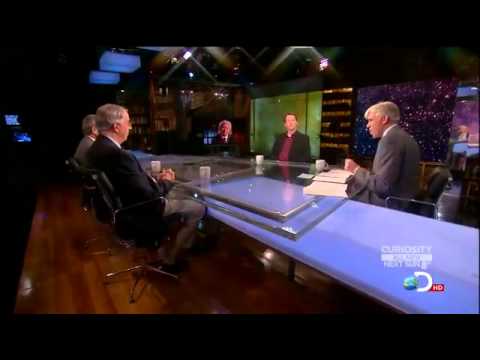
    Here is the video of the panel discussion from Discovery Channel’s Curiosity Conversation last Sunday. Not sure how official it is, so it might not last. Jerry Coyne was motivated to dig them up, since he doesn’t have cable TV. I’m putting the panel first — this is all about me, baby — and the Hawking program under the fold.

    The participants were me, David Gregory, Paul Davies, and John Haught. But there were also short video interventions from Jennifer Wiseman, William Stoeger, and Michio Kaku. Actually seeing the program made me even more frustrated about the lack of time and inability to discuss any issue in depth. Also, while the makeup of the original panel seemed fair (committed atheist, wishy-washy physicist, Catholic theologian), the pre-recorded videos all took the line that science shouldn’t be talking about God. That gave the final program more of a “gang up on the atheist” feel than I would have really liked. I don’t think the videos added much, other than to eat into our valuable time. An hour-long program would have been better, and it probably would have been a much sharper conversation if there had just been two panelists rather than three. But again, credit to Discovery for having the event at all.

    Specific thoughts on the participants:

    • David Gregory: I thought he did fine. Not sure why some people were complaining about the questions; his job was just to get the conversation going and keep it moving, which he did with admirable professionalism.
    • John Haught: He actually had a very difficult job, since his take on the nature of God isn’t easy to boil down to a sound bite. Still, I personally don’t think there’s any there, there. If you can’t imagine a universe in which God doesn’t exist, you need to work on your imaginative skills.
    • Paul Davies: A very clear speaker and strong communicator, but again not a sound-bite kind of guy. He did win the Templeton prize, but isn’t very explicitly religious. (At least, not that one can discern, which is part of the problem.) But he does strongly believe that it’s not okay to simply say “the universe is like that” — he thinks there is necessarily a deeper explanation for the laws of physics.
    • Jennifer Wiseman and William Stoeger: Neither really even tried to argue in favor of God’s existence. They just took the angle that religion talks about value while science talks about facts. I think it’s important to get the facts right before you start talking about values, and said as much, but we didn’t have time to dig into that issue.
    • Michio Kaku: I tease Michio. The guy is a brilliant science communicator, but I don’t think he added anything of value here.
    • Me: This isn’t an easy format, and I would probably grade myself a generous B. I don’t feel like taking back anything I said, but I definitely could have been more forceful about it. Still looking to improve at things like this — any suggestions?

    Okay here are the videos, judge for yourselves. First the panel, in two parts:

    Curiosity: Special: The Creation Question: A Curiosity Conversation (2/2)

    Here’s the episode of Curiosity, hosted by Hawking, in four parts. (more…)

  • Live-Blogging Curiosity, Hawking, and God

    Tonight’s the premiere of Curiosity on the Discovery Channel, featuring Stephen Hawking talking about cosmology and God, followed by the “Curiosity Conversation” panel that I’m on along with David Gregory, Paul Davies, and John Haught. Hawking’s hour-long show is scheduled for 8pm Eastern/5pm Pacific, and will then repeat 3 hours later (11E/8P). Our half-hour panel discussion follows immediately afterward — you do the arithmetic.

    There’s a lot to say about these shows, and in particular there’s a huge amount that we didn’t have time to say during the panel. So as I sit in front of the TV, I’ll be live-blogging along by adding updates to this post. This will be the early show, so the fun will happen 8pm-9:30pm Eastern. Hey, Nathan Fillion live-tweets during Castle, so why not me? There is also a chat going on at the Discovery site.

    The main attraction of Hawking’s program is not that he has disproven the existence of God. Certainly I don’t think he’s going to be changing the minds of many religious believers. His argument is essentially that the universe is self-contained, and doesn’t really have “room” for God (nor any need to invoke a creator). It’s very easy to wriggle free of that conclusion, if you are inclined not to accept it.

    But “changing people’s minds” isn’t the only reason to talk about something, even about controversial issues. Religion, like sex and death, is one of those topics where it’s very difficult to simply have a dispassionate discussion without making people uncomfortable. It can happen within a group of similarly-minded people, of course, but once a wider range of views gets involved, it’s hard to maintain comity. (Comedy, on the other hand, is pretty easy.) I don’t mean everyone has to agree — just the opposite. We should be able to talk about things we completely disagree on, while still maintaining level heads.

    That’s why I think this episode of Curiosity is potentially important. It’s a forthright statement of a view that doesn’t often get aired in American media. Even if nobody’s mind is changed, simply talking rationally about this issues would be a step forward.

    Pre-show update: I should note ahead of time that I was not wearing a tie. Haught, Davies, and Gregory were all wearing ties. But Hawking wasn’t. Maybe atheists don’t wear ties? (Although I’m pretty sure Jesus never wore a tie, either.)

    Start: We begin with a disclaimer! These are Stephen Hawking’s opinions, not those of Discovery. 🙂

    4 minutes: I hope the analogy here is clear. “People who believe God made the universe are kind of like the Vikings shouting at the Sun to stop a solar eclipse.”

    8 minutes: Snark aside, the message here is a fundamental one. Nature obeys laws! Something that’s certainly not a priori obvious or necessary, but a really profound truth.

    14 minutes: I wasn’t able to find an independent confirmation of this story about Pope John XXI condemning the idea of “laws of nature.” (It’s true that he did die when the roof collapsed.) Presumably this refers to the Condemnations of 1277.

    20 minutes: The universe is a big, messy, complicated, and occasionally quite intricate place. On the face of it, the idea that it’s all the working-out of some impersonal patterns of matter and energy, rather than being constructed by some kind of conscious intelligence, is pretty remarkable. (But true nonetheless.)

    27 minutes: Hey, a tiny ad for Discovery Retreats!

    28 minutes: Hawking says Einstein might be the greatest scientist ever. He has long favored Einstein over Newton, I’m not sure why. Hawking appeared on an episode of Star Trek: TNG, where he was a hologram playing poker with Einstein, Newton, and Data. He actually wrote the script, and Newton doesn’t come off well.

    36 minutes: Ah, negative energy. Depends on what you mean by “energy,” but this isn’t the venue to get overly technical, obviously. Roughly, matter has positive energy and gravity has negative energy. That’s hopefully enough to help people swallow the crucial point: you can make a universe for nothing. There isn’t some fixed resource, out of which we can make a universe or two, before we hit Peak Universe. There can be an infinite number of universes.

    41 minutes: People on Twitter are asking why Hawking doesn’t have a British accent. He easily could, of course; voice-synthesis technology has come quite a way since he first got the system. But he’s said that he now identifies with that voice he got years ago, and doesn’t want to change it; it’s identified with him.

    47 minutes: Okay, here’s the payoff. He’s saying that generally we’re used to effects being caused by pre-existing events. (The first step toward a cosmological argument for God’s existence.) You might think that a chain of causation takes you back to the Big Bang, which then requires God as a cause. But no! The Big Bang can just … be.

    50 minutes: The point of the black hole discussion is to get to the idea of a singularity, a conjectural point of infinite curvature and density. The Big Bang, in classical general relativity, is also a singular moment. But classical GR isn’t right. We need quantum gravity. Hawking believes that quantum gravity smooths the singularity and explains how there was no pre-existing time. (At least in the TV show, unlike A Brief History, he doesn’t start talking about “imaginary time.”)

    56 minutes: Ultimately Hawking’s argument against God is pretty simplistic. He assumes that if God created the Big Bang, God must have existed before the Big Bang, but there was no “before the Big Bang,” QED. It’s easy enough to simply assert that God doesn’t exist “within time” (if that means anything). It would have been better (IMHO) to emphasize that modern cosmology has many good ideas about how the universe could have come to be, so there’s no need to rely on a divine creator.

    58 minutes: Final thought from SWH: no life after death! Enjoy it while you’re around, folks. An important message.

    Panel discussion starts: Forgot to mention that Paul Davies has shaved off his moustache. Disconcerting.

    4 minutes: Also disconcerting: watching myself on TV. Hate it. But I persevere for the greater good.

    5 minutes: Here’s Michio Kaku, not saying very much.

    7 minutes: Jennifer Wiseman and I were actually grad students together! She’s good people, even if we disagree about the whole God thing.

    9 minutes: I come out in favor of basing purpose and meaning on reality. But I’m pretty sure a longer remark was cut off there. Arrrrgh! Nothing nefarious, we intentionally recorded a bit more than they had time to show. But enormously frustrating that there was so little time.

    13 minutes: Not sure why we kept talking about the multiverse. Hawking didn’t bring it up, did he?

    17 minutes: I thought a lot of what Haught said was not even really trying to argue in favor of God’s existence, but simply expressing a desire that he exist. “God is the grounding of hope” isn’t evidence for God’s existence.

    22 minutes: Haven’t said anything completely silly yet, so that’s good. But so little time…

    27 minutes: Always time for more Michio!

    30 minutes: Arrrrgh again, this time for real: in the live conversation, I had the last word and it was a pretty good one. In the televised program, not so much. Had to end wishy-washy.

    Thanks for tuning in. Wouldn’t it have been wonderful to have the time for a real conversation? But big ups to Discovery for hosting the panel at all — it’s a rare event on TV.

  • Water on Mars

    Here’s a pretty picture from JPL, based on data from NASA’s Mars Reconnaissance Orbiter. Click to see a larger version. (Note that the image is highly doctored, in the best NASA tradition; not just false-color, but they’ve “reprojected” so that a satellite image now looks like it was taken by a flying helicopter!)

    Water on Mars” is one of those things (like “black holes” or “the missing link”) that seems to be discovered over and over again. That’s because we’re not really finally discovering it once and for all; we’re slowly gathering new evidence, and also evidence for different manifestations. It seems clear that frozen water exists in the polar regions of Mars; also, there’s good reason to think that there used to be running water at some point. This new finding would be evidence for running water right now.

    In this case, NASA scientists have noticed seasonal changes in hillside patterns such as this one. The dark streaks seen in the image appear in the spring and summer, then fade again in winter. (Kind of like the Los Angels River, but backwards.) The best idea we have for an explanation is running water. Not that the darkness is water itself, but some change in the underlying substance as a result of water. It’s a very good idea — likely true — but still not quite like we’ve filled up a cup and done a chemical analysis.

    Anything with any tenuous connection to “life on other planets” runs the risk that everyone wants it to exist and is looking very hard; consequently, skepticism is always warranted. Still: awesome pictures!

  • A Universe Out of Chaos

    How did the universe come to be? We don’t know yet, of course, but we know enough about cosmology, gravitation, and quantum mechanics to put together models that standing a fighting chance of capturing some of the truth.

    Stephen Hawking‘s favorite idea is that the universe came out of “nothing” — it arose (although that’s not really the right word) as a quantum fluctuation with literally no pre-existing state. No space, no time, no anything. But there’s another idea that’s at least as plausible: that the universe arose out of something, but that “something” was simply “chaos,” whatever that means in the context of quantum gravity. Space, time, and energy, yes; but no order, no particular arrangement.

    It’s an old idea, going back at least to Lucretius, and contemplated by David Hume as well as by Ludwig Boltzmann. None of those guys, of course, knew very much of our modern understanding of cosmology, gravitation, and quantum mechanics. So what would the modern version look like?

    That’s the question that Anthony Aguirre, Matt Johnson and I tackled in a paper that just appeared on arxiv. (Both of my collaborators have also been guest-bloggers here at CV.)

    Out of equilibrium: understanding cosmological evolution to lower-entropy states
    Anthony Aguirre, Sean M. Carroll, Matthew C. Johnson

    Despite the importance of the Second Law of Thermodynamics, it is not absolute. Statistical mechanics implies that, given sufficient time, systems near equilibrium will spontaneously fluctuate into lower-entropy states, locally reversing the thermodynamic arrow of time. We study the time development of such fluctuations, especially the very large fluctuations relevant to cosmology. Under fairly general assumptions, the most likely history of a fluctuation out of equilibrium is simply the CPT conjugate of the most likely way a system relaxes back to equilibrium. We use this idea to elucidate the spacetime structure of various fluctuations in (stable and metastable) de Sitter space and thermal anti-de Sitter space.

    It was Boltzmann who long ago realized that the Second Law, which says that the entropy of a closed system never decreases, isn’t quite an absolute “law.” It’s just a statement of overwhelming probability: there are so many more ways to be high-entropy (chaotic, disorderly) than to be low-entropy (arranged, orderly) that almost anything a system might do will move it toward higher entropy. But not absolutely anything; we can imagine very, very unlikely events in which entropy actually goes down.

    In fact we can do better than just imagine: this has been observed in the lab. (more…)

  • Hawking and God on the Discovery Channel

    Last week I got to spend time in the NBC studio where they record Meet The Press — re-decorated for this occasion in a cosmic theme, with beautiful images of galaxies and large-scale-structure simulations in the background. The occasion was a special panel discussion to follow a Stephen Hawking special that will air on the Discovery Channel this Sunday, August 7. David Gregory, who usually hosts MTP, was the moderator. I played the role of the hard-boiled atheist; Paul Davies played the physicist who was willing to entertain the possibility of “God” if defined with sufficient abstraction, while John Haught played the Catholic theologian who is sympathetic to science.

    The Hawking special is the kick-off episode to a major new Discovery program, called simply Curiosity. I predict it will make something of a splash. The reason is simple: although most of the episode is about science, Hawking clearly goes all-in with “God does not exist.” It’s not a message we often hear on American TV.

    The atheistic conclusion is really surprisingly explicit. I had a chance to talk to someone at Discovery, who explained a little about how the program came about. The secret is that it was originally produced by the BBC — British audiences have a different set of expectations than American ones do. My completely fictional reconstruction of the conversation would go something like this. Discovery: Hey, blokes! Do you have any programs we could use to launch our major new series? BBC: Sure, we have a new special narrated by Stephen Hawking. Discovery: Perfect! That’s always box office. What’s it about? BBC: It’s about how there is no God. Discovery: Ah.

    [Update: Alas, reality is intruding upon my meant-to-be-funny imaginary dialogue. The episode was actually originally commissioned by Discovery, not by the BBC, although it was produced in the UK. More power to Discovery!]

    At first, I will confess to a smidgin of annoyance that an opportunity to talk about fascinating science was being sacrificed to yet another discussion about religion. But quickly, even before anyone else had the joy of pointing it out to me, I realized how spectacularly hypocritical that was. I talk about religion all the time — why shouldn’t Stephen Hawking get the same opportunity?

    The more I thought about it, the more appropriate I thought the episode really was. I can’t speak for Hawking, but I presume his interest in the topic stems from similar sources as my own. It’s not just a coincidence that we are theoretical cosmologists who happen to go around arguing that God doesn’t exist. The question of God and the questions of cosmology arise from a common impulse — to understand how the world works at its most fundamental level. These issues naturally go hand-in-hand. Pretending otherwise, I believe, probably stems from a desire on the part of religious believers to insulate their worldview from scientific critique.

    Besides, people find it interesting, and rightfully so. Professional scientists are sometimes irritated by the tendency of the public to dwell on what scientists think are the “wrong” questions. Most people are fascinated by questions about God, life after death, life on other worlds, and other issues that touch on what it means to be human. These might not be fruitful research projects for most professional scientists, but part of our job should be to occasionally step back and look at the bigger picture. That’s exactly what Hawking is doing here, and more power to him. (In terms of his actual argument, I’m sympathetic to the general idea, but would take issue with some of the particulars.)

    Nevertheless, Discovery was not going to feature an hour of rah-rah atheism without a spoonful of sugar to help the medicine go down. Thus, our panel discussion, which will air immediately after the debut of Curiosity (i.e., 9pm Eastern/Pacific). The four of us had fun, and I think the result will be an interesting program — and hopefully I did the side proud, as the only legit atheist participating. Gregory seemed to enjoy himself, and joked that he might have to give up politics to do a weekly show about cosmology. (A guy can dream…) But we all agreed that it was incredibly frustrating to have so little time to talk about such big issues. The show will run for half an hour; subtract commercials, and we’re left with about 21 minutes of substance. Then subtract introduction, questions, some background videos that were shown … we three panelists had about five minutes each of speaking time. Not really enough to spell out convincing answers to the major questions that have troubled thinkers for centuries. Hopefully some of the basic points came across. Let us know what you think.

  • Downward Causation

    Reading about emergence and reductionism and free will and determinism has led me to finally confront a concept I had vaguely heard about but never really looked into before: downward causation, a term that came to prominence in the 1970’s. (Some other views: here, here, here.) I think it’s a misguided/unhelpful notion, but this is way outside my area and I’m happy to admit that I might be missing something.

    Physicists are well aware that there are different vocabularies/models/theories that we can use to describe the same underlying reality. Sometimes you might want to talk about a box of gas as a fluid with pressure and velocity, other times you might want to talk about it in terms of atoms and molecules. Philosophers and psychologists might want to talk about human beings as autonomous agents who do things for reasons, while admitting that they can also be thought of as collections of cells and tissues, or even once again as atoms and molecules. The question is: what is the relationship between these different levels? In fluid mechanics/kinetic theory things are pretty clear, but in the mind/body problem things begin to get murky. (Or at least, there are people who take great pleasure in insisting that they are murky.)

    Reductionism notes that some of these descriptions are more complete, and therefore arguably more fundamental, than others. In particular, some descriptions are in terms of entities that are literally smaller than the others; atoms are smaller than neurons, which are smaller than people. The smaller-level descriptions tend to have a wider range of validity; we can imagine answering certain questions in the atomic language that we can’t answer (correctly) in the fluid language, like “what happens if we divide the box in half, and then divide that in half, and so forth a million times?” It therefore seems natural to arrange the descriptions vertically: “lower” levels refer to small-scale descriptions, while “higher” levels refer to macroscopic objects. The claim of reductionism is, depending on who you talk to, that the lower-level description is either “always more complete,” or “capable of deriving the higher-level descriptions,” or “the right way to think about things.”

    (more…)

  • The Core Ideas of Science

    A National Academy of Sciences panel, chaired by Helen Quinn, has released a new report that seeks to identify “the key scientific practices, concepts and ideas that all students should learn by the time they complete high school.” An ambitious undertaking, but a sensible one. At the very least, efforts like this serve to focus attention on what’s important across a wide variety of K-12 curricula, and at best it could help prod schools (or states, really) across the country into teaching more coherent and useful science to kids. Here’s the web page for the report, a summary (pdf), and the report itself (pdf, free after you register).

    So what are the core ideas of science? They are all listed in the summary report, and divided into three categories. The first category is “Scientific and Engineering Practices,” and includes such laudable concepts as ” Analyzing and interpreting data.” The second category is “Crosscutting Concepts That Have Common Application Across Fields,” by which they mean things like “Scale, proportion, and quantity” or ” Stability and change.” It’s great that the organizational scheme emphasizes ideas that stretch across disciplinary boundaries, but there is definitely a danger that the resulting items come off as a bit vague. The secret to success here will be how they can be implemented, with concrete examples.

    The third category is the nitty-gritty, “Core Ideas in Four Disciplinary Areas,” namely “Physical Sciences,” “Life Sciences,” “Earth and Space Sciences,” and “Engineering, Technology, and the Applications of Science.” (Math is not within the report’s purview.) And here are the actual core ideas proposed for the physical sciences: (more…)