I still haven’t seen Interstellar yet, but here’s a great interview with Kip Thorne about the movie-making process and what he thinks of the final product. (For a very different view, see Phil Plait [update: now partly recanted].)
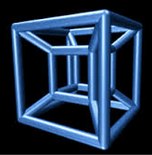 One of the things Kip talks about is that the film refers to the concept of a tesseract, which he thought was fun. A tesseract is a four-dimensional version of a cube; you can’t draw it faithfully in two dimensions, but with a little imagination you can get the idea from the picture on the right. Kip mentions that he first heard of the concept of a tesseract in George Gamow’s classic book One, Two, Three… Infinity. Which made me feel momentarily proud, because I remember reading about it there, too — and only later did I find out that many (presumably less sophisticated) people heard of it in Madeleine L’Engle’s equally classic book, A Wrinkle in Time.
But then I caught myself, because (1) it’s stupid to think that reading about something for the first time in a science book rather than a science fantasy is anything to be proud of, and (2) in reality I suspect I first heard about it in Robert Heinlein’s (classic!) short story, “–And He Built a Crooked House.” Which is just as fantastical as L’Engle’s book.
So — where did you first hear the word “tesseract”? A great excuse for a poll! Feel free to elaborate in the comments.
Comments
35 responses to “Discovering Tesseracts”
Umm, am I the only one who first heard this word in the Avengers movie?
“presumably less sophisticated”
Whatever your thoughts of me and my thoughts of you, you’re funny and I get great enjoyment from it. Keep it up.
I discovered it on my own, using a simple visualization trick I have not seen mentioned anywhere, and proudly named my ‘discovery’ an ‘Octocube’. Alas, a trip to the to the local library set me straight.
Nonetheless, that experience did alter the course of my life. It was the first time I got a taste of the joy of scientific discovery, and eventually it led to me to take up a formal study of physics, whereas prior to that, I would have never dreamed of doing such a thing.
Victor Vasarely
Sean, I would really like to know what your take is on the recent hype about “Many Interacting Worlds”
Doesn’t Phil Plait get it badly wrong about the planets needing a star? What’s worse is he contradicts himself in his own article. Black Holes are supposed to be the brightest objects in the universe – due to the very accretion disk he shows in the article.
http://stream1.gifsoup.com/view5/2127157/tesseract-o.gif
This is a better visualization tool than a static picture.
There is a beautiful discussion of tesseracts in John Archibald Wheeler’s book in the SciAm series, A Journey into Gravity and Spacetime:
http://www.goodreads.com/book/show/1405966.A_Journey_into_Gravity_and_Spacetime
which includes an illustration showing 2-D projections of eight 3-D cross sections of a tesseract.
The eight cubic cross sections can be understood as follows:
a spacelike cube at time T1;
that cube carried at time T2 where |T2-T1| = the length of an edge of the cube;
and the worldpaths of each of the six faces of the cube, from T1 to T2.
I had imagined the reference was to Salvador Dali’s depiction of the Crucifixion.