Entanglement is one of the “spookier” aspects of quantum mechanics. In classical physics, the states of two distinct objects (their positions, velocities, spins, etc.) are specified completely separately from each other. Knowing what this tomato is doing gives you no information, in principle, about what that carrot is doing. But quantum mechanics says there is only one “state of the whole world,” which refers to absolutely everything in it. And, of course, the quantum state is specified as a superposition of possible measurement outcomes, rather than one definite possibility. So the quantum state of two vegetables might take the form “the tomato is in the refrigerator and the carrot is on the kitchen counter, or the carrot is in the refrigerator and the tomato is on the counter.” Although usually we talk about spins and polarizations of particles rather than locations of foodstuffs.
Entanglement is by no means a mystery, in the same way that the measurement problem is a mystery. It’s just a straightforward prediction of quantum mechanics, repeatedly verified by experiments. But it bugs us, because it seems “nonlocal.” In the state described above, I can look at the tomato and instantly infer what the carrot is doing, without ever looking at it. This bothers people, although it doesn’t lead to anything dangerous or immoral, like communication faster than light. That’s because physical information still travels slower than light. Someone wondering about the carrot doesn’t gain any information just because you measured the location of the tomato; you still have to tell them what answer you got.
Still, entanglement is pretty cool. And now Anton Zeilinger’s group in Vienna, one of the leading labs working on quantum experiments, has queried the Zeitgeist and responded in a way appropriate to our internet age: they made a YouTube video. (Since they are also old-fashioned scientists, they also wrote a paper.)
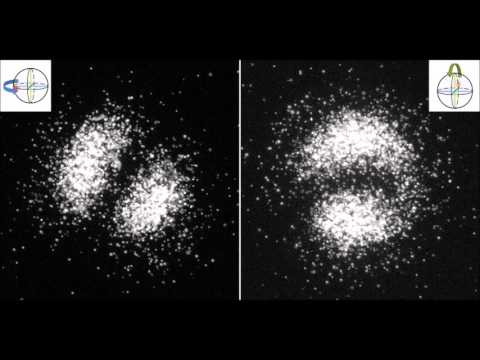
Let me try to explain this as I understand it, but I’ll confess up front this is a bit outside my comfort zone so real experts should chime in. Here we have two entangled photons, which can be polarized either H (horizontal) or V (vertical). The quantum state is of the form HV + VH, which means that we don’t know what either polarization is, but we know that the two polarizations must be opposite of each other. (If the state had been HH + VV, we still wouldn’t know either one, but we would know they were the same.) We send each photon through a merry path, observe one of them (that’s on the left), and see what happens to the other one (on the right). We’re looking at an image of where the individual photons land on a screen. You can see how the state of photon #2 is affected by what’s happening to photon #1.
Doesn’t it seem like you could use this to send information faster than light, if photon #2 is instantly affected by what we do to photon #1? I believe the trick here is that we’re not taking an image of all of the #2 photons. We’re only taking images of #2 if photon #1 was registered in a certain state. That is, we send photon #1 through a filter that only lets horizontal polarizations through. If photon #1 gets through, we turn on the camera and image photon #2. If it doesn’t, the camera never triggers, and photon #2 hits the screen harmlessly. So no superluminal chitchat, you science-fiction fans out there.
Nevertheless, pretty awesome. Quantum mechanics is sufficiently non-intuitive that we would only ever come up with it by having it forced on us by data. Even though experiments like this are completely explained by quantum mechanics as we currently know it, every little demonstration helps us appreciate it a bit more viscerally. As we strive toward a deeper understanding, that’s a crucially important part of the process.
Comments
25 responses to “Visualizing Entanglement In Real Time”
“Doesn’t it seem like you could use this to send information faster than light?”
I thought the key had something to do with the phrase that appears at 0:32–“Summing up the frames to reveal the imaged mode structure.”
I’m not exactly sure what that means, but you can only see the effect of what the carrot is doing on the tomato if I look at the joint statistics of the carrot and the tomato. That’s what makes the non-locality somewhat consistent with SR.
Something is happening around :35 such that the images are switching to represent joint statistics, not separate statistics. entanglement can never be seen in separate statistics.
In the second paragraph:
“That’s because physical information still travels faster than light.”
You mean slower, right?
“That’s because physical information still travels faster than light”
– did you mean slower than light?
Great article, experiment and video!
[…] That’s because physical information still travels faster than light. […]
faster or slower?
Slower! Although clearly corrections from commenters appear nearly instantaneously. 🙂
Fixed.
I think that Freudian slip is absolutely a wonderful example of what’s been on your mind lately…perhaps. There are many experiments to the contrary, and was just thinking about the EPR experiments of course too.
Zeilinger has been involved with so many great and cool QM experiments, this is another one. The capabilities of the technology used is pretty impressive.
No Nobel for modern experimental work confirming Quantum Mechainics is surprising. I wonder if Bell had not died so young whether Aspect and Clauser would have shared a Nobel award with him in the 1990s.
Now that Bell is ineligible, Zeilinger would be a natural third recipient, but they may have to compete with the Higgs discovery this year (although the uncertainty over the exact nature of the ~126GeV Higgs may delay an award for another year)
Using the description of “If photon #1 gets through, we turn on the camera and image photon #2. If it doesn’t, the camera never triggers, and photon #2 hits the screen harmlessly”, I can think of a simple communication scheme:
Have an uninterrupted flow of imaged photons, let’s say 10 per nanosecond (to use a round number). Normally, the polarization matches, so the photons get through and hit the screen. Assign each hit a value of 0. Whenever the polarization is rotated 90 degrees and the photon doesn’t hit the screen, there’s a dropout. Assign dropouts a value of 1.
Then we can assign protocol overhead, like sequence patterns for BOM, EOM and parity.
Bob F
But you can’t deterministically control the polarisation of each photon #1 so how would you construct a message?
The image on the right rotates in response to the one on the left. You could just swivel it backwards and forwards to send a message. There’s more than enough there to transmit a message. (Not that I think it would actually work).
“We send each photon through a merry path, observe one of them (that’s on the left), and see what happens to the other one (on the right).”
I read the paper differently. Figure 1 of the paper shows that the detection, or “observation”, is done by a separate non-imaging, single photon detector. This detection then triggers a CCD camera to image the other entangled photon. The detected polarisation of this trigger photon is varied by rotating a polariser in front of the detector.
The left and right panes in the video show the images in the CCD camera resulting from two different polariser settings for the single photon detector.
Craig is right, there is only one camera.
[…] Link. Carroll is nervous that he is messing up his explanation. Which shows how weird this is. Mysterious too damnit. […]
I find the introductory paragraph misleading. Even in classical physics, two distant objects can be correlated. For example, if a mass at rest explodes into two pieces, we know by momentum conservation that the two pieces have opposite momenta. So if we observe one, we instantly know the other, even though that particle might be far away. There’s nothing shocking about this.
What makes the quantum situation more puzzling is that in the classical case, while we don’t know the momenta before observation, we do believe that the particles have specific momenta before we observe them. In the quantum case, we believe strongly that the particles are in a true superposition of states. Even this doesn’t lead to anything too shocking, unless you believe that looking at something causes the wavefunction to “collapse”. If instead you regard the observer as part of the physical world, there is no need to assume any non-locality.
“The quantum state is of the form HV + VH”
In the video it says diagonal polarization trigger. Is that equal to vertical?
“I believe the trick here is that we’re not taking an image of all of the #2 photons. We’re only taking images of #2 if photon #1 was registered in a certain state. That is, we send photon #1 through a filter that only lets horizontal polarizations through. If photon #1 gets through, we turn on the camera and image photon #2”.
Sounds good to me. I think it’s worth reading J.S. Bell’s Concept of Local Causality by Travis Norsen at http://arxiv.org/abs/0707.0401 :
“Many textbooks and commentators report that Bell’s theorem refutes the possibility (suggested especially by Einstein, Podolsky, and Rosen in 1935) of supplementing ordinary quantum theory with additional (“hidden”) variables that might restore determinism and/or some notion of an observer-independent reality. On this view, Bell’s theorem supports the orthodox Copenhagen interpretation. Bell’s own view of his theorem, however, was quite different.”
It’s very different to what you usually hear. Norsen even quotes Bell talking about a relativistic aether.
In real – macro – world almost everything is entangled and “tomato vs carrot” is simply misleading example. Have a look at this: if “photographer” makes “still images” that exist on flash drive as “jpg” files, then as soon as “bmp” format gets introduced for “still images”, literally ALL PHOTOGRAPHERS IN THE WORLD – at the same time – would become capable of making bmp files. And if you observed only one photographer capable of making jpg, you wouldn’t need any other photographer being observed, as all other photographers are entangled with the observed by you one in a matter of capacity of making jpg files. So, exposure of entanglement is only a matter of “how you looking”. If you looked at things in both micro and/or macro world as at informational system, giving proper respect to “connections” established between its elements in some way, you’d instantly realized that the entire world were “spooky”. Dont you think that electrons were some kind of other sort of being “spooky” things. From informational system point of view, you must expect them to behave exactly as photographers, since they both belong to their respective groups, connected in some specific for the groups way. Hence if its still “spooky” for you, it’d only be if you were looking at electrons as at tomato and carrot. I mean – in some sort of incorrect way, with the following incorrect expectations. Change the way you’re looking though 🙂
BTW, really hoping you write the short book mentioned at the end of this post!
https://www.preposterousuniverse.com/blog/2005/12/26/no-reasonable-definition-of-reality-could-be-expected-to-permit-this/
-O
@ossicle: Agreed! He’s due for a short book at this point. 🙂
Is it not disentanglement in proper time?
Suppose a purely classical, isolated mechanical system is moving chaotically internally, but has zero total linear and angular momentum. The system then blows apart into just two pieces by an unspecified internal mechanism. Each of the two pieces then can have a nonzero angular momentum about its own center of mass, such that the relative orbital and total angular momentum about the joint center of mass is zero.
As in the quantum mechanical case of two electrons in a singlet state, measurement of the unpredictable projection of the internal angular momentum of one of the two particles at once establishes the projection of the internal angular momentum of the other. No inference about the pecularities/uniqueness of quantum mechanics seems
to be justified from comparision of these two examples.
Something like the Bell inequalities of three non-orthogonal angle correlations between the spins of the two parts seems to be needed to establish quantum mechanics as “sui generis”.
the modes of existence. I think beautiful is an overused word in physics, to the point of being as pompous and cliche as one could get. So I’ll just say it was balls-out awesome. Poetic.
[…] Robert Fickler, Mario Krenn, Radek Lapkiewicz, Sven Ramelow & Anton Zeilinger, “Real-Time Imaging of Quantum Entanglement,” Scientific Reports 3: 1914, 29 May 2013. Más información en “Sean Carroll, “The Universe on a StratocasterNew Video Project,” S = k log W, May 29, 2013. […]
“I can look at the tomato and instantly infer what the carrot is doing, without ever looking at it.”
Since when do we have time ordering for space-like seperated events? Sean, this is elementary special relativity theory! It should be:
“I can look at the tomato and instantly infer what the carrot’s state is, without ever looking at it.”
I (a scientist but non-physicist) still struggle with how non-locality is not “spooky.” What is the evidence that observation is key to determining the properties of each entangled partner, as opposed to they have fore-ordained (yet opposite) spins?
If both entangled particles were “observed” at the exact same time, then the results revealed simultaneously, would they be as statistically entangled as if only one were “observed” and reported?
Does “spookiness” depend on whether you believe the wave fxn in literally real vs. only a mathematical, probabilistic approximation? I struggle to tie that current debate to the entanglement “spookiness” opinion continuum.