
Black holes, as Stephen Hawking discovered, do grow old: they emit radiation, lose mass, and eventually evaporate away. But our fascination with black holes never grows old. This is especially true today, as we are seeing a flood of new data and intriguing theoretical ideas, which both tests the limits of Einstein's general relativity and teach us new things about the astrophysical universe. At the Center of Gravity at the University of Copenhagen, they are currently celebrating Black Hole Week, which provides an excellent opportunity to talk with Center director Vitor Cardoso about what we've been learning about these singular cosmic objects.
Use code MINDSCAPE at https://monarch.com/ to get your first year of Monarch Core half off at just $50. #ad
Upgrade your everyday and get free shipping and 365-day returns at https://quince.com/MINDSCAPE. #ad
See what ElevenAgents can do for your specific workflows at https://elevenlabs.io/MINDSCAPE. #ad
Support Mindscape on Patreon.
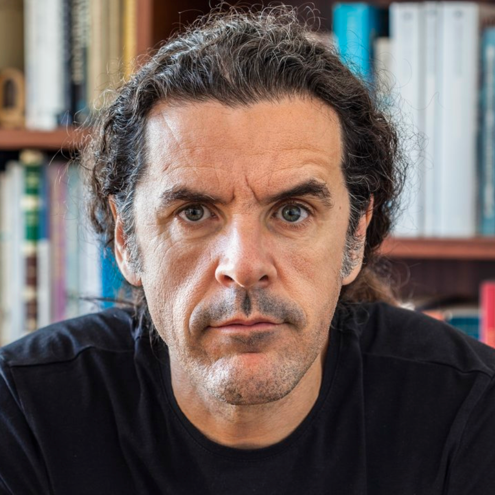
Vitor Cardoso received his Ph.D. in physics from the Instituto Superior Técnico in Portugal. He is currently a Villum Investigator and Director of the Center of Gravity at the Niels Bohr Institute in Copenhagen, and a Distinguished Professor at Técnico.
Click to Show Episode Transcript
0:00:00.3 Sean Carroll: Hello, everyone, and welcome to the Mindscape Podcast. I'm your host, Sean Carroll. I'm not sure if you know this, but if you're listening to this podcast the week it is being published, it is Black Hole Week. I don't know if it's Black Hole Week all over the world or even all throughout the galaxy, but in Copenhagen, it is Black Hole Week. Black Hole Week is a thing that is sponsored by the Center of Gravity. Maybe it's the Center for Gravity, but it sounds sexier if it's the Center of Gravity at the Niels Bohr Institute in Copenhagen. It started two years ago when they realized that two years ago was the 50th anniversary of Stephen Hawking showing that black holes actually emitted radiation and really changing our view of what black holes are. And they decided to make it a biannual thing. Every two years, they're gonna have a celebration of black holes that lasts a week long in Copenhagen, and there's various events and so forth. Hopefully, it catches on worldwide.
0:00:57.8 SC: I think that black holes are important enough that we could use them as an excuse to celebrate science in all the different ways that science intersects with our lives. And today's guest is the perfect person to talk to us about black holes. Vitor Cardoso is the director of the Center of Gravity at the Niels Bohr Institute in Copenhagen. And the reason why he's the perfect person, besides his title, is that he is a theorist who sort of grew up thinking about how black holes work in general relativity and string theory and with particle physics and things like that. And in this modern era, where we're having enormous amounts of data come in from gravitational wave observatories, from the Event Horizon Telescope and elsewhere that are teaching us about properties of black holes, he has been very active in that observational program as well, thinking about what we can learn about black holes from the data that we're collecting.
0:01:50.8 SC: And I think that's why it's worth having a podcast episode about black holes in the middle of Black Hole Week, because the landscape is changing. Black holes are a different kind of thing now in the practice of science than they were just 20 years ago. Not only do we have enormous progress theoretically in thinking about how black holes work with quantum gravity and with other classical theories of gravity, the behavior of black holes in astrophysical situations, but we have all these new telescopes and observatories that are teaching us about them. So we're gonna do the basics of black holes, but then we're gonna get into what we're learning. What do you know that you didn't know when you see two black holes spiral together and you're catching their gravitational waves? What are the future prospects for new observatories? How does this all intersect with quantum gravity and other theories like that? The scope of black hole physics is enormous and it's moving forward very quickly. So there's a lot to talk about. Let's go.
[music]
0:03:07.6 SC: Vitor Cardoso, welcome to the Mindscape Podcast.
0:03:10.1 Vitor Cardoso: Thank you. Pleasure to be here.
0:03:12.5 SC: So every time I have a biologist on the podcast, I ask them to define what a gene is, [chuckle] and they always give me different answers. So for astrophysicists, I gotta ask how you define what a black hole is.
0:03:27.8 VC: That's a wonderful question because I think it really depends also on the type of astrophysicist you ask. I think for somebody doing observations, a black hole is a point-like object which is very massive and dark, and that's the end of it. It kind of controls the gravitational interaction with nearby matter. But if you ask somebody a bit more like me, who works on theory and is interested in the fundamental concepts, then a black hole is a very different beast. It's an object that curves spacetime to the extent that time stops at the event horizon. It has an event horizon. So it's a very special geometry in the universe. It's a very special place out there in the universe. And this question therefore goes to the small-scale structure of these type of objects. I'm interested. Event horizons means I'm actually zooming in on the structure of the object rather than zooming out as an astrophysicist would do when they do observations.
0:04:31.4 SC: It's already very interesting because there are different kinds of scientists out there, different kind of physicists and astrophysicists. And I try to like... I enjoy giving people the lay of the land. And you're kind of in between as someone who's a theoretical physicist thinking about black holes, but also thinking about the observations and what we can learn from the data.
0:04:52.0 VC: Yeah, I think there's a reason for that. Our field, if there is such a thing as our field, changed dramatically in the last 10 years. I was raised to do theory, to look at mathematical equations, solve them numerically, and don't really even care about observations or about practical applications of that in observations, because there were no observations in essence. Black holes were really distant from our everyday experience. In the last 10 years, maybe more, of course, but everything changed. We started seeing black holes with gravitational waves in 2015. And in the last five, six years, we've seen images of black holes, of matter close to the horizon of a black hole. We're doing interferometry, so we're seeing stars passing really close to black holes. So all of a sudden, somebody that was doing purely theory is now thinking, "Hey, wait a minute, what I'm doing actually has an application. I want to know if we're seeing the stuff I predict."
0:05:53.5 SC: Yeah.
0:05:53.6 VC: You know. [chuckle]
0:05:54.1 SC: Yeah. Are there a lot of people like you who grew up thinking about spacetime metrics and quantum fields and things like that near black holes who are now thinking about ringdowns and templates and observational constraints?
0:06:11.3 VC: I think we're many. Yes. [chuckle] And those who are not yet here are trying to do the transition. And we need that. We need new ideas. We need new people that come with fresh concepts. Just the very concept of a black hole. How can we know that we're looking at a black hole other than just saying, "Oh, it looks very massive and it looks dark?"
0:06:33.3 SC: Right.
0:06:33.8 VC: Just this question, how do we test the concept of a black hole, in itself requires a lot of effort, a lot of thinking and understanding what observations are giving us. So it does require a transition from one field to the other and that we speak both languages, I think.
0:06:52.4 SC: Is it worth going backward even a little bit more? We went backward 10 years already. But could you sort of explain to us a little bit about the historical reception of the idea of black holes? I mean, at least in the last... Since general relativity. We don't need to go back to Laplace or whatever. But Einstein went to his grave not knowing about black holes. And it did take a while for the concept to really catch on among physicists and astronomers.
0:07:18.0 VC: Well, actually, that's fascinating because Eddington didn't believe that nature would allow something like eternal gravitational collapse, so black holes to form. Einstein was aware of something like a coordinate singularity or a singularity at the horizon. He didn't like it either. In fact, he has a famous work where he tries to show that these objects just don't form. And the way he tried to show it was that he was trying to build one of these objects, and he showed that matter would just reach the speed of light outside the horizon. And then he would conclude, "Therefore, it's because we cannot go beyond the speed of light, this stuff doesn't form. Nature finds some way out of that." But then in the 70s, observations were giving us stuff that we just couldn't explain in any other way, right? So there was this immense theoretical effort to dissect, to understand all the physics of black holes that finally, in the last 10, 20 years, has been met by observations and experiments.
0:08:25.3 SC: It is kind of fascinating to me how scientists throughout history, at least the parts of history that I know about, let's say the last 200 years, will often derive a wonderful equation, and the equation fits the data perfectly well, and the equation has some implications they don't like, so they just won't believe it, right? Whether it's black holes or antimatter or the Big Bang or many worlds in quantum mechanics, we don't often have the courage to face up to the implications of our own equations.
0:09:00.1 VC: That's a beautiful question. But there's also something mysterious about it. I get asked this question so much, how can you study black holes with pen and paper and the supercomputer, and then you're trying to tell me that the object and the implications you find on your screen tell us something about what nature produces millions of light years away? There's something intense about it, that the universe is indeed written in some mathematical language and it doesn't go astray from those rules, right?
0:09:34.2 SC: Yeah.
0:09:34.9 VC: But I think there's also something else in that, which is, well, in this particular case, we also know that the theory itself breaks down inside of black holes. There is the case to go after and try to check detail by detail whether the predictions of general relativity hold true close to black holes.
0:09:58.3 SC: Yeah, we will definitely get there. Let me just, but one more sort of preparatory question because you remind me of... I was actually an astronomy major as an undergraduate and a graduate student, in fact. I have no degrees in physics. I don't know anything about physics.
[laughter]
0:10:13.7 SC: It's all astronomy. But I was shocked at how... 'cause the professors I worked with as an undergraduate were just doing photometry, not even spectroscopy, right? They would take a light curve of some eclipsing binary star, and you could show them this light curve and they would read off this elaborate story about, "Oh, there's an accretion disk and a chromospherically active star," and whatever, and they're able to milk all of this detail out of very little data. And I'm wondering, is that the impression you get these days from much more sophisticated observations?
0:10:47.2 VC: Well, not yet. I do get the impression we're moving in that direction. But because this field, gravitational wave astronomy, is built... The foundations is called matched filtering, which means we need to have extremely accurate predictions from general relativity to go and dig the signal under the noise. It's still, I would call it, a precision science. We know to the percent level what we're going after. And so this is not a hand-waving kind of science.
0:11:21.1 SC: Yeah. Okay, good. So let's back up then and let's dig into some of the details about what someone like you does for a living. Famously, black holes are not that varying in their structure, right? There's a no-hair theorem that says that all black holes are kind of simple. Can you tell us about that?
0:11:42.4 VC: Yeah. So there's a result, a mathematical result in general relativity that says if everything is devoid of matter, so vacuum, okay, then black holes need to belong to a certain family. We call it the Kerr family. And the Kerr family basically is specified entirely by two parameters: the mass of the black hole and the rotation of the black hole, how fast the black hole is rotating. Any black hole in the universe. That means of all the trillions of black holes we think are out there, all of them are specified entirely by just two parameters. And kind of maybe doesn't look like much, but it is. It's like saying we have 9 billion people in the planet and all of them and any of them are totally specified by their height and their mass, which is obviously not true.
0:12:36.3 SC: Right.
[laughter]
0:12:37.1 VC: Yeah.
0:12:38.2 SC: And there's also charge in there, but you left that out.
[laughter]
0:12:41.5 VC: Yes, there's also charge, but we think that the universe doesn't really like charge very much. Whenever there's electromagnetic charge somewhere, we go and get another to neutralize it, because the universe as we see it is neutral to a very good extent. But let me just say this is one of the things where people like me and thousands of colleagues are important, because this no-hair theorem, the fact that black holes are fully specified by two parameters, as you were saying, it has ingredients. The proof, the mathematical proof requires some ingredients. One of them is the geometry has to be stationary, which means it's not varying in time, and it's vacuum. And so we need to think beyond this. Clearly you and I, Sean, are talking here. So vacuum is not a good assumption. And because we are talking, stationarity is also... Things happen in the universe. And so one of our jobs is to go and say, okay, so let's now try to break these assumptions. How is that gonna change the object? How is that gonna change the emission, the dynamics of these guys?
0:13:51.9 SC: I remember reading a quote, and I think it was from Chandrasekhar, I'm not sure, but how struck he was with this beautiful fact that literally every black hole in the universe is precisely described by the Kerr metric and just the Kerr metric. The Kerr, by the way, is K-E-R-R for those listening at home. But I remember when I read the quote, my immediate response was, except no, none of them are, because [chuckle] there's stuff around them. You're not embedded in empty space. There's a warping of spacetime because there's extra stuff. So those details might someday matter.
0:14:28.1 VC: That is true, but so I use that quote very often in my talks. But I think Chandrasekhar had a history of dealing with stars and planets. I mean, he's one of the big names of people doing stellar physics. And when you do stellar physics, you realize that the equation of state, the relation, the exact relation between pressure and density of matter does change the global structure of a star, for instance. Whereas black holes, because gravitational collapse acts so efficiently, it just cleans them of any detail, of any other detail. They're really just simple, curled-up vacuum.
0:15:07.3 SC: Fair enough. No, I mean, I got the spirit of it. And Chandrasekhar obviously is someone we all should admire for the right reasons. Maybe one thing that I should have said earlier, but let's get it right for the audience, for what you're talking about and what we're gonna talk about for the rest of the episode, what happens inside the event horizon is completely irrelevant. Is that correct?
0:15:30.4 VC: As far as we know, it's by definition. It's totally irrelevant. By definition, the horizon is this surface beyond which we have no access. So it's causally disconnected from us. There's no experiment we can do in the exterior that let us see inside the black hole. Yeah.
0:15:48.7 SC: So this is kind of what inspired some people to say you can think of the black hole as just this two-dimensional boundary at the event horizon and it doesn't matter what's going on inside it. You made me think of it because, of course, for stars it matters a lot what's going on inside.
0:16:05.4 VC: Totally. But I think that's also what makes black holes such a special thing. I mean, so suppose you're told there's a box with all sorts of things and precious materials in unimaginable things, but no one can open it. You have no access to that box. This is exactly what a black hole is, right? All the secrets that we think there are about quantum gravity or quantum effects in strong gravitational fields, the fate of the star that collapses, all of that is hidden from us. So it's very different from anything else we know of around us.
0:16:44.3 SC: Yeah. Okay, good. So we have mass and we have spin. So let me just ask questions about the actual values of these things in the real world. Is it one of these things where spin could exist in principle, but in fact, most black holes are pretty stationary, or the other way around?
0:17:01.0 VC: Well, I mean, so rotation is inherited from the progenitor. So if I have a star that suddenly runs out of fuel and it starts collapsing, it will carry the rotation... We call it angular momentum... It will carry the rotation as it collapses. It's true, on the other hand, that black holes spin slowly. There's also a result in general relativity that says that the rotation of a black hole is limited by an upper number. Okay? And if it goes beyond that, it cannot be a black hole. It has to be something weird. That means that as stars, on the other hand, carry a lot more, on the average, a lot more angular momentum than a black hole with the same mass can hold. So as gravitational collapse proceeds, the star has to get rid of the angular momentum. It expels angular momentum in winds and so on. It's maybe good to have an idea of what exactly we're talking about, okay? So if a child takes a spinning top, okay, like just a toy, and makes the spinning top, puts it to spin on a table, the angular momentum that this toy has is orders of magnitude above that which a black hole could carry. Okay, so from this way of measuring...
0:18:27.9 SC: Sorry, you mean like per mass or something like that? A black hole's very big. [chuckle]
0:18:31.6 VC: Yeah, per mass. So what I mean is there's a dimensionless combination of angular momentum, which is of rotation, angular momentum over the square of the mass.
0:18:41.2 SC: Okay.
0:18:41.8 VC: This number for a black hole is very small. And what I'm saying is a child can produce something which is orders of magnitude above this.
0:18:50.7 SC: Okay. And you did sort of say something provocative in there that I'll let you elaborate on.
[laughter]
0:18:59.3 SC: You said if it did have more angular momentum, it would be something very weird. Does that mean it just can't have more angular momentum than that, or are there weird things that...
0:19:10.4 VC: That's an open question. That's an open question. Maybe let me be again very practical. If our planet, the Earth, would suddenly decide to collapse to a black hole and everything that composes the Earth would fall onto the black hole, it could not be a black hole because it's spinning too fast. And what the equations would tell us is there would be no horizon.
0:19:34.5 SC: Yeah.
0:19:35.1 VC: Right. So we would be able to see whatever happens inside, and we don't have a theory for that. We don't have a theory that takes us all the way in a collapsed object with too much angular momentum. And we call... So we try to protect ourselves from this. We call it the censorship, the cosmic censorship, which says, you know, there will always be an horizon protecting us from when gravitational collapse happens. But this is pretty much an open issue in physics. We do not know if the conjecture is true or not.
0:20:08.5 SC: That's why we do both theory and experiment, right? We gotta figure these things out. It's a journey.
0:20:13.2 VC: That's true. And we saw when we do physics, gravitational physics in a number of spacetime dimensions higher than four, we have seen cosmic censorship failing. We have seen all of this goes to... Yeah, doesn't work.
0:20:29.5 SC: Okay, let's go back to the real world then a little bit. When I was young, when I was your age, we thought that black holes would arise from explosions of massive stars. And the typical black hole would be a few times the mass of the sun. But now, of course, we have data, we're not just guessing. What is the distribution of different kinds of masses of black holes?
0:20:52.9 VC: Yeah, so in gravitational wave science, we have seen black holes which are more massive than we'd expect. We would expect some mass... We call it a mass gap... No black holes in a certain mass range. We see black holes exist all the way up to 120 solar masses. We don't really know how they form. But if we look at the beginning of the universe, we are also seeing objects that seem to be black holes way more massive than we thought they could be, way earlier than we thought they would form. Possibly they form out of the gravitational collapse of clouds of dust, but that's still pretty much an ongoing debate.
0:21:34.4 SC: Maybe you can give the audience some feeling for why physicists are so surprised at all these black holes with different masses. Because how hard can it be to make a black hole? [chuckle]
0:21:48.3 VC: Well, that's a wonderful point. So if I'm given stars across a mass range, if I'm given a star which has 10 solar masses or 100 solar masses or 2,000 solar masses, I can easily ask the star, just burn the fuel and collapse to a black hole. The problem is that if I try to form one of these stars above 80 solar masses, for example, the star becomes unstable. It doesn't want to be there. And we don't really have an elegant way to get across this gap, to tell the star, just stay put, be stable, burn the fuel, and then collapse to a black hole. That's one of the issues that we're having.
0:22:33.1 SC: So it would... If you had a big cloud that you were trying to make a 100 solar mass star from, our current state of the art says it would just break up into several stars.
0:22:41.1 VC: That's correct. That's correct. So of course you can always say, well, okay, that's true, but then why don't I assemble a black hole via... I collapse a less massive star, then I form a black hole, then I collide it with another black hole and I grow this way. The problem with this is that the black hole is not such a populated place. So it's hard to merge two black holes. Black holes are really tiny for the mass they have. So it's hard to make them come together and just start growing in this way.
0:23:13.7 SC: And so, okay, but so what is the population census of the black holes? So we have these 30 to 100 mass black holes, and I know that we have supermassive black holes in the centers of galaxies. So what does the distribution look like?
0:23:28.2 VC: Well, we have a pretty good understanding up until when they're 200 solar masses. We know the rate, we know how many they are, how many collide per year. The LIGO-Virgo gravitational wave network has been giving us these numbers. We have also a very good understanding that all the galaxies have supermassive black holes. And I mean by this a 1 million to 1 billion solar mass black hole. They sink towards the center of the galaxy as the millions of years pass. And of course, if you're given a brain, then you're thinking there must be a link between the two kind of populations.
0:24:07.1 SC: That was gonna be my question, yeah. [chuckle]
0:24:09.2 VC: Yeah, there should be intermediate mass black holes. We have some tentative evidence for them, but not really any substantial observation of black holes which are 10,000 solar masses, for example. Hopefully the coming decade or two will show us these black holes in the gravitational wave spectrum.
0:24:29.9 SC: Well, it's a good example of how observations and experiments matter. It's not that those black holes aren't there, it's just that we have detectors in LIGO and Virgo that are not tuned to find them, right?
0:24:44.1 VC: That's totally true. And we're surprised all the time. We were building this amazing device called LIGO, and Virgo also in Europe, and we thought we were building it to see neutron stars, actually. They were kind of designed so that the sweet spot would be on the mass of neutron stars. And all of a sudden, we realized, "Wait a minute, we're just catching black holes after black holes after black holes." So we're always being surprised, right? [chuckle]
0:25:11.3 SC: Yeah. Well, there's a rule of thumb that every time you look at the universe with a different technology, you're surprised. You see something you didn't think you were gonna see before.
0:25:21.9 VC: Yeah, which is also kind of a stimulus to go after new technology to see things we haven't seen before. Yeah, yeah.
0:25:28.8 SC: What's your opinion on very tiny black holes, much less than the mass of the sun?
0:25:36.3 VC: So those are harder to form with the traditional classical gravitational collapse, just because it's hard to form... We know how to form planets like the Earth, the moon, and whatnot, but those are not gonna collapse into black holes because pressure there is just gonna hold the system forever. So we think we might be able to form tiny black holes out of, we call it quantum fluctuations in the beginning of the universe. We have not seen any of these yet. There's claims flying around that maybe we have seen a couple of them, but the signal-to-noise ratio is really just too small, meaning there seems to be something there, but it's really just claims. This would be an extraordinary claim to say we've seen a pair of objects colliding and these guys have a mass smaller than, say, one solar mass. Then I think the least radical explanation would be this should be two black holes that have to have been formed in the beginning of the universe out of some quantum process. This would be amazing.
0:26:50.3 SC: That would be amazing. What is our best chance for making that happen someday?
0:26:56.2 VC: Continue observations. I mean, I think if they're out there, as years go by, the evidence, the signal-to-noise ratio, we call it, would just keep on growing.
0:27:01.1 SC: Right.
0:27:06.5 VC: So if we keep the instruments on and they exist, at some point we will have substantial evidence for them if they're there.
0:27:14.1 SC: Do you have any credence that the dark matter might be tiny black holes?
0:27:21.5 VC: That's a tough question. So I was raised in high-energy physics. I quickly moved to gravitational physics, gravitational wave science. And I realized that, maybe just as you, Sean, that dark matter is kind of a world on its own.
0:27:38.7 SC: Oh, yeah. [chuckle]
0:27:40.1 VC: Everything is possible. Anything is possible because the only measurement, if you wish, of dark matter has been with gravity, has been with the way things move via the gravitational interaction. And I think some of us try to hold on to everything we've known, traditional matter, and that means baryonic matter and black holes, as an explanation for dark matter. But as years go by, all or many of the possibilities have been ruled out. So most of the black hole range that could explain dark matter has been ruled out by microlensing. So if they were under the form of black holes, once in a while, micro black holes, one of these black holes would pass in front of a star, and it would lens the light from that star, so we would see the light from that star changing. And we haven't seen this. So that kind of rules a large fraction of parameter space. You can still hold on to that explanation. There's a tiny corner in parameter space where black holes would still be an explanation. To me, it sounds too good to be true, or it sounds a bit desperate to be true.
0:28:59.2 SC: Right, right. No, this is a very good point. I want to dwell on this because scientists do think this way, and it's good to sort of let the broader public in on how we think. It could be, if I understand what you just said, that dark matter is black holes. When you propose that explanation, you have to be more specific, like you say, what mass black holes are you talking about? And then you can start ruling out different possibilities from the data. And what you're telling us is we've ruled out most of the possibilities. There's a little sliver left, but come on. How unlikely would it be that the universe lives exactly where we just haven't looked yet?
0:29:35.1 VC: Exactly. So if most of dark matter came under the form of very massive black holes, these would lens the light from stars, and we would see the star kind of blipping. If the black holes were just too small, so very light black holes, they would evaporate under Hawking radiation. So they wouldn't be here today for us to see it. So as years go by, you use scientific method, you start excluding possibilities. So right now I would say it's possible, but it's just unlikely.
0:30:10.3 SC: Okay, good. And this is fascinating because you've already given us a couple of glimpses into how we do collect data on black holes. You just mentioned microlensing, previously talked about gravitational waves, LIGO and Virgo. But there's also this thing called the Event Horizon Telescope, which is kind of sexy and interesting. Tell us about how that works.
0:30:32.9 VC: Yeah, so, in fact, in the last, I would say, decade or so, we realized that we can... So the way telescopes, traditional telescopes, work is they gather light from distant objects. And so the more light they gather, so the larger they are, the better. So, of course, ideally, we would have a huge global telescope that just gathers the most amount of light that we can. But we realized that we can replace a mega telescope with just an array of different telescopes spread throughout the globe and combine the data. What we actually combine is the electric field that each of those telescopes measures so as to produce an equivalent super large telescope. So the Event Horizon Telescope, in essence, is something like that.
0:31:29.1 VC: It's a global array of telescopes that observes mostly two galaxies, M87 and the center of our galaxy. And the idea is to observe the central black hole. It's not the only one. There's a different instrument, it's called the GRAVITY instrument, that's focused on the center of our galaxy. The working principle is similar, but the Event Horizon Telescope works on the radio. The GRAVITY instrument works on the infrared. So oscillations in the infrared, oscillations of the electric field, are just too rapid for us to collect the electric field. So they need to combine on the spot. So these guys take four telescopes and combine the observations in one go on the spot. Okay.
0:32:20.7 SC: Okay.
0:32:21.5 VC: But so, yeah, I'm getting technical, but it's important because there's been a huge progress that's due to this technological understanding of how we can combine different measurements. And so what we've been doing is actually observing matter. And by matter, I mean either stars or hotspots, hot material close to large black holes. And they need to be large because the telescopes are good, but they still need a large angular thing on the sky. So we need large black holes. And the two largest black holes we know of are the one in the center of our galaxy, just because it's very close, and the one in the M87 galaxy. It's a thousand times larger, but the galaxy is also a thousand times farther. So roughly, the position on the sky is similar.
0:33:14.4 SC: Yeah. So when you say we need a large thing, you want the angular size of it to be large. We know that out there in the universe, there's even bigger black holes than our galaxy has, but they're further.
0:33:23.4 VC: That's right, but they're just further away.
0:33:26.4 SC: And I want to dig into a little bit more what exactly it is we're seeing when we do these observations. They're called the Event Horizon Telescope, but we're not really seeing the event horizon. The event horizon is not giving off any light.
[chuckle]
0:33:40.9 VC: That's true. The event horizon, by definition, as we kind of discussed, is impossible to see. But I still think it's a sexy name.
0:33:48.7 SC: It's a good name. Yeah.
0:33:49.9 VC: It's a very good name. It should be called the Light Ring Telescope.
0:33:55.2 SC: Tell us what that is.
0:33:55.7 VC: So around black holes, or at least around the black holes that we think that gravity produces, there's a region where if you send a laser beam, okay, if you shine a laser beam very close to the black hole in this so-called light ring, the laser beam is going to orbit in a circle around the black hole. Okay, so you can think of this as extreme light deflection. Light is always falling in the same way that the moon is falling to the Earth, but it's always falling, so therefore it's orbiting. So light can orbit black holes in this close trajectory. So this light ring is actually what defines the things we can see when we look at a black hole. What this means is the following. If you take a black hole and you place a source of light behind the black hole, so you're going to see some black hole shadow. The shadow of the black hole is governed by this light ring.
0:35:03.3 VC: Any photon, any light that goes within the light ring just gets trapped by the black hole. It falls into the horizon. Okay. Anything that's pointed outwards of this light ring is going to eventually come to an observer such as us. So what's in an image? I guess my point is why should we choose a certain name or another, and what exactly is in an image? And I think there was a lot of discussion, I've been in some of these discussions of what an image even means, what the Event Horizon Telescope and similar instruments are seeing. And so in the end, I do think it's a wise choice to name it the Event Horizon Telescope because in the end, it is, I think, a good description of what we're after. And we're after physics close to the event horizon of a black hole because that's where we expect new things to occur. If there's new physics, it's going to show up close to the horizon. We're trying to go as close as we can.
0:36:04.5 SC: And so is the light coming from stars behind the black hole or from stuff in the accretion disk, or what is the actual light that we're seeing in the Event Horizon Telescope?
0:36:16.5 VC: Yeah, yeah, the actual light that we're seeing comes from possibly remains of stars that were tidally disrupted and formed what we call an accretion disk around black holes, and friction heats up the material. The material heated up gets brightened, and so that's exactly what we see. We also see in both the center of our galaxy and the galaxy M87 that there's transients. It's not a perfectly smooth, stationary, boring disk. There's flaring episodes where we see things happen, which possibly is what you'd expect. But this flaring and all this activity in the future... So this is new science for the next 10 years or so... Are gonna be used to make videos. No longer images of the center of galaxies, but videos. So it's gonna be... There's amazing stuff coming on. And again, the purpose is to understand what exactly is gravity doing close to black holes.
0:37:15.6 SC: I think people are a little bit spoiled by these ultra-high-precision images of black hole accretion disks, which are actually from the movie Interstellar, not from actual data. The real Event Horizon Telescope images are kind of blurry.
0:37:31.3 VC: Oh, they're extremely blurry. And they're reconstructed. And that means, in fact, they're reconstructed from, I would say, roughly 10%. So 90% of the image is reconstructed, and it's reconstructed based on thousands of simulations that we do of matter around black holes. So there's prior knowledge that goes into these images. Ideally, we would have instruments that see much, much better, that don't require prior knowledge. And I think that's where we want to go in the future.
0:38:09.0 SC: Do we think that essentially all black holes have accretion disks around them to help us see them, or are we just looking at the ones that happen to be lit up that way?
0:38:17.3 VC: I think the lore is that supermassive black holes should have that stars 'cause it's easy to smash a star when it approaches the black hole. Stellar-mass black holes, less so. And we've seen two or three hundred of these guys merging, and we have never seen an electromagnetic counterpart to the gravitational wave signature. So if they do have matter around them, it's really weak, and we don't have many mechanisms to produce a substantial accretion disk around stellar-mass black holes.
0:38:54.5 SC: So just to be clear, my impression is we have seen electromagnetic counterparts for LIGO events, but that's because there was a neutron star involved. You're saying that whenever it's just two black holes, we've seen no photons?
0:39:09.7 VC: We have seen no photons, yes. The only big event was, in fact, a neutron star binary merger. That was a beautiful event. We saw light. In fact, we used that beautiful event to understand that gravitational waves travel at basically the same speed as light, 'cause the interval between the arrival of a photon and of a gravitational wave was basically zero.
0:39:33.6 SC: I think that's worth digging into even more deeply or just emphasizing, because to we theoretical physicists, of course gravitational waves and electromagnetic waves travel at the same speed. It would be absolutely flabbergasting if they did not. But therefore we should test it, because we like to be flabbergasted by big discoveries. And we did. That's what goes on. We test all these big ideas. I mean, how do you think about results like this with the speed of gravity versus the speed of light?
0:40:07.6 VC: To be honest, Sean, I dislike them because they're so...
[laughter]
0:40:15.2 SC: Good. Be honest. It's time to be honest.
0:40:18.1 VC: Well, I think most of my career, we're after the unexpected. So maybe we're gonna see in our lifetime something that's totally against the lore, something that's gonna say general relativity is wrong or black holes are not what we thought they were. And maybe that would be a good start. Gravitational waves are not traveling at the speed of light. So I'm always expecting some news along that side of things. So I always get a bit not depressed, but okay, it's the speed of light with 15 decimal digits. Okay, good.
[chuckle]
0:40:57.8 SC: So you don't like it in the sense that you love the experiment, you don't really like the result that we've gotten.
0:41:02.8 VC: It's a beautiful result. It's also somewhat unexpected and lucky in the sense that we measured that speed by observing gravitational waves and 1.4 seconds afterwards light from the same event. So that constrains a lot. It's also somewhat lucky, but it's a beautiful result. It's not exciting, is it? Because that's what we expected.
0:41:25.2 SC: Right. That's right. And just so the audience has a lay of the land on the experimental side, we're still working, as far as I can tell, with LIGO and Virgo, which were the two big gravitational observatories that won the Nobel Prize for stuff 10 years ago. I know that everything takes very, very long. What does the future horizon look like for different kinds of gravitational wave detectors?
0:41:52.2 VC: So I think, first of all, gravitational wave physics, science, I think is gonna be the future because it gives us an entirely new channel. So there's a bunch of new detectors programmed. Some of them are online, like KAGRA in Japan is working. In late, so around 2030, India is gonna have one detector that actually came from the US. So they should also be operating elsewhere in the globe. Europe is planning the Einstein Telescope. Europe and the US are about to launch LISA into space. So I think there's... And then there's new technology like atom interferometry that's also aiming at seeing gravitational waves, but not with light interferometry, but atoms.
0:42:38.8 SC: But tell us what this is. What is LISA? What is the Einstein Telescope?
0:42:43.4 VC: So they are, if you wish, upgraded versions of LIGO. So the working principle of LIGO is really just to send light beams between two mirrors and they record the distance by seeing how the mirrors move, if they move and if it's not noise. But the ability to see the gravitational wave clearly depends on roughly the distance between these mirrors. So LISA is gonna fly into space with a length between the mirrors of the order of a million kilometers, which we should contrast with LIGO's four kilometers. So that's an increase in sensitivity, but it also gives us access to the low-frequency regime. So LIGO is measuring events, gravitational waves that have somewhere between 20 hertz and a kilohertz.
0:43:35.2 VC: So the size of the detector roughly mimics the size of the source we're looking for. So LISA is gonna look for supermassive things, very big things, lower-frequency things. In parallel, we're thinking about the Einstein Telescope, which is really a better version of LIGO. The arms are gonna be slightly longer, the technology is evolving, so that's also gonna be better. And the hope is maybe we see something we were not expecting. We're gonna probe different scales, we're gonna see better. Something has to give. Something has to come up.
0:44:11.6 SC: So Einstein Telescope is here on the ground. It's an interferometer just like LIGO?
0:44:17.5 VC: Yes, it's here on the ground. It's not decided yet where exactly it's gonna be. Germany, Italy, but that's still under discussion.
0:44:26.2 SC: Okay, very, very good. I mean, what would LISA, which is looking into different... You said supermassive things. So what do you hope to measure about the supermassive things?
0:44:37.1 VC: Well, first we hope to see if supermassive black holes exist out there and if they're interacting. We know we've seen supermassive black holes in isolation. We want to know if galaxies merge and if we can see them. But there's a number of other things that happen at low frequency, or at least that we expect that happen at low frequencies. And one of them relates to the birth of the universe. Right? When the universe was forming, you might expect things to happen, non-homogeneous things that get redshifted, that get pushed to lower frequencies as the universe expands. So that's one of the things we might be able to see.
0:45:18.4 SC: Okay, yeah, that's cool. So we do have good evidence for the existence of these supermassive black holes, but we don't have a lot of data. I mean, it's all kind of indirect, right? I mean, we see things nearby, we see the accretion disk, et cetera. The Event Horizon Telescope has helped us a bit.
0:45:35.9 VC: That's right. I mean, it's also based on expectations, right? You expect that as things get more massive, they go down and pile up at the center of the galaxy. So we do have some formation mechanisms, robust ways of growing black holes and piling them at the center of galaxies. I think the question is slightly more interesting. The question is, first of all, how did these guys form and grow to be so massive, a billion solar masses? How does that happen? But also, and that's something that we do not have a good answer to, how do I take two of these supermassive black holes and I get them close enough together that they merge and they emit gravitational waves? We don't have yet a very robust way of getting them across the last parsec, actually, of distance.
0:46:27.7 SC: Okay, I see. So there's still some mysteries out there. But these mysteries are all even if we think general relativity is the right theory of gravity. I mean, the other fun thing to think about is could we finally possibly discover something that is not consistent with general relativity? I mean, do you have a favorite either theoretical possibility for what that could be, or experimental possibility for how we could find that?
[laughter]
0:46:54.7 VC: Yeah. So I think each of us has their own favorite thing. But if we think back to the beginning of our conversation, which is just how grotesque and special black holes are, my favorite item is, can we quantify the evidence that the things we're looking at are black holes? How do we do that? The only thing we're doing is measuring how mirrors move. The intellectual challenge is enormous. How can we, from the motion of two mirrors, understand if we're looking at black holes? And how deep into the gravitational well can we probe? I think this is a fascinating issue that takes most of my time, I would say.
0:47:38.9 SC: Okay, so you're kind of model-independent in some way. It's not that you have a favorite alternative to general relativity. You just want to see how close can we push the data to figuring out whether GR is on the right track or not.
0:47:51.6 VC: That's right. Actually, I would say the opposite. I don't think there's any alternative to general relativity that's more elegant or that solves any of the problems that general relativity has in a better way.
0:48:05.2 SC: Well, again, you and I are theoretical physicists, but for the people out there on the street, I mean, they've all heard that quantum gravity is hard to do. How do we know that quantum gravity won't change the predictions of general relativity for black holes?
0:48:20.9 VC: That's a very interesting question. So if we had predictions from quantum gravity of what would happen and that would tell us, "You go out there, you measure this, you're gonna find this," but those predictions don't exist. And I think it's also an interesting stage in physics. Somehow physics used to be, and I want to think it still is, driven by data and by observations. And so hopefully as precision in data gathering increases, we're gonna find something that's really not consistent with the paradigm. And that's when you and I need to sit down and think how can we model this in a better way.
0:49:00.4 SC: Okay, but I mean, do we have expectations for quantum gravity? Are there any hopes of seeing a hint of it in data from LIGO or LISA or Einstein or anywhere else?
0:49:13.6 VC: I think the serious, the most serious problem we face in gravitational physics, maybe you can correct me if I'm wrong, but to me is the existence of gravitational singularities. We really don't know what to, how to work with a theory that contains singularities. Now, as we were discussing, these are hidden or seem to be hidden from us within horizons, within black holes. So I think it's a natural expectation that if there's a theory of quantum gravity that's gonna change, that's gonna resolve, that's gonna do away with singularities, I think it's also a reasonable expectation that it's gonna do something to the region close to the horizon. In fact, I think many of the hand-waving things that we've seen in the last couple of decades tell us that there are issues in doing quantum mechanics around the horizon. So it's a natural expectation to search for changes close to the horizon, changes relative to what the theory of Einstein predicts.
0:50:09.4 SC: Good. And so then let's dig like just a little bit more specifically into what the data can tell us. I mean, I remember when I was hearing colloquia about LIGO before it existed, right, when they were still planning, there was these pictures that you would be shown. Okay, there's two black holes, they're spiraling in. And the claim was we understand very well what it should look like when the black holes are spiraling together. We don't understand what it's gonna look like after that. It's sort of messy and there's angular momentum and we don't know what's gonna happen. But my impression, which is as a quasi-outsider here, is that it wasn't all that surprising, actually, when we collected the data. That ringdown phase is better understood than we thought it was a few decades ago.
0:51:05.2 VC: Totally. I think that's our in hindsight, but again, hindsight is always 20/20. But I don't think we could ever have expected anything grotesquely different from a boring relaxation stage. Two black holes come together, they merge, a single horizon, a single black hole is born, and the only thing left for this guy to do is to relax to the final quiet stage. And that's what we've been seeing in numerical simulations, and that's what we've been seeing in observation. But I think it's also easy to discard just how revolutionary it is, the stage we're in. We are for the first time in the history of humankind seeing two black holes relaxing in the gravitational wave channel. I mean, it is amazing. They relax at the speed of light. So a black hole that's 10 kilometers wide, so the size of Copenhagen, relaxes in a fraction of a millisecond. How amazing is that that we have technology to measure this? So, I think we should tap ourselves in the shoulder at least for once.
[laughter]
0:52:14.0 SC: It is a funny thing, things that we thought were completely mysterious a little while ago, we figure out the answer and then suddenly it's old hat. Like, of course it's like that, let's move on.
[laughter]
0:52:23.5 VC: Yeah. And then we move on and forget how amazing it is.
0:52:27.0 SC: It is very amazing. And again, I'm sort of showing my age here because I actually heard more talks about LIGO, I think, before it collected data than after. There was also the claim that we needed to really understand the templates, you know, we needed to understand the prediction ahead of time. So that when we collected data on some event, we could say, "Oh, yes, the mass of this black hole was this, the angular momentum was the other thing." Is that still true? Is that the right way of going about taking the journey from the data to the story that we tell about what happened?
0:53:05.3 VC: Totally. So actually, my first international school, this was back in 2001, and all the experts, these are big names, I heard them at lunch saying, "I think in the end these detectors will only see earthquakes. They'll never see gravitational waves." And then 15 years after, here we are and we see all of it. So, yes, totally the way it goes. So we call it matched filtering.
0:53:32.5 SC: Okay.
0:53:32.7 VC: And really it means we match the signal, the output in the detector we have, with some theoretical expectation for the signal. And that means solving Einstein equations and finding a very precise and accurate waveform, a prediction for the signal as a function of time. We have other ways of checking that there are events. It's not the only way we have to search for it. It's just the best. Banks and other companies have been using this for decades, even just to know if it's your signature. We do matched filtering as well. We compare what you write down in the paper with prior expectations, because somewhere, at least back in the day, we used to have a signature somewhere in the bank of banks.
0:54:19.0 VC: So this is still the way to go. And you can imagine the unbelievable effort that it took us to have template banks of millions of waveforms. We need to have a template bank for each of the possibility, because it could be that a 10 solar mass black hole is merging with a 20 solar mass black hole. But we don't know. Maybe it's a 10 versus an 11 solar mass black hole. And we need to build templates, accurate templates that describe the full history of the merger until they collide. So it's a colossal effort. And as a community, I think we've done brilliantly. Yeah.
0:54:59.6 SC: And is that still sort of the future? Or like, I guess I'm still a pencil and paper theorist. [chuckle] I still write down equations. Maybe I use my iPad now rather than literal paper, but other people just sit at the computer and write a code and make predictions. Is there still room in black hole physics for pencil and paper theory, or have we turned it over to the computers?
0:55:22.9 VC: I don't think so. I think there's room and there's the need for people like you. I'm also on that camp, I would say. We need both sides. We need people that sit down and say, "We need to run supercomputer simulations for five years until we have this bank of templates." But you only get what you feed the machine. Then you need other people doing their job, which is to say, "Look, that's all fine, but I'm afraid you're only doing vacuum black holes. The universe is full of plasma. The universe is full of dark matter. How can you start including that? Let me tell you a few things." Okay? And so that's where you and I should come in and say, "Let's join hands." It's a larger scale effort.
0:56:08.0 VC: And now, you see, having two black holes merging, you need to specify mass, you need to specify rotation of each of these black holes. So it's still doable. We need millions of templates, but it's still doable. When you start adding dirty astrophysics, "Now I need an accretion disk. Now I need a dark matter halo," suddenly building banks of templates for this, it's not feasible. So the search will have to be hierarchical. We need to find a way, template-based, for instance, that sees something happens, and then we take this event off the grid and we say, "Okay, now let's scan this for maybe there's environment here, maybe there's some dark matter halo around the black hole."
0:56:47.3 SC: Well, dark matter halo around the black hole, that's an interesting idea. I should have asked this earlier, but I'm sure that many listeners are thinking, what about dark matter? Does not knowing too much about the dark matter get in the way of making predictions for black holes?
0:57:02.6 VC: Well, it does get in the way, but on the other hand, it's our job. So it gives us a way of [laughter] keeping things going. So the possibilities are so wide, you're right, that where exactly do we start? Is dark matter like normal matter, like dust, that we can somehow model and think that it's gonna pile up and orbit around the black hole? Or is it something a bit different, like a field, like radiation, long wavelength radiation that hovers around the black hole? And how do we model this? There's been huge progress, I think, on both sides of these possibilities, but it is a challenge. What is dark matter?
0:57:45.5 SC: So it's late in the podcast, so we can be just a little bit even more technical than we've been being here now. I mean, you mentioned sort of long wavelength waves as dark matter. I know that axions are a favorite dark matter candidate, one of my favorites. And I also know that people have put a lot of theory work into the interaction of axions and black holes. Like axions are a certain kind of elementary particle that can kind of hang around black holes and have effects on what we see. And so you know much more about this than I do. Why don't you tell us what that story is?
0:58:21.8 VC: The story is beautiful. So even without the axions, when the concept of black holes was kind of understood, people also realized that if you shine light on a black hole, and if the light is sufficiently low frequency, then you shine light and it's gonna come back with a higher amplitude. You get more than you put in. Right? I mean, it's not that surprising. I can extract energy from a carousel. Anything that's rotating, I can use it to extract energy. [0:58:55.2] ____
0:58:55.4 SC: So it's not magic. You're actually just getting energy out of the black hole by slowing it down. Yeah.
0:59:01.5 VC: That's right. You're just slowing the black hole down. The special thing about black holes is that it all happens in vacuum. That's, I think, the feature. But the point is we also understood that if light had a mass, if light was like a stone, as it tries to escape the black hole, eventually it falls down again. Right? So you shine some light on a rotating black hole. This light extracts rotating energy from the black hole. It tries to escape, it tries to go wherever it wants to go, but it has a weight, so it falls back. If light had a weight, it would fall back, it would be amplified, and so on and so forth. We call this the black hole bomb mechanism.
0:59:47.6 SC: Okay.
0:59:47.8 VC: And when axions came into play, when we realized, wait a minute, we can do physics with black holes and axions, axions usually have a mass. They are light, but they have some mass, so they fall back. And we realized that what this would lead to is to the condensation of clouds, of axion clouds around spinning black holes. It's a fascinating thing to think that if dark matter would come under the form of axions, there might be systems there that look like atoms: a nucleus, which is a spinning black hole, surrounded by a cloud, like the hydrogen atom, a cloud of axions. It's a fascinating thing. There's been thousands of work trying to predict the spectrum of this system, how do they look like, how much energy is in the cloud, and so on and so forth.
1:00:37.4 SC: And what is your, I don't know, this is an unfair question, what is the probability you think that axions exist?
[chuckle]
1:00:46.3 VC: That's a tough question because zero. I always take it at zero.
[laughter]
1:00:52.6 SC: You don't. I know, you don't.
1:00:52.8 VC: We haven't seen anything.
1:00:54.6 SC: I know you're [1:00:55.3] ____ now.
1:00:56.6 VC: So I work, I think we most do, we work because of the theoretical challenge. We think there's a non-zero chance that axions exist in the mass range that's gonna be giving us something interesting. And then there's the challenge of how exactly do we solve these mathematical equations and we get a good understanding of the system. And I think that drives most of us. As we were discussing in the beginning, it turns out that the universe is very naughty. Whenever you do something in an equation, it finds a way of making it happen. So as I said, I start with the assumption that they don't exist, but I'm constantly surprised. Things are out there.
[laughter]
1:01:40.2 SC: That's a very good motto. Okay, so the last question, last issue I wanted to talk about, a slight change of path here. We're doing this on this particular day, this podcast, because there's something called Black Hole Week in Copenhagen that you're part of. And we both know that black holes capture the popular imagination, right? I mean, they're things that the person on the street knows about even if they know very little physics. And so talk about that kind of public image of black holes. Is it good? Is it bad? Are we using it? Are you happy that so many people know about black holes? Do you want more of them to know about axions? [laughter] How do you think about this?
1:02:22.5 VC: Well, so a week ago, I took a guest, Noa Zilberman, to dinner in a restaurant nearby the Niels Bohr Institute. We sat down, we were talking about black holes. She's doing quantum field theory in black hole spacetimes. And after five minutes, the manager of the restaurant overheard us and, "You do black holes? Oh my God, I'm so interested in entanglement entropy around black holes."
1:02:46.8 SC: Oh, that's good. [chuckle]
1:02:47.9 VC: Ten minutes later, a customer on the next table got up and said, "I love black holes. Can I go to the institute? Can I learn more?" So the point is, I think we are capitalizing. Black holes still capture the imagination, I think because there's things we don't know. Physics has to be completed, and we know black holes are a key ingredient in the story. So we're doing this, we're reaching tens of thousands of people in Copenhagen. Just today, I got a couple of messages of people, strangers, volunteering to help in this because they want to learn more about black holes. They want to see how exactly are we gonna learn, what exactly do we know right now in 2026. So I think as a physics community, we're doing rather well. I think we're doing rather well, Sean. Yes.
1:03:42.7 SC: What exactly happens during Black Hole Week?
1:03:46.5 VC: Many things. I don't know. So there's gonna be an opera singing.
1:03:49.6 SC: Okay, I would not have guessed that.
[laughter]
1:03:53.2 VC: There's gonna be a scientific event called Science and Cocktails where five experts are gonna discuss the status of observations. There's gonna be an immersive live performance on black holes called Your Borrowed Stardust. There's gonna be a comic books exposition, things for children, painting black holes with light, all sorts of things that you can imagine, it's gonna happen. So it's gonna be wonderful.
1:04:19.5 SC: What are the dates?
1:04:21.7 VC: 22nd to 26th, well, to the 29th of August. So the last week and a half of this month.
1:04:27.9 SC: Okay, I'm sorry I'm not gonna be in Copenhagen for this. This sounds fascinating.
1:04:30.8 VC: Oh, Sean, you have to come back. You have to come back.
1:04:32.4 SC: Is it every year? Do you have Black Hole Week?
1:04:34.9 VC: Every two years.
1:04:36.2 SC: Every two years. Okay, good.
[chuckle]
1:04:37.8 SC: I actually Googled it and I realized by mistake I was reading the 2024 one because it said the 50th anniversary of Stephen Hawking's fantastic discovery. But so was that the first Black Hole Week, or is this...
1:04:50.5 VC: That was the first Black Hole Week.
1:04:52.2 SC: So now you're gonna try to do it every two years?
1:04:53.7 VC: Yes.
1:04:54.2 SC: All right.
1:04:54.8 VC: We hope you're here for the next one.
1:04:56.6 SC: Okay. I'll put that on the calendar tentatively. That would be great. I love Copenhagen. It's not hard to love. So that's good. I'm very glad you're doing this. I'm very glad the public is excited. And Vitor Cardoso, thanks very much for being on the Mindscape podcast.
1:05:10.0 VC: Thank you, Sean. My pleasure.
[music]
Happy to hear Copenhagen has been relocated to the Netherlands. It’s a great place to visit. Now I can go there anytime I feel like it. I used to fly from Amsterdam to Copenhagen, but now that’s in the Netherlands I can drive and be there within two hours. That’s how small the Netherlands is, convenient. 🙂
Hi Sean, love your podcast. Though I’m sure you always triple-check your science facts carefully, your geography facts weren’t spot on this week. Copenhagen is in Denmark… not Netherlands. I’m sure you know this so it’s just a small point of correction. Thanks !
Thank You Prof. Carroll , for this engaging topic & conversation.
Regards