Author: Sean Carroll

  • Which Heads Should Blog?

    Yesterday Mark and I recorded a dialogue for Bloggingheads.tv, which hopefully should appear tomorrow. The Bloggingheads people love science, and they are always looking for suggestions for new participants. In addition to Mark and me, we’ve already had Julianne appear. I can think of two other obvious ideas: JoAnne and John could discuss the LHC, and Daniel and Risa could discuss late-universe cosmology. I’ll get to work on those.

    So — any other ideas? Who should BH.tv have on to talk about science? They need not be bloggers, although that’s always nice. They do need to be realistic — Richard Dawkins or Steven Weinberg would be great, but they have other outlets when they want to reach a wide audience. (Although it wouldn’t hurt to ask, I suppose.) Any suggestions?

  • Timelessness

    After the FQXi Essay Contest, I was asked to comment on some of the essays besides my own, but I never did. Mostly because I didn’t take the time to read them all (there were an awful lot), but also because I just don’t know what to say about many of them. In her essay (which I liked), Fotini Markopoulou divides the world in two:

    There are two kinds of people in quantum gravity. Those who think that timelessness is the most beautiful and deepest insight in general relativity, if not modern science, and those who simply cannot comprehend what timelessness can mean and see evidence for time in everything in nature. What sets this split of opinions apart form any other disagreement in science is that almost no one ever changes their mind…

    That’s just about right (although perhaps there are also other splits with the same quality). Julian Barbour, whose essay finished first in the judging, has famously championed the view that time does not exist, even writing quite a successful book about it. In a recent Bloggingheads discussion with Craig Callender, Barbour talks a bit more about his view.

    To which all I can muster is: I don’t get it. There are a set of technical arguments, which for the most part I do get, that can be used to make it seem as if time does not exist. In ordinary classical mechanics, we can perform some formal tricks to remove the time variable from the conventional equations of physics. More dramatically, in general relativity or quantum gravity we can express Einstein’s equation (at least in certain circumstances) in a form where time does not appear. On the other hand, we can usually re-write any of these equations in a form where time does appear (at least, again, in certain circumstances).

    But none of these technical arguments are really the point. What I don’t understand — and this is a sincere lack of understanding on my part, not an indirect claim that this perspective is wrong — is what’s supposed to be so great about timelessness. What are we supposed to gain from thinking in this way? What problems is it supposed to solve?

    Put it this way: clearly time appears to exist, at first glance. Even the timelessness crowd somehow manages to submit their essay competition entries by the deadline, and finish their Bloggingheads dialogues within an hour. So the claim “time does not exist” certainly doesn’t mean the same kind of thing as “unicorns do not exist.” It must mean (I suppose) that, while we all find time very useful in our everyday lives, there is a deeper level of description in which time doesn’t appear at all; it only emerges in some sort of approximate description of reality. But that approximate description seems extremely valid and useful, including all of the phenomena in the observable universe. Surely it behooves us to take this purportedly-non-fundamental notion seriously, and attempt to understand some of its puzzling features? Moreover, even if “time” doesn’t turn out to be fundamental, why would that tempt you into saying that it doesn’t exist? Protons are made of quarks, but you don’t hear particle physicists going around claiming that protons don’t exist.

    The problem is not that I disagree with the timelessness crowd, it’s that I don’t see the point. I am not motivated to make the effort to carefully read what they are writing, because I am very unclear about what is to be gained by doing so. If anyone could spell out straightforwardly what I might be able to understand by thinking of the world in the language of timelessness, I’d be very happy to re-orient my attitude and take these works seriously.

  • World Science Festivities

    I’m back from the World Science Festival, which was a rousing success, leaving thousands of smiling attendees chattering excitedly about the mysteries of the universe as they dispersed through the streets of Manhattan. So naturally I want to talk about how it could be improved. Writing about one’s travels can be one of the least compelling arrows in the blogger’s quiver, but it would be great if the science-festival idea caught on more widely, so perhaps there is something to be learned from the experience.

    A science festival, one presumes, aims to bring science to a wide audience through a series of events concentrated in space and time. But there are a lot of different approaches we could imagine taking to achieve that goal. Kirsten Sanford insightfully compares the WSF to the San Diego Science Festival — two similar-sounding events that end up having a very different look and feel. The WSF appeals to the cultural and cool, while the SDSF aspires to be a noisy bring-the-family affair. Neither is right or wrong, and in these cases each is appropriate to the venue; but the choices of how to proceed should be made consciously.

    Public events for science can be placed in a two-dimensional parameter space, where one axis ranges from “observational” to “participatory,” and the other ranges from “inspiring” to “informative.” Again, none of these reflects a normative judgment; inspiring and informing are both laudable goals, and sometimes the best way to achieve those goals is to have the audience observe a performance, while other times it’s better to have them participate more directly. The point is not to say what’s better or worse, it’s to figure out what is appropriate for the circumstances.

    The parts of the WSF I experienced directly — the opening gala, the two events in which I participated, and two events where I sat in the audience — were roughly speaking more observational than participatory, and more inspiring than informative. For the three events I watched, I think that was exactly right, but for the two events I participated in, I think they could have been even better had the balance been shifted. (Which obviously raises the possibility of some sort of bias on my part, left for you to decide.) In other words, I think a slightly more diversified portfolio of approaches could be beneficial to future science festivals.

    The opening gala, a science-and-art extravaganza that both set the stage for the festival and celebrated E.O. Wilson’s 80th birthday, was a great example of an event for which the inspiring/observational paradigm worked perfectly. It was a big production, at Lincoln Center, with a rapid-fire series of performances bridging the gap between art and science; it would have been crazy to try to invite audience participation. And inspiration is just what you need to kick off a big festival. Brian Greene, who along with Tracy Day (“the first couple of New York science“) founded the WSF, did a tag-team presentation with violinist Joshua Bell. Brian would talk a bit about string theory or various wonders of the cosmos, while videos from The Elegant Universe played in the background, and then Bell would play some music appropriate to the mood. Very little educational was going on — nobody came out of the performance considerably more knowledgeable about the secrets of string theory than they went in. But it was an artistic success, putting people in the frame of mind to excitedly tackle meatier fare over the next few days.

    (more…)

  • Holes of Silence

    Black holes are black because you can’t go faster than the speed of light. So what about the speed of sound?

    Of course there is no problem in having something go faster than sound, but sound waves themselves are stuck with that speed limit. That fairly elementary fact inspired Bill Unruh years back to propose a clever idea: a black hole that you could make in the laboratory, but using sound rather than light. He called them dumb holes, although I’m not sure people get the right idea when they hear that name.

    I used to think that this was an amusing thought experiment, but was believed to be unrealistic to actually attempt. But now Lahav et al. have apparently done it! (Via Swans on Tea and arXiv blog.)

    A sonic black hole in a density-inverted Bose-Einstein condensate
    Authors: O. Lahav, A. Itah, A. Blumkin, C. Gordon, J. Steinhauer

    Abstract: We have created the analogue of a black hole in a Bose-Einstein condensate. In this sonic black hole, sound waves, rather than light waves, cannot escape the event horizon. The black hole is realized via a counterintuitive density inversion, in which an attractive potential repels the atoms. This allows for measured flow speeds which cross and exceed the speed of sound by an order of magnitude. The Landau critical velocity is therefore surpassed. The point where the flow speed equals the speed of sound is the event horizon. The effective gravity is determined from the profiles of the velocity and speed of sound.

    The idea is simply that you get a fluid flowing faster than its speed of sound in some region, so that the sound waves cannot escape the “horizon” bounding that region. (The flow speed has to change within the material; taking a balloon full of air and putting it on a supersonic jet doesn’t count.)

    But the reason this could some day be very exciting is when quantum mechanics gets into the game. Just like black holes, dumb holes should have “Hawking radiation” — but instead of particles, the holes should emit quantized sound waves (conventionally known as “phonons”). That would be very interesting to observe, although the experimental state of the art isn’t there yet.

    To be clear, we wouldn’t be learning much about quantum gravity if we observed Hawking phonons from dumb holes. The underlying physics is still that of atoms (and, in this case, a Bose-Einstein condensate), not that of general relativity. Indeed, one of Unruh’s original motivations was to show that the physics on small scales didn’t affect the prediction of Hawking radiation. So the prediction of Hawking phonons should be rock-solid, no matter how little we know about quantum gravity. Still, it would be very cool.

  • Jerry Zucker Steals My Joke

    The Science and Entertainment Exchange has lurched into the early 21st century by starting its own blog, the X-Change Files. They’re going to have a weekly “column” rotating between Lawrence Krauss, Matt Parney, Jennifer Ouellette, Sid Perkowitz, and Jerry Zucker. So you know where to go for your regular dose of science and entertainment goodness.

    Jerry Zucker and his wife Janet Zucker deserve a great deal of credit for turning the idea of the Exchange into a reality. More importantly, for a twelve-year-old such as I was at the time, The Kentucky Fried Movie was a major event in modern cinema. So I was pleased to see that the title of Jerry’s post (“I’d Like to Thank the National Academy”) was the same one that I had used when I gave a talk at the NAS annual meeting. Not that either one of us should be overly proud of that particular line.

    Also, he gets away with saying stuff like this:

    The really great thing about these scientists is that because their brains are exactly two-and-a-half times the size of the average person’s in the movie business (although in fairness, that also includes talent agents), they are actually more creative and therefore much better at coming up with science-related ideas for movies than our so-called “creative community.” I don’t mean to offend anyone but as much as I loved Slumdog Millionaire, it’s no Viagra. Often, science gets tacked on like wallpaper in a story, but when it’s really integrated into the narrative it can take things in surprising new directions. And thanks to the Exchange and the National Academy of Sciences, research just became much more fun.

    That thing about the brain sizes is what they call “creative license.” But it’s deployed in the service of making a good point! Scientists are good at coming up with ideas, and it would be great if a closer relationship between science and Hollywood helped some of those fun ideas percolate into the wider culture. (My giant brain scoffs at giving specifics about how this will actually happen.)

  • Abortion and the Architecture of Reality

    George Tiller, a doctor and abortion provider in Kansas, was shot and killed outside his church on Sunday. The large majority of people on either side of the abortion debate are understandably horrified by an event like this. But it sets up a rhetorical dilemma for anyone who takes seriously the claim that abortion is murder. If George Tiller really was a “baby killer” comparable to Hitler and Stalin, it’s difficult to express unmitigated sadness at his murder. So we get Randall Terry, founder of Operation Rescue, admitting regret — but only that Tiller was a mass murderer who “did not have time to properly prepare his soul to face God.”

    On those rare occasions when they attempt to actually talk to each other, people on opposite sides of the abortion debate usually end up talking past each other. Supporters of abortion rights speak in the language of the autonomy of the mother, and her right to control her own body: “If you don’t like abortion, don’t have one.” Opponents of abortion speak in terms of the personhood of the fetus. (Yes, Dr. Seuss’s Horton Hears a Who! — “A person’s a person, no matter how small” — is used to teach this point to Catholic children, over Theodor Geisel’s objections.) Opposition to abortion rights can also be a manifestation of the desire to control women’s sexuality, but let’s concentrate on those whose opposition is grounded in a sincere moral belief that abortion is murder.

    If someone believes that abortion really is murder, talk of the reproductive freedom of the mother isn’t going to carry much weight — nobody has the right to murder another person. Supporters of abortion rights don’t say “No, this is one case where murder is completely justified.” Rather, they say “No, the fetus is not a person, so abortion is not murder.” The crucial question (I know, this is not exactly an astonishing new insight) is whether a fetus is really a person.

    I have nothing original to add to the debate over when “personhood” begins. But there is something to say about how we decide questions like that. And it takes us directly back to the previous discussion about marriage and fundamental physics. The upshot of which is: how you think about the universe, how you conceptualize the natural world around us, obviously is going to have an enormous impact on how you decide questions like “When does personhood begin?”

    In a pre-scientific world, life was — quite understandably — thought of as something intrinsically different from non-life. This view could be taken to different extremes; Plato gave voice to one popular tradition, by claiming that the human soul was a distinct, incorporeal entity that actually occupied a human body. These days we know a lot more than they did back then. Science has taught us that living beings and non-living objects are the same kind of things, deep down; we’re all made of the same chemical elements, and all of our constituents obey the same laws of Nature. Life is complicated, and rich, and fascinating, and not very well understood — but it doesn’t obey separate rules apart from those of the non-living world. Living organisms are just very complicated chemical reactions, not vessels that rely on supernatural essences or mystical élan vital to keep them chugging along. Except “just” is a terribly misleading adverb in this context — living organisms are truly amazing very complicated chemical reactions. Knowing that we are made of the same stuff and obey the same rules as the rest of the universe doesn’t diminish the value or meaning of human life in any way.

    (more…)

  • Putting the Internet to Infinitely Good Use

    Finally someone has discovered a useful purpose for all of those wires connecting all of our computers. Infinite Summer is basically an online book club, devoted to David Foster Wallace’s Infinite Jest. (Via Ezra Klein, who commandeered the only obvious blog post title.) Anyone who would like to join along should plan on reading 75 pages a week (not at all burdensome), and can then come join the conversation.
    I once read through Gravity’s Rainbow with a real-world reading group, and it added a lot to the experience. And I would like to do a blog-based book club when my own book comes out, so this should be a learning experience. I’m going to give it a shot, anyway.

  • Susskind Lectures on General Relativity

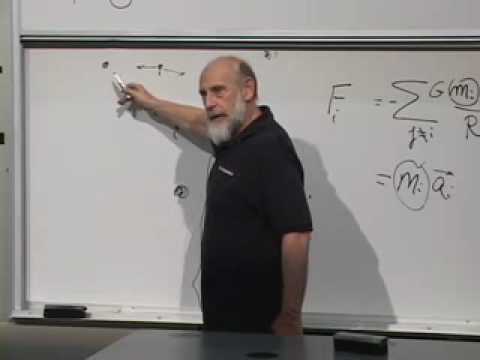
    Via Dmitry Podolsky, a series of YouTube videos from Stanford encompassing an entire course by Lenny Susskind on general relativity. I didn’t look closely enough to figure out exactly what level the lectures are pitched at, but it looks like a fairly standard advanced-undergrad or beginning-grad introduction to the subject. (For which I could recommend an excellent textbook, if you’re interested.) This is the first lecture; there are more.

    Einstein's General Theory of Relativity | Lecture 1

    It’s fantastic that Stanford is giving this away. I don’t worry that it will replace the conventional university. The right distinction is not “people who would physically go to the lectures” vs. “people who will just watch the videos”; it’s between “people who can watch the videos” and “people who have no access to lectures like this.” And Susskind is a great lecturer.

  • Silence is the Enemy

    Sheril at the Intersection has put up a brave post, using her own experience with sexual assault to bring attention to the plight of victims of sexual violence in Africa and elsewhere. She and Dr. Isis are organizing a campaign of bloggers to urge people to speak out, write to Congress, and donate to charities that working to help victims of sexual violence.

    Rape is a problem no matter where it happens, but conditions in Africa have grown desperate, especially in the Congo, Sudan, Rwanda, and Liberia. In Liberia alone, over the course of the civil war, it is estimated that 75% of women were raped. Three out of four. Children are especially vulnerable: in Liberia, 28 percent of rapes involve children 4 or younger. These aren’t typos.

    The numbers are from a recent column by Nicholas Kristof. Sexual violence isn’t about sex; it’s about power and domination, and in this case it’s being used as an instrument of war. And it’s nothing peculiar to Africa; rape has always accompanied war, and was a major part of violence against Muslims in Bosnia, not to mention Japan’s invasion of China. It’s an ancient tradition; as the Bible says in Zechariah 14:2:

    For I [God] will gather all the nations against Jerusalem to battle, and the city shall be taken and the houses looted and the women raped.

    Here is Kristof’s report on Jackie, a 7-year-old girl who was raped by a security guard at her school.

    As Kristof says,

    The evidence is overwhelming that the best way to deal with rape — whether in Darfur or Liberia, or even in the United States — is to demystify it, dismantle the taboos, and address it directly.

    Let’s do that.

  • Leave Nature Alooooooone

    This might be my favorite Atrios post ever:

    Exciting Maps With Lots Of Colors

    Play around with maps at the H&T Affordability Site. Not very surprisingly, people who live (for example) in the city of Philadelphia drive less and have lower vehicle carbon emissions per household. Though not surprising, there is a weird tendency to equate environmentalism with being near nature when in fact the enviornmentalist thing to do is LEAVE NATURE ALOOOOONE and live a modestly-sized place in an urban hellhole with decent mass transit.

    (via the overhead wire)

    Though I live car free in my urban hellhole because I don’t need a car and like my urban hellhole, not because of environmental concerns.

    Sadly my own carbon footprint is presumably enormous, even though I live in an urban hellhole, because I drive an aspirational vehicle and fly around the world a lot. If I were prone to feeling guilty about things, I’d definitely feel guilty for that. But I make up for it by giving talks in Second Life, so I’m pretty sure everything is balanced.