Author: Sean Carroll

  • How To Get Tenure at a Major Research University

    [Update: added a couple of useful points.]

    This is the time of year when prospective graduate students are visiting different universities, deciding where they will spend the most formative years of their scientific lives. Amidst the enthusiastic sales pitches, I try to make sure to remind everyone that the odds of success are long — there is a bottleneck that shrinks as you go from grad school to postdoc to junior faculty to tenure. Probably the biggest hurdle is the leap from postdoc to junior faculty; it’s easier to get tenure once you’re a professor (statistically speaking) than to become a professor in the first place.

    But it’s not guaranteed! As many of you know, I was denied tenure myself. This actually puts me in a pretty strong position to talk about the ins and outs of what it takes to succeed, having seen lack-of-success (is there a word for that?) up close and personal. I’ve avoided talking too much about this topic, partly because armchair psychologists have trouble resisting the temptation to take anything general I would say and attempting to match it to specific people and aspects in my own case, despite a pretty thorough lack of familiarity with the facts. On the other hand, maybe I can offer some actually useful guidance to people who are trying to do something difficult and important for their future lives.

    So here goes: how to get tenure. But first, caveats. My own experience from grad school on has been at top research places, so those are the only ones I can speak usefully about; the situation will generally be very different at places that put more of an emphasis on teaching, for example. So really I’m talking about places that think of themselves as being in the top 10 or so in their research fields. And of course, to every set of rules there are exceptions; it’s not hard to find people who violated one or more of these guidelines, so don’t take them as written in stone. Every case, and every department, is different. Finally, don’t think of these as too bitter or cynical; I’m simply trying to be honest, with perhaps a small slant to counteract some of the misinformation that is out there. (This misinformation doesn’t usually arise from willful lying, but from the slightly schizophrenic nature of the mission of research universities; see The Purpose of Harvard is Not to Educate People.) I’m generally in favor of the tenure system; like democracy, it’s the worst system out there, except for all the other ones that have ever been invented.

    With all that throat-clearing out of the way, let’s get down to brass tacks. Here is the Overriding Principle: what major research universities care about is research. That’s all. Nothing else. But even once you recognize that, there is still some craft involved in shaping your research career in the right way. This isn’t the place for me to pass judgment on this principle; I’m just elucidating its consequences. This is a how-to manual for the real world, not a roadmap for Utopia.

    You’ll be pleased to learn that there are actually two different routes to getting tenure, so you can choose which one works better for you. The first one is simple to describe, and comes down to a single suggestion:

    • Be a productive genius. This deserves to be classified as a separate technique because, for the small number of easily-recognized true geniuses out there, the rest of the suggestions below are beside the point. Do whatever else you like, as long as you are revolutionizing the field on a regular basis. It’s worth stressing the word “productive,” though. The trash heap of history is littered with geniuses who thought it was beneath their dignity to actually produce anything; that won’t fly, generally speaking, in this game. So if the genius thing is working out for you, great; just be sure to put it to productive use, and you’ll be fine.

    The rest of us schlubs, on the other hand, need a more explicit checklist. So here’s what ordinary people should try to do if they have a junior faculty job at a major research university, and would like to get tenure. (more…)
  • Life Under Dictatorship

    As the fighting continues in Libya, the Gaddafi government has invited foreign reporters to Tripoli, as long as they stay in the Rixos hotel. They are barred from leaving to report on actual events, but occasionally get to hear government statements or get taken on organized tours for propaganda purposes.

    That tightly-controlled system was violated this morning when Eman al-Obeidy, a Libyan woman from the rebel stronghold of Benghazi, escaped from two days of imprisonment at the hands of Gaddafi’s militia. She managed to flee to the Rixos, where she told reporters about her ordeal. According to Obeidy, she was tied up, beaten, and raped by 15 men, who also defecated and urinated on her. She pleaded for her friends who are still in custody, and showed a number of bruises and injuries on her body.

    Being surrounded by international media did not keep her safe, as she was soon confronted by security forces as she told her story. Despite resisting frantically and some attempts at intervention by journalists, she was taken away in a car. Hotel employees sided with the security forces, threatening Obeidy and using knives to hold off journalists who were trying to help her. Soon thereafter, government spokespeople accused her of being drunk and mentally ill, claiming that her story of rape and abuse was a fantasy.

    Here’s a video of Obeidy being taken away. Warning: intense and very real.

    http://www.youtube.com/watch?v=adOYtk_bY60

  • Quantum Smell

    Over on the Facebooks, Matt Strassler points to a BBC story about the role of quantum mechanics in explaining our sense of smell. There aren’t any equations in the article, and I haven’t read the research papers, but the idea seems to be that electrons move from one part of a protein to another part via quantum tunneling. The potential that allows this to happen is only set up if you have the right chemical involved, which is how the protein purportedly “smells” the existence of this chemical. The resulting mechanism is just absurdly sensitive — apparently fruit flies can smell the difference between hydrogen and deuterium (chemically identical, but tiny differences in atomic energy levels from having an extra neutron in the nucleus).

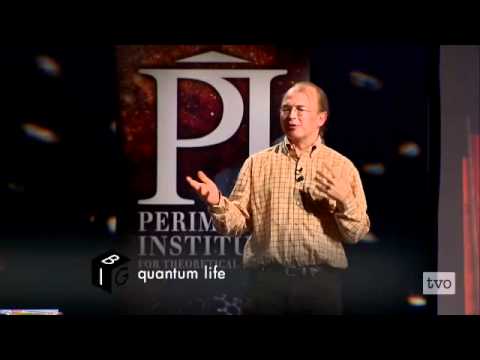
    It’s still a controversial theory, but apparently not crackpotty. The question of how important quantum mechanics (as opposed to just its classical limit) is for biological processes was brought up in our earlier post on quantum photosynthesis. Which reminds me in turn of this worthwhile talk by Seth Lloyd, on the basic topic of “quantum life” and photosynthesis in particular. In between learning about how quantum phenomena might remain relevant in the hot, warm environment of a plant, you can enjoy Lloyd’s principled stance not to use PowerPoint under any circumstances.

    Seth Lloyd on Quantum Life

  • Busted

    Loyal reader Mandeep Gill points out that I wrote “prevarication” when I clearly meant “equivocation” in the consciousness post. It’s now corrected. Very annoying, as I do like to use words to mean what they’re supposed to mean. I think I have a pretty good track record with “begging the question.”

    While I have your attention, fellow loyal reader Richard O’Connell points us to a poem relevant to that post: Robert Browning’s Caliban upon Setebos. It begins:

    ‘Will sprawl, now that the heat of day is best,
    Flat on his belly in the pit’s much mire,
    With elbows wide, fists clenched to prop his chin.
    And, while he kicks both feet in the cool slush,
    And feels about his spine small eft-things course,
    Run in and out each arm, and make him laugh:

    There’s a lot more.

    Also! Flip Tanedo points out that Brian Hill’s transcription of Sidney Coleman’s lectures on quantum field theory have finally been LaTeXed (pdf). Thanks to Bryan Gin-ge Chen and Ting Yuan Sen for undertaking this thankless task. I took that course a couple years after the notes were made, and every student in the class had a photocopy. Yes, Sidney did gripe a bit that nobody laughed at his jokes any more because they had all read them in the notes.

    That’s all I got right now. Just trying to lower the bar so our co-bloggers will be encouraged to contribute more frivolous posts.

  • The Radio Spectrum

    At every point in space, there is something we call the “electric field.” It’s a tiny vector, a quantity with a magnitude and a direction. If you want to measure it, just put an electron at rest at that point, and watch it start moving. The direction and size of its acceleration (over and above what we get from gravity) is proportional to the electric field. Typically, if you watch closely enough, you’ll see our little electron jiggle back and forth like mad. That’s because the electric field doesn’t just sit there; we are surrounded by an extraordinary superposition of all kinds of electromagnetic waves, pushing by us with different amplitudes and directions and frequencies. If you build the right type of gizmo with an appropriate collection of electrons, you can pick out just a single wavelength from amidst the cacophony. Voila! You are listening in on the electromagnetic spectrum.

    In the modern world, there are an awful lot of devices out there communicating by shooting electromagnetic waves at each other. In particular in the radio frequency range (roughly between 10 kHz and 300 GHz), which has the nice property that its waves aren’t blocked by annoying things like walls or air. This means that everyone building such devices wants to produce waves at some part of the spectrum, and that in turn means that the right to do so is an extraordinarily valuable commodity. In the US, the Federal Communications Commission gets to decide who can do what at various different radio frequencies.

    This state of affairs has come into the news once again, as wireless carrier AT&T has swallowed competitor T-Mobile; many people would be unsurprised if Verizon counters by swallowing Sprint, leaving us with a duopoly and possibly giving consumers the squeeze. Currently big chunk of spectrum is allocated to broadcast TV, which some are arguing is a waste, since you could stick a lot of mobile data devices in there and everyone has cable anyway.

    All very fascinating, but somewhat over my head. I’m more of a theoretical kind of guy. I just wanted an excuse to link to this gorgeous chart (pdf), showing how the spectrum is currently allocated.

    Click for much bigger and more legible pdf version. There’s a lot going on here; see the zoom-in of a tiny region near 30 GHz:

    Nice to see that there is space carved out for scientific research, including radio astronomy. Those jiggling electrons have a lot of work to do, let’s hope they can keep everything straight.

  • Crawling Into Consciousness

    We’re not very good at defining what “consciousness” is, although we think we know it when we see it. One promising avenue of attack on the problem is to consider how consciousness may have developed over the course of the evolution of life. There’s a great blog post about this by Malcolm MacIver over on our sibling blog Science Not Fiction. He is thinking about an obviously-important event in the history of life — the moment when aquatic organisms first flapped up onto land and starting breathing air, if we may greatly simplify a complicated process — and asking about its consequences for consciousness.

    The idea is one of those deceptively simple ones that makes you wonder why you didn’t think of it all along. The point is: attenuation lengths. In water, you just can’t see very far; your vision becomes blurry after a matter of meters. Consequently, you don’t have much time — maybe seconds — to react to the world around you, whether what you see is prey, a danger, or a potential love interest. So the evolutionary pressure is to “make up your mind” extremely quickly, essentially right away.

    Now imagine you crawl up into the air. Suddenly, you can see for kilometers! Now a different mode of action becomes useful: thinking about hypothetical alternatives. Under water, too much Hamlet-like equivocation would have made you someone’s dinner before long; now, you can ask yourself whether it would be better to duck under a rock, scurry up a tree, or finally take a stand against that big bully.

    The ability to contemplate competing alternatives before making a decision is a crucial part of what we call consciousness. It’s related to another idea I believe I first got from Steven Pinker’s The Language Instinct, although I don’t remember the precise passage: the claim that what really separates the conscious from the non-conscious is the ability to use grammar. In particular, the subjunctive mood, in which we talk about hypothetical futures. (“If I were to go and bring you back some tasty fish, would you let me live?”) Lots of animals can communicate using something like “language,” but the ability to make agreements based on contrary-to-fact scenarios is what separates the shouters from the negotiators. And of course, the ability to contemplate hypothetical scenarios is an important prior step to being able to communicate about them.

    Be sure to read the comments, where man good questions are asked (“What about octopuses?” “Aren’t there senses other than vision?”) and also answered. Malcolm also provocatively tries to imagine what it would mean if we vastly improved our sensory capabilities, which of course technology is doing for us all the time. What’s next after consciousness?

  • Does the Universe Need God?

    I’ve had God on my mind lately, as I’ve been finishing an invited essay for the upcoming Blackwell Companion to Science and Christianity. The title is “Does the Universe Need God?“, and you can read the whole thing on my website by clicking.

    I commend the editors, Jim Stump and Alan Padgett, for soliciting a contribution that will go against the grain of most of the other essays. As you might guess, my answer to the title question is “No,” while many of the other entries will be arguing “Yes” (or at least be sympathetic to that view). I think of my job as less about changing minds than informing — I want thoughtful people who are committed Christians reading this volume to at least understand where I am coming from, even if they don’t agree. Think of it as an elaboration of “Why (Almost All) Cosmologists Are Atheists,” which was a bit breezier.

    Hopefully there is still a bit of time for tweaking the essay before the editors get back to me with their comments, so please let me know if you think I’m getting something importantly wrong. Again, the whole thing is here, but I’m including the final section (minus the footnotes) as a teaser below the fold. In the earlier sections I do more nitty-gritty cosmological stuff, talking about the Big Bang, the anthropic principle, and meta-explanatory maneuvers. In this section I finally evaluate the God hypothesis in scientific terms. (more…)

  • Moral Realism

    Richard Carrier (author of Sense and Goodness Without God) has a longish blog post up about moral ontology, well worth reading if you’re into that sort of thing. (Via Russell Blackford.) Carrier is a secular materialist, but a moral realist: he thinks there are such things as “moral facts” that are “true independent of your opinion or culture.”

    Carrier goes to great lengths to explain that these moral facts are not simply “out there” in the same sense that the laws of physics arguably are, but rather that they express relationships between the desires of particular humans and external reality. (The useful analogy is: “bears are scary” is a true fact if you are talking about you or me, but not if you are talking about Superman.)

    I don’t buy it. Not to be tiresome, but I have to keep insisting that you can’t squeeze blood from a turnip. You can’t use logic to derive moral commandments solely from facts about the world, even if those facts include human desires. Of course, you can derive moral commandments if you sneak in some moral premise; all I’m trying to say here is that we should be upfront about what those moral premises are, and not try to hide them underneath a pile of unobjectionable-sounding statements.

    As a warm-up, here is an example of logic in action:

    • All men are mortal.
    • Socrates is a man.
    • Therefore, Socrates is mortal.

    The first two statements are the premises, the last one is the conclusion. (Obviously there are logical forms other than syllogisms, but this is a good paradigmatic example.) Notice the crucial feature: all of the important terms in the conclusion (“Socrates,” “mortal”) actually appeared somewhere in the premises. That’s why you can’t derive “ought” from “is” — you can’t reach a conclusion containing the word “ought” if that word (or something equivalent) doesn’t appear in your premises.

    This doesn’t stop people from trying. Carrier uses the following example (slightly, but not unfairly, paraphrased):

    • Your car is running low on oil.
    • If your car runs out of oil, the engine will seize up.
    • You don’t want your car’s engine to seize up.
    • Therefore, you ought to change the oil in your car.

    At the level of everyday practical reasoning, there’s nothing wrong with this. But if we’re trying to set up a careful foundation for moral philosophy, we should be honest and admit that the logic here is obviously incomplete. There is a missing premise, which should be spelled out explicitly:

    • We ought to do that which would bring about what we want.

    Crucially, this is a different kind of premise than the other three in this argument; they are facts about the world that could in principle be tested experimentally, while this new one is not.

    Someone might suggest that this is isn’t a premise at all, it’s simply the definition of “ought.” The problem there is that it isn’t true. You can’t claim that Wilt Chamberlain was the greatest basketball player of all time, and then defend your claim by defining “greatest basketball player of all time” to be Wilt Chamberlain. When it comes to changing your oil, you might get away with defining “ought” in this way, but when it comes to more contentious issues of moral obligation, you’re going to have to do better.

    Alternatively, you’re free to say that this premise is just so obviously true that no reasonable person could possibly disagree. Perhaps so, and that’s an argument we could have. But it’s still a premise. And again, when we get to issues more contentious than keeping your engine going, it will be necessary to make those premises explicit if we want to have a productive conversation. Once our premises start distinguishing between the well-being of individuals and the well-being of groups, you will inevitably find that they begin to seem a bit less self-evident.

    Observe the world all you like; you won’t get morality off the ground until you settle on some independent moral assumptions. (And don’t tell me that “science makes assumptions, too” — that’s obviously correct, but the point here is that morality requires assumptions in addition to the assumptions we need to get science off the ground.) We can have a productive conversation about what those assumptions should be once we all admit that they exist.

  • LIGO to Collaboration Members: There Is No Santa Claus

    Ah, the life of an experimental physicist. Long hours of mind-bending labor, all in service of those few precious moments in which you glimpse one of Nature’s true secrets for the very first time. Followed by the moment when your bosses tell you it was all just a trick.

    Not that you didn’t see it coming. As we know, the LIGO experiment and its friend the Virgo experiment are hot on the trail of gravitational waves. They haven’t found any yet, but given the current sensitivity, that’s not too much of a surprise. Advanced LIGO is moving forward, and when that is up and running the situation is expected to change.

    But who knows? We could be surprised. It’s certainly necessary to comb through the data looking for signals, even if they’re not expected at this level of sensitivity.

    Of course, there is something of a bias at work: scientists are human beings, and they want to find a signal, no matter how sincerely they may rhapsodize about the satisfaction of a solid null result. (Do the words “life on a meteorite” mean anything to you?) So, to keep themselves honest and make sure the data-analysis pipeline is working correctly, the LIGO collaboration does something sneaky: they inject false signals into the data. This is done by a select committee of higher-ups; the people actually analyzing the data don’t know whether a purported signal they identify is real, or fake. It’s their job to analyze things carefully and carry the whole process through, right up to the point where you have written a paper about your results. Only then is the truth revealed.

    Yesterday kicked off the LIGO-Virgo collaboration meeting here in sunny Southern California. I had been hearing rumors that LIGO had found something, although everyone knew perfectly well that it might be fake — that doesn’t prevent the excitement from building up. Papers were ready to be submitted, and the supposed event even had a colorful name — “Big Dog.” (The source was located in Canis Major, if you must know.)

    Steinn Sigurðsson broke the news, and there’s a great detailed post by Amber Stuver, a member of the collaboration. And the answer is: it was fake. Just a drill, folks, nothing to see here. That’s science for you.

    When the real thing comes along, they’ll be ready. Can’t wait.

  • Danny Hillis on Richard Feynman

    One more video from TEDxCaltech. Danny Hillis is the founder of Thinking Machines, the Long Now Foundation, and Applied Minds. Touching and inspirational.

    TEDxCaltech – Danny Hillis – Reminiscing about Richard Feynman

    See also Lenny Susskind’s reminiscences.