
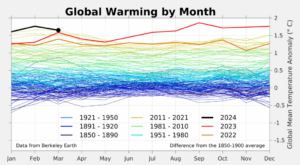
The Earth's climate keeps changing, largely due to the effects of human activity, and we haven't been doing enough to slow things down. Indeed, over the past year, global temperatures have been higher than ever, and higher than most climate models have predicted. Many of you have probably seen plots like this.
Today's guest, Gavin Schmidt, has been a leader in measuring the variations in Earth's climate, modeling its likely future trajectory, and working to get the word out. We talk about the current state of the art, and what to expect for the future.
Support Mindscape on Patreon.
Gavin Schmidt received his Ph.D. in applied mathematics from University College London. He is currently Director of NASA's Goddard Institute for Space Studies, and an affiliate of the Center for Climate Systems Research at Columbia University. His research involves both measuring and modeling climate variability. Among his awards are the inaugural Climate Communications Prize of the American Geophysical Union. He is a cofounder of the RealClimate blog.
Click to Show Episode Transcript
0:00:00.0 Sean Carroll: Hello everyone. Welcome to the Mindscape Podcast. I'm your host, Sean Carroll, and here at Mindscape, which I've been doing now for quite a while. You know, I constantly get suggestions or requests for guests to invite for topics to cover, and I love getting these by the way. Many of the episodes that we've done have been, risen as suggestions from audience members. I get way more than I can possibly say yes to. So if you make a suggestion and it doesn't get followed up on, sorry, don't feel bad about that. There's just a numbers game going on. But one topic that has gotten a lot of requests in recent years is the climate and climate change. And we haven't done a lot of climate change. We have done some, but the most pointedly climate centric episodes that we've done were quite a while ago, Michael Mann, Rames Nam, people like that.
0:00:48.3 SC: And it's not random that hasn't happened. It's sort of my fault. I have a feeling that, obviously, the science of climate change is incredibly interesting. It's very intricate. There's a lot going on, a lot to think about, but there's also a political social aspect to it, which to me is incredibly frustrating. Not because there shouldn't be a political social aspect to it. There's a political problem to be addressed both within countries and internationally. We need to do something about this. But my attitude is that we should all know by now that we should be doing something about that. And it feels a little repetitive and a little frustrating. Just say the same true things over and over again. I didn't wanna fall into that trap. So I'm here to confess that I was completely wrong in that attitude. That was a bad attitude to have.
0:01:40.3 SC: Part of the reason why I changed my mind was because there is something new that was a little bit surprising, namely that over the last year, the temperature of the earth has been even warmer than it should have been according to the climate models. So something is not quite fitting, and that raises a new scientific question. So I finally said, all right, let's, it's time to figure this out. Learn something. And Gavin Schmidt, who is today's, podcast guest, is the perfect person to talk about these kinds of things. Many of you will have heard of Gavin before. He's not only a very respected climatologist director of NASA's Goddard Institute for Space Studies, Co-author of the various IPCC reports, et cetera. But he's also active in public engagement, which is very, very important, more important for climate scientists to do than physicists or philosophers, let's put it that way.
0:02:31.3 SC: The Real Climate Blog is one that he and a group of friends founded. I learned by talking to Gavin before today's episode that Cosmic Variance, which was the group blog that I was a part of for a while, was one of the inspirations for Real Climate starting up. So I thought that was very nice. But they're still going strong. You can still follow them and check them out. So anyway, Gavin is not only very knowledgeable about these things, but incredibly articulate at explaining what is going on and keeping interest high, and I think hitting the right notes of giving us insight into the science while nudging us in a productive direction in terms of policy and politics and things like that. So I think, you know, again, I was wrong. My fault, long overdue. This episode, I think this is gonna turn out to be one of the best episodes of Mindscape that you will listen to.
0:03:22.7 SC: Occasional reminders, if you like Mindscape, you can support the podcast at patreon.com/Seanmcarroll. Drop a buck or two for every episode of the podcast. You get a warm and fuzzy feeling. Also add free versions of the podcast and the ability to ask questions at monthly AMAs. And it's just a good thing to do. You should support good things that you like at a relatively low level of cost. I think overall, I think it's worth it in an hour podcast every week. Anyway, with that, again, I think that this is a great discussion of some super important topics in a very clear way. And we get in a bit sciency in here. There's some isotopic abundances that we're gonna dig into. So let's go.
[music]
0:04:21.2 SC: Gavin Schmidt, welcome to the Mindscape Podcast.
0:04:23.7 Gavin Schmidt: Thank you very much, Sean. Good to be here.
0:04:26.0 SC: So the climate, how's that going? How's the climate doing these days?
0:04:30.5 GS: Well, [laughter], let me tell you. So it's totally abundant to anybody who ever sticks their head outside that the climate is changing. We are seeing in all the data sets, in the temperatures on the land in the ocean. We're seeing it in the ice. We're seeing it in the sea level rise. We're seeing it in the change of weather extremes. The intensity of rainfall, the heat waves, the change in the plant hardiness zones, that are moving upward and poleward on a maybe decadal basis. Not quite every year, but on a decadal basis. New York City where I live is now subtropical, it turns out. And it didn't used to be. But so that makes a difference to what you're planting.
0:05:22.5 GS: It makes a difference to what you're seeing. It makes a difference to the pests that you get. And we're seeing changes in... You know, I could go through the litany of stuff that, that people have seen. But it's everywhere. And the evidence for that change is everywhere. And, if that's all there was, it would be, "Oh, well, that's interesting, what's going on?" But it isn't all that's going on because we actually understand why it's changing. And we have been predicting why it was going to change, why it is changing, and why it will continue to change for many decades now. And we have been doing so successfully. And the answer is da duh, it's us. And it's our emissions of greenhouse gases, notably carbon dioxide, methane, carbon the CFCs, changes in ozone, changes in nitrous oxide. It's a whole list of things that we're doing. Deforestation the evolution of various sorts. We are now very clearly a geophysical force, and our imprint on the system is comparable to almost the biggest things that have happened in the last 65 million years. And down...
0:06:55.8 SC: One of the complaints, There are doubters out there. We're not gonna give them too much airtime, but there's a lot of people who want to throw up reasons to be skeptical of the whole climate change story. And one for a long time has been, "The climate is really complicated. It's a very complex system. It's very hard to model. How do we know what's gonna happen?" And to be honest, I'm interested in your perspective on this, I never quite bought that argument, but I wouldn't have been shocked. The climate is very complicated. There are a lot of...
0:07:27.6 GS: Absolutely. Yeah.
0:07:29.2 SC: It is amazing how well you folks have done in modeling it. It seems like a very hard thing to do.
0:07:37.1 GS: Yes. And this is something that is, this far, I think, well-appreciated. We've been doing climate modeling at a serious level for since the beginning of the 1980s, so that's over 40 years. And the amazing thing was... And at the beginning, nobody thought it would be useful. The climate is too complicated. Look at all the weather. Look at all the details. Everything is. There's so much heterogeneity. You're never gonna be able to get something on the global scale, regional scale that is gonna be anything other than academic. But the fact of the matter is, is that a lot of that noise cancels out. A lot of it is just, in fact, noise. And you can extract the signal from that noise in models relatively easily, and then in the data, there's a little bit more noise, and so it takes a little bit longer to come out in the data, but you can see it. And it turns out that that signal is in fact, far more robust to the details than we really anticipated 40 years ago.
0:08:53.2 GS: And so the climate is complex. I dunno if you ever saw my TED talk, but that's how we start. The climate is enormously complicated, and you can see so many different feedbacks and interactions between the clouds and the particles and the ocean and the land. And it is very hard to keep track of. But the models that we have created, even the first set of models that we created 40 years ago, have managed to skillfully predict what happened in the global mean temperatures, in the pattern of temperature change, in the rate at which we were warming, and the impact on rainfall and things like that. They didn't get everything right. We still struggle with getting the sea level projections right, because you need to include the ice sheets and the dynamic ice sheets and underneath the ice sheets and all of the other things that happen to water. That's still very much at the cutting edge. We haven't been able to successfully predict when the tipping points of rainforest systems are, when you have deforestation and drying, and when do they not work anymore. We don't know that. So there are still detailed, complicated questions that we're still working on. And we can get to perhaps some of the ones that are relevant for exactly what's going on right now, 2023, 2024, a little bit later in the talk.
0:10:38.7 GS: And so there are very much open questions. But the big question, the big issue, like, why is it different now to what it was 100 years ago? It turns out that the answer that we came up with 40 years ago has stood the test of time and is not going away.
0:10:56.1 SC: And I definitely do wanna get into the modeling, especially, 'cause that's just a fascinating scientific subject, but let's be good empirical scientists and talk of the measuring a little bit.
0:11:06.0 GS: Absolutely.
0:11:06.1 SC: So my most basic question is, What does it even mean to talk about the temperature of the earth or the atmosphere? I mean, the temperature here in Baltimore is not the same as the temperature in Oslo or in Cairo. So how well-defined is that? Is that something that is a good guess, we all agree? Is there a dispute about what it means?
0:11:29.8 GS: Well, no. Temperature is a three-dimensional field, and I can average it over any two-dimensional surface I want and I can get a number. Now, the question is, is that meaningful? So the issue is not, can I define a global mean temperature? The issue is, is that meaningful? And you might think that it might not be very meaningful because, well, all of these things are non-linear, and so it matters that somewhere is a little bit warmer and somewhere is a little bit colder, and that doesn't give you quite exactly the same thing as if everybody was at the same temperature. And that's a valid point, but it turns out that it's a pretty small point.
0:12:13.3 GS: The heuristic model that we have of the climate where the sun brings the energy in, the infrared goes out, and that's mediated by effectively the surface temperature, it actually works pretty well. It helps explain, not everything that you're seeing, but it does help explain the bulk issues. And that's why those early models were so successful, because they didn't do very much else other than chop the world up into quite large boxes and average those together. And so as we've gone to more and more detail, as we've allowed for more and more of those non-linear interactions and more and more details and more and more complexity, it turns out that those average heuristics that we started off with, they're still pretty valid.
0:13:10.5 SC: Yeah. Again, there must be a explanation for why we should have thought 40 years ago we'd be doing this well. Is there some ex post facto way of thinking that we were too worried about non-linearities or Chaos theory or something, or is that...
0:13:27.7 GS: Oh, no. It's not that we don't think that Chaos theory is valid. It totally is. And so but it's a question of how much of the shift that we see in inter-annual temperatures or whatever measure that you want to look at is is rated to wherever you are on the attractor and where that attractor is in space, right? So there's effectively two things, and I think some people get caught up by thinking that we're just on that attractor, and we're just going around and around and around, and people can visualize the the Lorenz Butterfly and you say, "Okay, well, how can we ever know anything?" But the climate problem is not working out where you are on the attractor. It's where that attractor is in face space.
0:14:22.1 SC: Yeah. Okay.
0:14:22.9 GS: Right. And it turns out. I'm sorry.
0:14:27.0 SC: Some overall kind of well-defined point, right?
0:14:30.3 GS: Yeah. Yeah. And so how much of the climate changes that we've seen are that attractor moving? And how much of it is like, kind of within the wheels? And it turns out that almost all of the change that we've seen is because that attractor has shifted not because what we don't know quite where we are on that attractor.
0:14:53.7 SC: Okay. When we compare, when we say that it has warmed, the average temperature has gone up. Obviously, in the past, we're using different methods to measure the temperature. So that's the thing. I mean, for you personally, like what is the most relevant thing us compared to 100 years ago, or 1,000 years ago, or 100,000 years ago, and how, what is the, I presume it gets less and less certain as you go into the past.
0:15:18.7 GS: Sure. And so let's take that view and, go back in time. So we have great data back to 1979, which is really the beginning of the satellite year. I work for NASA. We're very proud of the satellites the contribution the satellites have made, but they really make a step change in how much stuff we knew.? And that started in the 1960s with the Teros satellites. But anyway, but, but 1979 is really the starting point for comprehensive satellite measurements to what's going on. Okay? Before 1979, we have instrumental records on the ground. And that takes us back to the middle of the 19th century. So we had temperatures on boats, we had temperatures in weather stations.
0:16:04.8 GS: And there's less and less as you go back in time, but you can get back to the mid 19th century without too much uncertainty. After that, it starts to get a little bit [0:16:16.0] ____. And you need to use alternative methods. And so people have been working on this for many, many decades. If you want high resolution data, right? So that you have data that tells you what's happening every year, every season you have to look at things like corals in the tropical areas. They have layers just like trees. Trees have layers. And so you can extract temperature signals from both of those. Caves like Stalactites, stalagmites, I think we use stalagmites.
0:16:53.5 GS: It's not Stalactites. So we you know, they have layers. We can date those layers very precisely. We can go back even further. But yeah, I mean, it's probably we have ice cores. The ice cores have annual layers until about 50,000 years ago. Something like that. You can count individual layers. So there is a lot of data there that comes from a lot of different parts of the world. But, you're right. I mean, the further back you go, the more uncertain it gets balance that though, the further back you go, the bigger the signal gets. And so the signal to noise ratio for a lot of stuff that happened in the past is actually pretty comparable to what we can detect even the last a hundred years, right?
0:17:40.1 GS: So you go back to go back 20,000 years. So you are in Baltimore 20,000 years ago, that was a tundra coastal plane where you are now, you would've been in maybe a hundred miles from the coast. And it would've been mammoths and various tundra like things where I am. We would've still been under the ice sheets maybe a kilometer of ice on Manhattan. Now, ice sheet obviously stretched from oddly enough, Brooklyn all the way to the Arctic Circle. And that was a huge climate difference from the, lay Holocene that we kind of grew up in as a society. And that was about some what, who, what audience are we talking to? Do I just, do I have to convert everything to Fahrenheit? I can't [laughter]?
0:18:37.0 SC: No. You can, and we're gonna trust the Mindscape listeners out there to plug in if they need to.
0:18:43.0 GS: Okay. Okay. So anyway, it's about five to six degrees Celsius colder. In the last a hundred and so years, we've warmed about one and a half degrees Celsius. So the uncertainty on that one and a half degrees is about 0.1, 0.2 degrees, right? So let's say a 10% noise compared to that signal. The uncertainty in the last glacial maximum temperatures is maybe a degree, right? So maybe it was six degrees, maybe it was four and a half degrees, maybe six and a half degrees, right? So it's about a degree out of that five. So that's about a 20% era. So we can go back and we can still see those large signals because they are large, right?
0:19:35.5 GS: So if we go back even further, we can go back to the Pleistocene before the [0:19:40.4] ____, before the glaciation really kind of kicked in. And we have reasonable estimates of the temperatures there. It's about three degrees warmer than pre-industrial. We can go back to the Cretaceous, even larger signals, dinosaurs flying around everywhere, Theropods probably flying anyway, dinosaurs everywhere. And a warming of maybe eight degrees Celsius above where we were in the pre-industrial. So, we can see those things and we can understand them. And then people will read our, like I say, all see climate change before and that's always a little bit amusing because you then ask them, well, so did the sea level, what was the sea level like in the Cretaceous, do you think?
[laughter]
0:20:29.5 GS: And for our listeners, it was about a hundred meters higher than it is today. So.
0:20:34.0 SC: 'Cause we would not like to have nothing again. Yes. But I know this is kind of obvious, but just so it's on the record here, the rate at which things are changing now, and for, like you said, reasons we a 100% or 98% understand, let's say, it has no analog in the historical fossil record.
0:20:56.7 GS: No, I don't. So we don't know quite how fast everything changed in the geological past, right? So that's one of the things that you lose is the ability to say, this took 20 years, this took 10 years. But compared to those large signals that I was talking about, so the warming out of the last ice age took 10,000 years to warm five degrees, and we've changed 1.5 degrees in the last a hundred. So that's quite a bit faster. Obviously, there's one thing that happened in the past that we're absolutely certain took no time at all effectively which was the KT impact. And we have records there of the day in the spring when that when that asteroids hit, which is insane, but anyway, that was very fast. But obviously most things in geological class didn't happen that quickly.
0:22:12.4 SC: Also, like with the sea level rise, that was pretty bad when that happened. You don't wanna say...
0:22:18.2 GS: That was bad. Yes. That was probably the worst day in the last a hundred million years, I would say.
0:22:24.2 SC: That is fair enough. And one of the things that I've learned from my very superficial reading about climate change and so forth, is that it's not just the atmosphere, right? The water temperature is hugely important. So can we get reliable estimates of what the water temperature was in the past?
0:22:40.4 GS: Yeah. So that's actually one of the real success stories of Paleoclimate has been able... Has been the ability to pull that out. And there's a couple of things there that kind of tie back into some of the things we've said already, which is how big is the signal? How big is the noise? One of the first things that people started looking at once they understood kind of post-war understanding of isotope systematics, right? People invented mass spectrometers, and they were able to, for the first time measure the ratios of isotopes of different elements in different substances. And one of the things that Harold Urey, who won the Nobel Prize for chemistry, for his work on this, he was looking at deuterium and Oxygen-18.
0:23:30.5 GS: All right. So deuterium is heavy hydrogen, a stable isotope, right? Oxygen-18 is a stable isotope of Oxygen. Most Oxygen is Oxygen-16, most hydrogen is standard hydrogen. And it turns out that the ratio of those two things in water changes pretty dramatically, depending on whether the water evaporates, whether it condenses in which pool it's in. And so it's a really good tracer of how water moves around in the system. And then it turns out that there's a fractionation, it's temperature dependent as well. And so if you look at things that form from water, particularly shells carbonates so that's CaCO3, right? The O there comes from the water, and the ratio of Oxygen-18 to Oxygen-16 in that Oxygen there actually reflects the water that the carbonate was formed in, plus a temperature signal.
0:24:34.5 GS: And people took that in and they said, okay, well, let's see if we can find carbonate around the world. And in the '90s and '50s... 1950s and '60s, as they were kind of really just kind of exploring the ocean, they didn't know about the mid ocean ridges at that point, that was a new discovery. They would drop cores and then pick up mud. There was a boat here at Lamont-Doherty, and the goal was anytime you stop for anything, take a core sample just in case.
0:25:03.1 SC: Good.
0:25:03.9 GS: And they ended up building this repository of data from the ocean's bottom, the mud in the ocean bottom, and you're saying, well, what's that good for? And it turns out that there are little single celled foraminifera that have carbonate shells that exist through time. And you can just, like in the ice cores, you can go back in time and you can analyze that ratio. And it turns out that it doesn't matter where you are in the ocean, you see something that looks very similar. You see this kind of like flat bed at the beginning, that's the Holocene. It goes up, but in temperature wise, it goes down into the Last Glacial Maximum, bounces around a bit, pops up again, a hundred thousand years earlier, goes back down, pops and then goes back in time. And as they put those things together, they started off with like about a million years worth of records, and they found out, oh, everywhere you go, it's the same thing. And putting that together with the theory for why the glaciations happened, which was developed by a physicist called Milanković, who had some spare time while sitting in a Serbian jail in the 1920s to calculate all these things, he calculated all of the changes in how much of the sun's energy was coming in as a function of the wobbles in the earth's orbit.
0:26:35.2 GS: This is before the days of mechanical calculation, it was very laborious, and it took him a number of years. But apparently, he had the time to spare.
0:26:47.3 SC: Long time this, yeah.
0:26:49.2 GS: And that was a hypothesis for why the climate would change. And for a long time, it didn't seem to fit. For a long time, the dating seemed wrong, but it turns out that it was the dating that was wrong. And when people got good at the dating, and then once they put together this stack of records from everywhere around the oceans, it was abundantly clear that he was spot on. And there's a hundred thousand year cycle, there's a 40 year thousand year cycle, there's a 19,000 year cycle, and put together, those of pace, have been the pacemaker of the glacial periods and the glacial-interglacial variations for at least the last 3 million years. And so that was a huge triumph of that kind of empirical science.
0:27:38.4 SC: Yeah. So you emphasized that measuring these water temperatures at different points, at different places around the globe gives you a consistent story. And I'm presuming the story that you get is also somehow consistent with the atmospheric temperatures.
0:27:52.6 GS: Yes. So this is before anybody had the ice core. So the ice cores kind of came in the early '90s. So people were very excited that there'd been some early ice core work in the 1980s, which kind of said, Ooh, something... We can see something interesting there. But that wasn't really done to the level that was required until the 1990s. And there, there were a number of efforts in Greenland, and there were a few efforts in Antarctica that gave extremely complementary and coherent results. In Greenland, they go back one glacial cycles, so they go back about a 120 thousand years. But in Antarctica, and now they've gone back almost a million years, and you can see these ups and downs of the glacial cycles and the greenhouse gases, right? That was the new thing that the green, that the Antarctic ice cores gave was the bubbles in the ice itself. We were able to measure how much greenhouse gas there was in each of those bubbles, which is incredible, right? And so, we get this beautiful record of the temperatures and the Carbon dioxide, the temperatures, and the Carbon dioxide which have gone hand in hand together until very recently, over the last three million years.
0:29:20.9 SC: Because when you say the phrase greenhouse gases, just so we're clear again with the audience, that doesn't mean created by human beings necessarily. There are gases.
0:29:30.1 GS: No, no, no, no, no, no, no. Yeah, so greenhouse gases in the rain are natural, right? So our planet is much warmer than it would be if it was a ball floating around in space for that, in the atmosphere because of the the heat trapping properties of small constituents in our atmosphere, but big deals in terms of the climate, right? So, most of our atmosphere is made up of nitrogen 78%. And I'll tell you a good story about why it's important to know that, maybe later on. 21% Oxygen, small smattering of Argon and things, it turns out that the Nitrogen, Oxygen and Argon are almost totally inert with respect to infrared radiation, so they don't absorb or emit any infrared radiation. So they absorb and emit the higher frequencies.
0:30:19.1 GS: But there are some gases and other substances in the atmosphere that absorb in the infrared. And the infrared is important because that's the temperature that the planet is emitting. And so if you absorb in the temperature that the planet is emitting, then you can make a difference. And so water vapor, which is triatomic, H2O Carbon dioxide triatomics, CO2, right? Methane, five atoms, all of these slightly more complex atoms have vibrational modes that absorb in the infrared. And that's what makes them greenhouse gases, and that's why they are so useful at keeping the earth's planet, the earth's surface much warmer than it otherwise would be.
0:31:02.6 SC: Okay. You gotta tell us an amusing story about why the abundance of nitrogen in the atmosphere is so important.
[laughter]
0:31:10.0 GS: So let me tell you, four decades of my life, I spent learning totally obscure facts about science and the earth. And they never came in handy until one day I am sitting in a bar, and there's a cute girl just next to me at the bar, and I had positioned myself so that I was being next to the cute girl. But I was chatting to the the bartender, but anyway, she turns around and asks me, "Do you know the primary composition of air?" And I said, "Yes. Yes, I do." [laughter] And so I said, "no, it is Nitrogen, 78%." And at which point she kind of went white and then, and turned back to our conversation. And it turned out that she had been trying to demonstrate to her conversational partner that nobody knows anything about science, and that this, I'm gonna prove it by going to this random person sitting next to me, and they're not even gonna know the first thing about the primary composition of air. And that was the beginning of a big conversation and blah, blah, blah, blah, and she's now my wife, so.
0:32:23.3 SC: Oh, that's very good. I was hoping we didn't know.
0:32:23.6 GS: Yes, no, of course, yes. Yeah.
0:32:26.6 SC: She turned white at first, but okay, she overcame that.
0:32:30.2 GS: Yes.
0:32:30.7 SC: Okay. One loose thread here is, I would kind of like to understand just a little bit better why the ratio of Oxygen-18 isotopes to Oxygen-16 isotopes depends on the temperature. I'm literally just the dumb physicist here. They're just isotopes. Why do they care what the temperature is?
0:32:48.8 GS: Well, so they don't, but you have to think about the water cycle on the planet. So where does water come to and go from in the atmosphere, right? It mostly evaporates in the subtropics, right? So kind of just north of the equator or just south of the equator. And when you evaporate water, it's much easier to evaporate lighter atoms, right? So when you evaporate water, you leave behind the Oxygen-18s, and you have more Oxygen-16s, right? So the ratio of 18 to 16 changes when you evaporate the water, okay? And now that water, where does it go? Well, effectively, it kind of moves north and you've got this export of water vapor towards the high latitudes, towards the poles.
0:33:36.3 GS: And as it gets further towards the poles, it gets colder. And as it gets colder, it rain... More of that water rains out. There's a lot more humidity in the tropics than there is in the mid-latitudes, and certainly as there is in the poles. And so as you rain that water out, what rains out first, the heavy atoms, right? So the Oxygen-18 gets more and more depleted. And so by the time you get to the snow that's falling in Greenland, you have much less Oxygen-18 than you started with. And it turns out that if it's a little bit warmer, you have a little bit more, and if it's a little bit colder, you have a little bit less. And so, if you measure the Oxygen-18 to Oxygen-16 ratio in that snow, that it becomes the ice that goes down through the ice core, when there's more Oxygen-18, it was warmer, and when there was less Oxygen-18, it was cooler. And you can calibrate that against a number of of different other ways of doing it. And so you can actually end up with this paleothermometer that is not perfect, but really quite good. Now...
0:34:47.5 SC: I'm sorry, keep going.
0:34:49.5 GS: Yeah. So, but that's not the only place where you're recording these isotopes, right? So I mentioned carbonates in foraminifera which are small plankton, but also in cave records, caves are carbonates as well. And it turns out that when you form carbonates, you take the Oxygen. So carbonate is formed when you have... Carbon dioxide dissolves in water, and it forms dissolved aqueous Carbon dioxide, carbonate, bicarbonate. And then when you want, if you are a creature, or if you're a cave record or a Stalagmite, you condense out the carbonate but the Oxygen came from the water.
0:35:32.8 GS: And as you do that, again, it's slightly easier to take the heavy Oxygen and make it into a solid than it is otherwise, and that's temperature dependent. So there, if the temperature is high, you get a little bit more Carbon-18 than you would do otherwise. So it's actually the opposite sense than in the ice cores. But in practice, it allows you again, to go back in time and to derive a paleothermometer that has other things going on. Particularly, the total amount of ice on land also changes the oxygenating content of the of the ocean. But effectively, it gives you a temperature signal. My kind of entry into climate modeling was really to try and simulate the interaction between those things.
0:36:35.7 GS: So how could you look at the Paleo record and instead of trying to invert those records and try to work out what went on, could you forward model the kinds of things that you would be measuring? So could you include the isotopes in the climate models, so that when the climate changed, it would tell you what the isotope signal should be, both on the land and in the ice cores and in the ocean? And that was really kind of my gateway drug into global climate modeling and the complexities of it. 'Cause it turns out that, that's actually a very big job. And I think it took us about eight years to be able to do the first coupled simulation of the full Oxygen-18, the Oxygen isotope climate record in a model. And I did not think it was gonna quite take quite that long, but it did and it worked out.
0:37:38.0 SC: Stories like that just remind me in a very nice, romantic way of how awesome science is. I mean, there's so many moving pieces in what you just talked about, and they all come down to the laws of nature being obeyed, and they work and you can test them, and they're robust, and we human beings can kind of mostly figure it out. It never ceases to amaze me.
0:38:01.9 GS: Well, I don't know if we can mostly figure it out. We've been able to figure out some things, and the fact that we've been able to figure out anything is remarkable.
0:38:09.1 SC: Fair enough.
0:38:11.5 GS: But a lot of times, we spend our time looking underneath the street lamp and not in the dark and so it's not quite clear what we're not seeing, but where we can see things. We have been successful at doing so, and we continue to push that zone of illumination, if you like, about the natural systems.
0:38:31.3 SC: Well, I have the luxury of being able to take the cosmic view over which all of human history is very short. You actually have more urgent things going on. So you want the rate of progress to be a little bit faster. So, let's, on that note, think about these models that we were talking about before. Everyone has probably seen some two dimensional diagram of photons sitting in the atmosphere and being captured by the greenhouse gases you already talked about. I take it that the models you get professionally paid to think about are a little bit more complicated than that. I mean.
0:39:05.0 GS: Yes.
0:39:05.6 SC: You give the audience like a, just a feeling of what are the elements that go into these? What do the modelers have to keep juggling in their codes and their heads?
0:39:16.4 GS: Oh, yeah. So, let's start at the source. So, the sun is the source of 99% of the energy that comes through the system. So you start off with that. Well, what does that look like? Well, it's spectrally interesting. So it's mostly in the visible, but there's a component in the near infrared, there's a component in the UV.
0:39:38.8 GS: That comes in. How does it interact with the atmosphere? Well, the atmosphere is made up of lots of different things. It has, we mentioned water vapor and greenhouse gases and ozone and clouds and small particles which can be absorbing or reflective or scattering or a little bit of all of them. And so you have to track what happens to that ray of sun, and it has to be broken up into the spectral bands. It has to interact with all those different things. One by one, there's a lot of what's called photolytic chemistry. So there are reactions that happen just because there are photons that come in and make that reaction happen, particularly in the stratosphere. And so you have to include that. And now you have to, obviously, you need to keep track of, well, where is the sun?
0:40:29.7 GS: And, well, the earth is rotating, half of it is in the dark, half of it is in the light. You have to keep track of where everything is. What happens at twilight. Some things are kind of chemistry wise. Twilight is a very interesting time. You have to include all of those things. Okay. Then now, this sunlight kind of reaches the ground. While some of that reflects because there's snow, some of it gets absorbed because the ocean is dark or the land is not quite as dark, darker. And then, that temperature changes and now you have to go back up again. Well, okay, so this is, everything down here is radiating in the infrared depending on its temperature, have to calculate that. Then you have to do those, all those calculations going back again, with what gets absorbed in the infrared.
0:41:15.6 GS: And so that could still include the clouds and could still include the atmospheric particles. It can still include the greenhouse gases. And finally, some stuff gets out. Okay, you say, okay, but like now that's set up a whole bunch of different things inside. So, those temperatures have set up gradients. They influence the winds. And so now we have to solve the equations of motion. Effectively the oiler equations. There's a little bit of navier stokes near the surface, but basically the oiler equations in the bulk of the atmosphere. But then that leads to upward motion and downward motion, and that leads to changes in the surface fluxes, which brings water into the atmosphere. And then that water condenses. And, okay, well now that's a cloud. How does the cloud interact with all those little particles?
0:42:01.2 GS: And what's the chemistry on the cloud particles? What's going on inside the clouds? How does that change the reflection or the absorption? And so you just keep on going? That sounded complicated, but I haven't even started.
0:42:14.6 SC: No, we're close.
0:42:16.9 GS: And so you try and do your best, you kind of chunk up the atmosphere so that you're not doing that, with every tiny little point, you're doing it on a kind of column that is maybe 25 kilometers by 25 kilometers, you can do higher resolution, but it starts to take much more time. And that makes it a little bit easier. A lot of the physics is just vertical. So, the radiation you can think of as just being a vertical process, to very good order. Convection is also just a vertical process. So there's a lot of things that you can do in the column that allows you to be quite efficient about how you solve the equations. So you can have each, each column like sits on a different processor, and so you can do lots of things at the same time, and then they interact via the winds and the waves and those kinds of things.
0:43:11.4 SC: Do you ever talk to astrophysicists who study stars or supernovae is relatively similar sort of spherically, symmetric, but not quite college hydrodynamics and energy transport going on?
0:43:23.6 GS: Yeah. They have a, so they, in some ways it's more complicated. In some ways it's simpler. So they have to deal with magneto hydrodynamics, which we don't really have to worry about. And it's a lot harder to get direct information from the middle of the sun, than it is to get information from the middle of the atmosphere. So I think we have some advantages on earth, and I think probably that's why we're a little bit ahead of the game in terms of making useful predictions.
0:43:51.4 SC: You said that the sun is almost all of the energy, input there.
0:43:55.6 GS: Yes, sir.
0:43:56.0 SC: What are the other things that matter? I mean, when I drive my car, obviously, if it's a gas guzzler, then that's something. But does the heat generated by the car matter? Does the heat generated by cities or for that matter volcanoes matter to the budget?
0:44:11.4 GS: Not very much. So the heat generated by volcanoes is part of the whole geothermal flux. So that's generated effectively by, there's a little bit of residual heat from the formation of the of the planet, but mostly it's generated by radioactive decay. But that's a pretty small number. It's about, well, it's about 0.05 watts per meter squared. And you are comparing that to the average, absorb solar radiation of about 240 watts per meter squared. So it's three or four orders of magnitude, too small to worry about. But you do you, I mean, it's not, you do need to include it, right? Because that's what part of what sets the temperature profile underneath an ice sheet or in the soils, right? So you need to include that. It's a small term that changes the temperatures, right along the mid ocean ridges and things like that as well.
0:45:13.6 SC: And go ahead.
0:45:15.4 GS: Yeah and then there are, you mentioned, the waste heat component. So we use about 15 terawatts of energy as a society. So that's everything, the renewables that we capture, the coal that we burn, the trees that we chop down, everything that we do there, including bioenergy and the energy that we give out. I mean it, but that's actually not a very large number either. So if you take the 15 terawatts, you divide it by the surface area of the planet, it's still not a very large number. And the changes that we have put into the system because of the change in greenhouse gases totally dominates that. So you can think of, you can assess that by thinking about, okay, here's the situation when we had the greenhouse gas levels in the past, here's the situation now with the current day at greenhouse gas levels, there's a lot more of them. It's a lot harder for the infrared energy to get out to space. And that means that if you just took like an instant, instantaneous thing and it didn't change anything else, what would be the change in energy at the top of the atmosphere by changing the greenhouse gases? It would be, well, the same amount of energy is coming in, but there's less going out. And so there's an energy imbalance. And so you would calculate that and it turns out to be roughly two and a half watts per meter square. That's the forcing that we have put on the system in the last a hundred years or so.
0:46:52.6 SC: Okay.
0:46:53.2 GS: And that's what's driving the warming. That's what's driving the climate changes, and that's quite a large number compared to the waste heat fluxes or any of those other things.
0:47:03.8 SC: Okay. And you did say one note that I have here I wanted to follow up on, you mentioned that most of the physics that was relevant here is vertical in the atmosphere. But in one of your article as I read about the idea of teleconnections...
0:47:16.5 GS: Is it...
0:47:18.4 SC: These sort of nonlinearities that are induced by currents in the air or the sea?
0:47:23.5 GS: Yeah.
0:47:24.1 SC: As soon as you just say that word and say that concept, I think they're probably in the minds of the audience. The complexity of the problem sort of expands quite a bit when you start need to take those things into consideration.
0:47:34.9 GS: Right. And this is where you see on a weather map. You're seeing those far fuel connections. You see, if you look at a satellite picture of water vapor. And you see that a lot of times, if you Google Atmospheric River for instance, you'll see water vapor pictures. And what you'll see is these, there's a lot of water vapor in the tropics, and then you'll see these kind of rivers of water vapor kind of escaping outta the tropics and then intersecting with the continents, maybe in California, maybe in Europe and then dumping huge amount of rain. But what you're seeing there is this kind of idea of a teleconnection that something happening in the Tropical Pacific is gonna affect the weather a long, long way, many thousands of miles away from the Tropical Pacific.
0:48:26.9 GS: And we have a pretty good empirical track record of how that works, so the El Nino La Nina events, is a bit of a slushing of warm water along the equator in the tropical Pacific. If you have an El Nino, that's the warm phase. It's warm right next to South America, that tends to lead to wet periods in the American Southwest, changes in the North East Brazil more fires and drought in Australia and Indonesia. And then when you have a La Nina, it's the opposite pattern. Not quite the opposite, but close enough. So these are patterns that you know, big things moving in the tropics and then impacting what seems to be the more chaotic and further afield weather and climate elsewhere.
0:49:24.7 SC: And that's one of the reasons why one of the things that people struggle with is, we talk about the global temperature, which we started talking about, but then the global temperature going up doesn't mean that the temperature in every place simply goes up. There's the patchiness, there's all sorts of these nonlinear effects.
0:49:42.6 GS: Yeah, sure.
0:49:45.3 SC: Is my impression correct? That increased variants in weather events is part of global climate change, or is that just because our expectations are not quite being met in the same ways that they used to be?
0:50:00.0 GS: There's more to that question than perhaps people realize. Are we seeing greater variability or are we seeing variability and then that variability is shifting. And it's a statistical statement. So it's quite easy to see if there's a change in the mean, because law of large numbers and it's take enough data, and then I can see whether there's a change in the mean. And there has been a change in the mean, almost everywhere on earth. So over the last, even since the 1970s, it has warmed over something like 98% of the planet, in a detectable way. There's a few places where it hasn't warmed. There's a patch right to the South of Greenland and there's a little band around the southern ocean near Antarctica.
0:51:02.1 GS: Unfortunately, nobody lives in either of those places. So anywhere that people live has warmed. Now, then you say, "Okay, well, so has the variance changed?" Well, as you might think, like to calculate the variance, well, you need to have an accurate picture of what the whole distribution is, and that needs a lot more data to be able to say that with some confidence. And we don't quite have enough data to be able to say that the variance has increased. We have enough data to say that the distributions have shifted.
0:51:38.7 SC: Yeah. Okay.
0:51:39.6 GS: So, are we getting as many cold, super cold days in St. Louis or in Baltimore? I think, no, we're not getting as many cold days. In fact, the climates in New York, in Baltimore and St. Louis, have shifted by about a month in the seasonal cycle. So, what used to be March temperature, they now get in February, what used to be February they are now getting in January. And the coldest month has now just disappeared. And so, we're seeing much less of the cold outbreaks and we're seeing much more warm outbreaks. So if you look at the number of days above 90 degrees, number of days about a hundred degrees. In general, these have all been increasing over the last four to five decades.
0:52:30.9 SC: And but this last year has been the worst. And not just the worst, because it's the most recent and therefore we're up there but even compared to the models, my impression is we're hotter than we expected to be.
0:52:44.5 GS: That's true. And we have been. We were talking earlier on about like how surprising it is that we've learned anything.
0:52:55.3 SC: Yeah.
0:52:57.0 GS: And then we... Perhaps we get a little bit complacent. Perhaps we then say, "Okay, well, you know, we know everything." And for the last 10 years or so, on the back of both those long-term trends, which we understand, and then, that [0:53:12.8] ____ in the Tropical Pacific, the El Nino, La Nina, I think, I've been doing this. There's a little college industry of people that kind of predict next year's temperature at the beginning of the year, right?
0:53:26.9 SC: Okay.
0:53:26.9 GS: So before you've had any data, adjust on the basis of what the trends are, and then whether you are in a La Nina or in an El Nino. And for 10 years, that made us look extremely clever.
[laughter]
0:53:42.1 GS: Right? And, we were going, "Okay, well, it's gonna be a little bit cooler. It's gonna be a little warmer, but the trends are gonna be up. You know, here's the chance of a new record temperature." And for 10 years that worked out nicely until last year. Last year, it was a total bust, total bust like way outside any of the uncertainties that you would add into such a prediction. And those uncertainties are based on the past data, like how good a prediction that would be, given all the different things that have happened in the past right?
0:54:13.0 SC: Yeah.
0:54:13.7 GS: So you would think that the noise in the system would be well sampled by just going back a hundred years and seeing all the things that had happened.
0:54:26.1 SC: Yeah.
0:54:26.1 GS: But it turns out no, no, no. And we were way off. And, we still dunno why. And that's a little disquieting. Is it because those empirical relationships that we derived, they're no longer any good because now we're in a new climate regime and the past is no longer a predictive of the future. That would be a little bit concerning. Or is there something else that's happened that I didn't include in that simple, empirical thing? So there are things that could be happening, right? So the sun is going through it's cycle, and we're kind of on the upswing now towards a solar maximum. Is it that? Doesn't seem to be. Is it changes in pollution in China or in shipping lanes because they've switched to cleaner fuels? Maybe.
0:55:18.4 GS: But the quantification of that has not matched that. Is it related to... There was a quite interesting volcano that happened a couple of years ago, the Hunga Tonga-Hunga Haʻapai volcano, that put a very surprising amount of water vapor into the stratosphere. It increased the stratospheric water vapor by 10% on its own, just in a day. It was an incredible eruption. It hit 56 kilometers. So that's over 40 miles into the atmosphere. And it was an underwater volcano, like nuts. I mean.
0:55:56.1 GS: So that's very dramatic. Did that do it? And so there's people calculating those things. It doesn't quite seem to add up. So if you take all those different things and then you add up, "Okay, well, maybe there's a little bit of the weather here, a little bit of the weather there." it still doesn't quite add up.
0:56:08.0 GS: And so we ended up with records at the end of last year, August, September, October, November, that were, like they were off the charts, but then they were off the charts in how much they were off the charts. So they were breaking the records where they were breaking the records by a record breaking amount as well. So that's the kind of double... That's record breaking squared, if you like, the second order record breaking. And we don't really have a good answer for that yet. And I know that there's a lot of work that's being done. People are sending me stuff. We're gonna have a session on this. Hopefully it's at the big meeting in December. We're looking into it ourselves, but we don't really have a good idea and so that as I said, is disquieting because well, what does that mean for the future?
0:57:02.1 GS: So we are still... March, just happened, was also a record breaking month. So we've had 10 months in a row of global record breaking months. I think, March might be the last one, maybe April, maybe a tad. But I think, that this particular run is almost done. And we would anticipate, based on those teleconnections that we have derived from the empirical data, that as the El Nino has faded in the Tropical Pacific, so well, that's kinda going away. And then by the summer, it'll be in a kinda neutral condition, and it may even go to the cool condition by the end of the year, that those record-breaking temperatures will come off that peak and will kind of... Will still be warm. We'll still have that 1.5 degree warming since the pre-industrial. But it won't be like bonkers and we'll be back to being able to say, "Oh, well, we told you so," because of the increases in greenhouse gases. But right now, it's a little bit tricky.
0:58:11.4 SC: But if... I just wanna understand, if March only barely broke the record, that's...
0:58:16.9 GS: Mm-hmm.
0:58:18.4 SC: Compared to last March, which broke the record by a lot. So it's not like we're...
[laughter]
0:58:23.4 GS: No. So the record that it was breaking was March of 2016, which was the March following the last big El Nino event. So normally what we expect is that the El Nino peaks in December, January, and then like a couple of months later, we get the peak anomaly in the global mean temperature. So that there's...
0:58:45.1 SC: Yeah.
0:58:45.4 GS: These teleconnections take a while to get out there. It doesn't happen at the speed of light. And so, we expect, and all the times that this has happened in the past, we expect the highest anomalies to happen in February and March, following an El Nino event. And up until this year, until 2023, up until last year, that's always what happened. So the fact that the highest anomalies last year were in August, September, and October is like, "That's never happened before. What's going on?" But the fact that the anomalies are happening this year in February or March is actually very predictable.
0:59:21.7 SC: Okay.
0:59:22.2 GS: And so we may be back to predictability land, but we are shaken in our confidence. And so, when a model kind of fails at a multiple sigma level then you have to go back to the model.
0:59:42.3 SC: Yeah. Well, and just as a point of science 'cause I think it's very interesting you mentioned empirical relations by which I take it you mean in science sometimes we can start with the basics, with the periodic table or with atomic physics and electromagnetism and derive everything. Other times we just gotta look at what actually happened and notice these two variables are correlated. And you're suggesting that previously reliable empirical correlations might have been off this last year. And that is, like you say, it's a little bit scary because that means they can get off more and more because they were never, like, if it were founded in the fundamental laws of physics, you could figure, okay, they're gonna come back, they're gonna be fine. But if it's empirical and we're not exactly sure what the derivation is, the changes in the underlying conditions can lead us places we don't wanna go.
1:00:33.4 GS: That's absolutely right. And that ties back in with some of the things we were talking about before. The temperature isotope relationships that people had first derived for the ice cores and for the things, it turns out they were wrong. Because they were based on empirical data that was derived from spatial variations that we can see today. But really what you want is changes in time. And it turns out that the things that cause things to change in time are not the same things that cause them to change in space. And so empirical relationships that are derived from, not from data that's available rather than the data that you need can indeed lead you astray. And it took us, I would say, 30 years to get to the point where we could calibrate those paleothermometers accurately using multiple methods. Replication and then like kind of doing this forward modeling of how things are actually happening based on more fundamental physics. Perhaps not quite at the totally first principle level, but at a much, at a more complicated level than the empirical correlations that people would use up until now.
1:02:00.9 SC: Okay. So let's just get a handle on where we are now then. Like we had a scary year, which we don't quite understand yet, but there is an overall trend that we're still seeing. You've mentioned 1.5 degrees Celsius as, I mean, that's the number that I hear for the average amount of warming over last 100 years or so.
1:02:16.8 GS: Yeah. I mean, plus or minus 0.1, 0.2.
1:02:19.7 SC: Absolutely.
1:02:21.8 GS: We're not actually gonna know when we cross that 1.5 threshold. There's no, nobody, there's no cosmic sign that says, you got it now, bing, bing, bing, bing, bing. No. So we're just gonna, it may have happened, it may not happen for another 10 years, it's a little...
1:02:37.9 SC: What is your feeling about, okay, the next 10, 20, 50 years? I know this is late in the podcast, we can be a little speculative now.
1:02:49.7 GS: So we are gonna continue to warm on the aggregates because we are continuing to put carbon dioxide and other greenhouse gases into the atmosphere. Until we get effectively to net zero, so no more addition of carbon dioxide to the atmosphere, temperatures will continue to climb. The less we put in, the slower that will be. But it will effectively, if our best estimate of when global warming will stop is when we get to net zero.
1:03:24.7 SC: Yeah.
1:03:25.5 GS: We are a ways from that. There are promising signs. So in the UK they burnt less coal last year than any year since before 1800. So that's pretty impressive. Per capita emissions in the US are down at like 1920s levels. That's pretty impressive too. The rollout of renewable energy is going very, very well, exponential, much half faster than expectations, et cetera, et cetera. But it isn't really displacing very much of the fossil fuel sourced energy. And in fact, a lot of the people were even wanting to, they're wanting to retire the fossil fuel plants, but then they're being bought by bitcoin miners who need an easy source of energy to make up stuff that is of no use to man or beast.
1:04:26.8 SC: We need to invent new things to spend energy on. So that's the problem?
1:04:29.7 GS: Well, that is a problem. That is a problem. But anyway so there are promising signs. There are promising technological things that are happening, energy efficiencies is improving, electric vehicles, not just Teslas, but electric cargo bikes. So I'm a big fan of electric cargo bikes, like makes life in the cities so much easier. And more people should have those. And that reduces the pressure on the roads, reduces the pollution levels, bit of a win-win all around. There are solutions that are coming out. Cities are more livable now than they were 20 years ago. Pollution levels are down, they're more walkable, there's a lot more space for pedestrians, bluh, bluh, et cetera, et cetera. So my feelings on the matter really kind of depend on what I'm reading in any particular day.
1:05:32.1 GS: I see an interview with the more paleo wings of various parties, and they're all into, oh, no, climate change isn't real. We should just burn everything. And then I see the worst case scenarios. And then I see, no, here, we did this solution in this small rural part of North Dakota. We, Texas is building absolutely massive amounts of wind and solar. And then I think at some point last week it was 70% of their grid was renewable. Which this is Texas. That's impressive. They're not doing it for ideological reasons. They're doing it for very practical reasons. And that's great. So, the cost estimates of these things keep going down, and the money available to invest in these things keep going up.
1:06:24.8 GS: And you think, okay, we're on a good path. We're not on the optimum path. We're not on the path that will prevent further damage and prevent the need for further adaptation. So, we're gonna have to be doing, we're gonna have to be building client resilience. We're gonna have to be adapting, we're gonna have to be mitigating, and you have to do all three. You can't adapt to an ever getting worse situation, it has to at some point stabilize. And you can't just mitigate because we're already seeing the impacts. And there's a lot of places that are not well adapted to even the climate we have now, which is not the climate we had 30 years ago, but there's certainly not gonna be adapted to the climate we're gonna have in another 30 years.
1:07:08.7 GS: So there's a lot of work to be done. I see a lot of people trying to push things in the right direction, try to improve those decisions that are being made. And so that gives me some, yeah, I wouldn't say hope so much, but as we said, it doesn't depress me quite as much as seeing people who know nothing. They like spanning on about the climate change and how we need to drill, drill, baby drill.
1:07:37.8 SC: Do you have any optimism for very, at this moment, hypothetical technological fixes for the atmosphere? Like actively going in there and poking around in the atmosphere to lower the greenhouse effect?
1:07:53.6 GS: So some of these are totally speculative. Some of them are based on real science that will work. But the problems that arise with these things are often not scientific. So let's take the most plausible thing that we could do, which we could put sulfates into the stratosphere, just as has happened with big volcanoes like Mount Pinatubo in 1991. And that will cool the atmosphere, and it will cool the surface. There's no question. The stuff stays up there two, three years, then it comes out, you have to put it back. But the problem with that as a solution, is that you need to keep doing it, right?
1:08:43.6 SC: Yeah.
1:08:43.7 GS: Until where you get your emissions under control and it doesn't wanna keep getting warmer anymore, you have to keep doing it. And if you keep increasing your emissions, then you have to increase the amount of stuff that you're doing. And then you say, Caroll, well, how long do you need to keep doing that? And the answer is hundreds of years. And so you say, okay, well, so are there mechanisms in place that could ensure that this thing continued regardless of wars, economic downturns, regional configurations, yeah, people like complaining sabotage? And the answer is no. It's very hard for me to see how such a system would be resilient to the stuff that we're seeing every day. The Iranians upset that it's not raining in Tehran, but it's raining in the Yellow River Valley. The Indians upset at the failure of the monsoon and blaming it on China who's running the... These are not all rational people making rational decisions. And when things happen, people are not gonna go back and say, well, let's just have a solid scientific commission and work out exactly why this is going on, unless, no, that people are just gonna start shooting at each other.
1:10:18.0 GS: And so the challenge is that the, a system of solar radiation management, is what they call it, is, will be robust to like the standard level geopolitical crises that we see every day, seems it's entirely fanciful to me. And that means that if you start, you will stop. And when you stop, it's much, much worse. It's like all of that climate change in like a year.
1:10:44.0 SC: Right.
1:10:44.6 GS: And we are having a trouble dealing with it when it's been over 100 years. And now you're saying, okay, well, we're gonna make, it's like, let's make it stop for a little bit. And then everything that we didn't have, we're just gonna have all at once. And it's like, no, that's recipe for an absolute disaster. And so people that put their faith in that I think are, they're taking a much bigger risk, than perhaps they realize.
1:11:13.9 SC: Now, that's a very good point. I actually had not thought of it. I mean, as we said before, the changes to weather patterns over the earth are sort of multifaceted, et cetera. So, maybe you could probably make an argument that anything that would make the overall climate better would make someone's climate worse.
[laughter]
1:11:33.6 GS: Oh, Yes. And who decides.
1:11:38.6 SC: Yeah.
1:11:40.0 GS: Right. That we don't have a global governing council to decide exactly who the winners and losers are going to be. It's effectively, it's fought out. Literally, it's fought out. And losers are not usually very happy about that. And so I don't see it as a solution that is gonna lead us down the Primrose Path to peace and world prosperity.
1:12:09.2 SC: I did recently interview Hannah Ritchie. I don't know if you know her work.
1:12:12.8 GS: Oh, I do know her, yes.
1:12:14.3 SC: She has a new book out arguing that, like, look, things are very bad, but we can't just say things are bad. We also have to give people some hope, otherwise they stop fighting for it. I mean, do you have... You've been in the public sphere having these arguments for a long time. Do you have any... Since we're near the end of the podcast, do you have any, like, words for the audience in terms of both the attitude they should take towards these challenges and how to maybe even do something at the small individual level to make things just a little bit better?
1:12:45.5 GS: Alright. So let me make two points. I don't think that as scientists we are obligated to give people hope. Like that's not really our job. We're not motivational speakers. We're trying to tell people what is going on in the real world, and if you don't like it, well, the real world doesn't care. Nonetheless, there are things that derive from the science that are, that people like to hear. One of the things that people like to hear is the fact that if we get to net zero, global warming will stop. If we got to net zero tomorrow, global warming would stabilize. I mean, the sea level will continue to rise a little bit, but slower and et cetera, et cetera. But the temperatures, which a lot of the weather extremes are associated with, would effectively stabilize. And that means that any future change in temperatures is actually related to future emissions, which means that we are in control. Which means that we as a society and the rich emitting parts of that society are in control. And we have agency, which means that no it's not hopeless in that sense. We have agency. Now, what do we do with agents? How do we translate our feelings, our personal feelings and our personal actions into agency that makes a difference to the global scale? The key thing to remember is that we wear many hats.
1:14:23.7 GS: We're consumers. Sure. We can make better decisions as consumers. We're commuters. We can make better decisions as commuters or we can not commute at all. But we are often members of our faith community. We are often members of the Parent-Teacher Association. We can go to our town halls. We can go to our city halls. We can vote in our local and state and federal elections. We can write letters to the editor. We can put comments on blogs. We can run a podcast. We can get our voice out there. If you have something interesting to say, keep saying it and eventually people will hear you. Our influence is not limited by our consumer choices. That would be bizarre. I mean, you think about Greta Thunberg or whatever you think about her personally. It's clear that a Swedish schoolgirl with no disposable income has had a massive global effect. Now, not everybody is going to be a Greta, but we can find ways to multiply our voice, our opinion, our body of thought beyond just choosing to recycle some plastic bottles or something.
1:15:53.0 GS: But let me finish on one thing, which is kind of related to that same thing. I said we wear multiple hats. And we've been talking about making predictions and doing science. And you might understand this. So where does the joy of being a scientist come from? It comes from observing things in the universe, encapsulating that in a theory, encapsulating it in some code, and then making predictions about things that you haven't already seen. And when you make those predictions and those predictions are skillful and you say, Okay, I have a useful theory, I've done something great, I've taken the vast, incoherent mass of information that's sitting out there and I've turned it into something useful. We're supposed to feel happy. We're supposed to find satisfaction in our job because we've made successful predictions.
1:16:51.0 GS: But when the predictions that you make suck, even if they're accurate, it's not joyful, it's not satisfying. It brings me absolutely no joy to be able to tell people that the next decade is going to be warmer than the last decade and it was warmer than the decade before that. It gives me no joy to tell people that, oh yeah, we're going to have another record-breaking year this year, next year, whenever. Because I'm not a sociopath. I'm a scientist, yes, but I'm also a person. And we live this dichotomy the people who are working in this area, and we're not the only scientists working in a troubled era there. You look at Oppenheimer and you say, oh look what we've done. Oh shit, what have we done? It actually runs through a lot of science. What do you do when you have predictions that work but you don't want to see them come true? And that was encapsulated by Sherry Rowland who won the Nobel Prize for the chemistry of ozone depletion.
1:18:09.5 GS: And he said exactly that in a New York article. What is the point of sitting around waiting for your predictions to come true. And so we don't. So in fact, right now, the joy, the satisfaction that one gets from being a scientist now is being able to tell people what is happening and having people act accordingly and having them understand what it is that is happening in order to avoid our predictions being correct.
1:18:49.0 SC: Well, I hope that being on this episode can move you epsilon closer to feeling that feeling of accomplishment. I think that you really look up. Yeah, I'll be very honest. Like I have mixed feelings about talking about climate change 'cause I know what's happening. The science is fascinating, but I very much feel that frustration, this sort of sense of banging your head against a wall that you alluded to. But I think this is going to energize people. I think this might just do it. I think this episode might eventually solve climate change. That's my guess. Yeah. Gavin Schmidt, thanks so much for being on the Mindscape podcast.
1:19:23.2 GS: You're welcome. Thank you very much.
[music]
A shame the audio quality is so poor on this podcast.
Dear dr Carroll
Comment on dr Schmidt statement that Milutin Milankovich was working on climate issues while being in prison
He was POW during the WWI
He was released very soon after the arrest and during the war was on
House arrest and spent time working different scientific subjects
He was renowned scientist and one of the founders of Belgrade University once we obtain independence from the Ottoman Empire
Milankovitch was an extraordinary scientist and Serbian patriot, not nationalist
He was born in Dalj that is now a village in Croatia then part of the Austrohungarian empire
He was educated in the empire but as I mentioned later become Serbian scientist and a professor at the university he helped to be established
I appreciate your podcast and topics discussed at
Best regards,
Darka Pecanac, MA in pharmaceutical sciences
NJ, USA
If I were to be pedantic, and I am, I’d point this out to your guest.
I think he said that most sunlight is in the visual band, which I take to mean the wavelgth region to which our eyes are sensitive.
In the blackbody approx, one hears that a 5800 K objects peaks at 5000 A. But that’s only because Wien woke up that fateful day and decided to think in terms of energy flux per unit wavelength. If he’s chose per unit freq he’d have gotten a peak at around 1.1u; in vLv or lambda Flamba the peak is around 0.8u. Both are part the range of significant visual sensitivity, and I think the fraction of the energy longward of the peak is about half, or even a little more.
For my opinion on the peaks see item #12 in the appendix to:
https://ui.adsabs.harvard.edu/abs/2015arXiv150102001A/abstract
If I were to be pedantic, and I am, I’d point this out to your guest.
I think he said that most sunlight is in the visual band, which I take to mean the wavelgth region to which our eyes are sensitive.
In the blackbody approx, one hears that a 5800 K objects peaks at 5000 A. But that’s only because Wien woke up that fateful day and decided to think in terms of energy flux per unit wavelength. If he chose per unit freq he’d have gotten a peak at around 1.1u; in vLv or lambda Flamba the peak is around 0.8u. Both are past the range of significant visual sensitivity, and I think the fraction of the energy longward of the peak is about half, or even a little more.
For my opinion on the peaks see item #12 in the appendix to:
https://ui.adsabs.harvard.edu/abs/2015arXiv150102001A/abstract
I’m an environmental scientist.
The fact that Sean feels squeamish or otherwise awkward about talking about the single greatest existential threat to the biosphere (yes greater than nuclear weapons) is the problem. Human enhanced climate change is real. Human activities are the cause. We have agency and are obliged to change our behaviours to avoid future harm.
People should be responding in a commensurate manner. Electors should be voting with climate change response in mind. Purchasers should be buying goods that improve climate change adaptation. Governments should be regulating for climate change adaptation. But overall, they are not, at the rate that is required to avoid significant change. And as the last year of weather records has revealed, there are unpredictable feedback loops and underlying phase changes that may occur, which could lead to dramatically different outcomes in living conditions.
Society globally needs to take this problem more seriously. It should not be awkward, taboo, boring or otherwise difficult to discuss. it is a clear and present danger. It should be treated like an approaching freight train, and we are a car stuck at the crossing signal. Or an asteroid on a collision course with Earth’s orbit. We are in the crosshairs of a future climate change bullet and we need to respond accordingly, across all levels of society.
hi Sean, I know you weren’t fishing for more guest requests but I think the book
The Blind Spot Why Science Cannot Ignore Human Experience
By Adam Frank, Marcelo Gleiser and Evan Thompson
would be a good topic for the pod.
mitpress.mit.edu/9780262048804/the-blind-spot/
I enjoyed the discussion with Dr. Schmidt! It was refreshing to hear about all the ways great research has gotten us to our current understanding. With regard to talking about climate change, social scientists have learned quite a lot about how people respond to different types of messaging and the best way to communicate the problem depending on the audience. I’d love to hear an episode with Dr. Katharine Kayhoe who has been a real pioneer in not only communicating climate science but also leveraging insight from psychology to improve how we frame and talk about climate change in order to motivate others to take action.
Thanks for this interview. While I appreciate people are working hard to understand what is driving the climate, It is also clear that we do not know. The IPCC models were built with biased towards the theory that human activities are the MAIN driver of climate change, PRIMARILY due to the burning of fossil fuels like coal, oil and gas. The models are not evidence, there is not enough computing power to simulate the earth in our universe with all of the variables drivers and signals. It is not clear at all that a CO2 induced warming planet is more dangerous to humans or life on the planet. It is not clear that CO2 is the leading driver. It is not clear whether the planet will balance itself or it won’t and there is anything we can do about it. Gavin admitted we do not have enough information. Are we frantically fighting future demons? Are we attacking the very industry that has been the primary support for our human advancement and this phase of evolution? Are we attacking the very industry that can continue to lower poverty and human hardship on the planet? Observational data do not appear to support the model predictions. Would it make sense to take on each of these subjects with a framework of real scientific process?
I found the dismissal of taking action to reduce the solar heating, for example, by adding sulfates to the atmosphere to counteract greenhouse heating, totally unconvincing. Schmidt said, we should not do this because we might not be able to do it on a regular basis.
One could use this argument for almost anything. One could say: “I am not going to exercise to improve my health, because I cannot guarantee I will be able to exercise every week. And then if I were to stop, I would get all that degradation of my health in 1 year.”
If there are multiple ways to reduce the impact of increased heating from solar energy, we should consider any of them. This does not need to go on forever. The amount of fossil fuel in the crust of the earth is finite. We are already about halfway through using it up. Sure, it would be best to slow our rate of usage of fossil fuels, but to ignore the additional paths to reduce global warming because “we can’t guarantee we can consistently do it” does not seem like a convincing reason to ignore it.